
Body Composition 5 min read
AWGS 2025 Sarcopenia Criteria: What’s Changed for Clinicians
Did you know sarcopenia has a new diagnostic framework? The standards AWGS set in 2019 have now been updated with the 2025 guidelines. Let’s break down what changed.…
Reading about body composition? Find an InBody test centre near you →
Did you know sarcopenia has a new diagnostic framework? The standards AWGS set in 2019 have now been updated with the 2025 guidelines. Let’s break down what changed.
Muscle health has become a major focus across clinical and community settings, especially as newer research shows that muscle decline begins earlier than previously assumed and progresses differently across Asian populations. The earlier AWGS criteria, while widely adopted, often missed individuals who were already experiencing measurable decline but did not yet fit the old diagnostic cut-offs.
The AWGS 2025 Consensus Update was introduced to solve these issues. The revision shifts the emphasis toward earlier detection, body-size–appropriate measurement, and a clearer separation between diagnosis and functional performance. These updates make the assessment of muscle health more precise, more inclusive, and more aligned with current evidence.
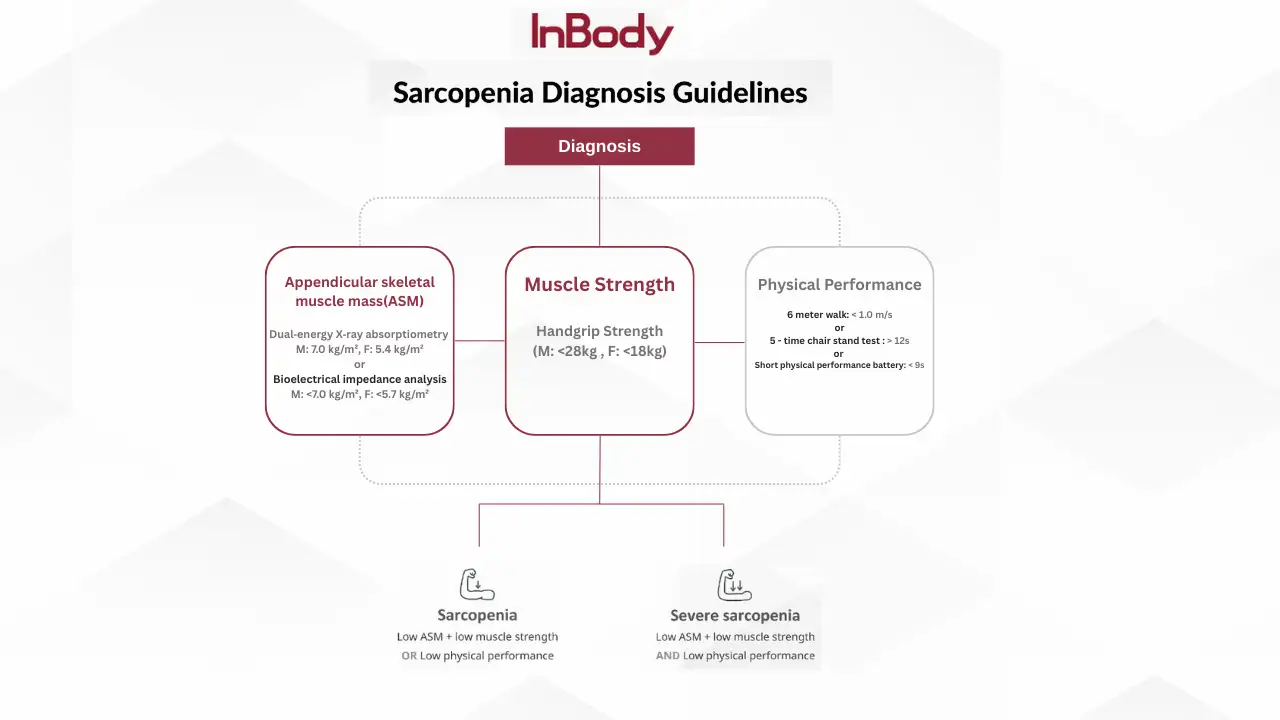
Previous Criteria
Why AWGS Revised the Criteria
Recent evidence highlighted shortcomings in the previous framework:
- Many individuals showed early strength or mass decline before meeting earlier diagnostic thresholds.
- Grip strength alone could be misleading in cases involving pain or neurological issues.
- Gait speed or chair-stand tests reflected consequences of decline, not the decline itself.
- Large Asian cohort data showed that muscle health begins deteriorating from around age 50, not only after 65.
- Differences in body size across Asian countries made height-adjusted muscle mass insufficient for universal accuracy.
- Simplification was needed for both clinical and community settings.
These findings led AWGS to refine definitions, strengthen diagnostic accuracy, and encourage earlier screening and prevention
Key Changes in AWGS 2025
1. Early detection of new diagnostic criteria for adults aged 50–64
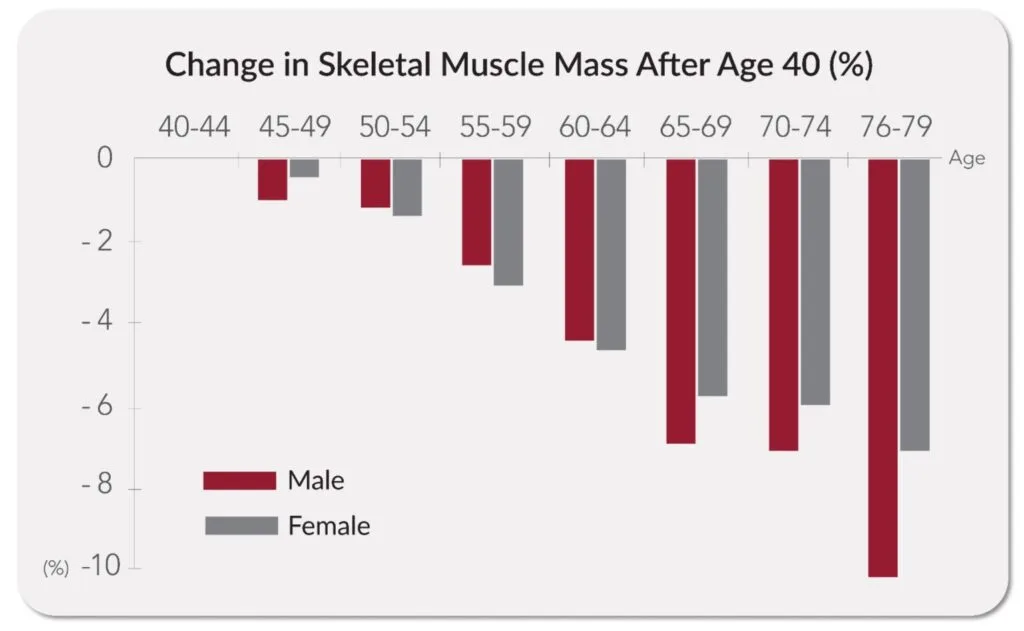
One of the most important updates is the inclusion of validated cut-offs for adults aged 50–64.
The data clearly showed that muscle decline accelerates from age 50.
To prevent late intervention, AWGS 2025 now provides age-specific cut-offs for this group, allowing clinicians to detect low strength and low mass earlier.
This change shifts sarcopenia from an “elderly-only” concern to a life-course muscle-health approach.
2. Introduction of ASM/BMI, a new diagnostic muscle-mass index
To improve diagnostic accuracy across different body sizes, AWGS added ASM/BMI, a BMI-adjusted muscle-mass measure.
This is now an official diagnostic option alongside ASM/height².
BMI-adjusted indices:
- Better account for variations in body proportion
- Improve muscle-mass interpretation in both smaller and larger body frames
- Align with global GLIS recommendations
This makes the sarcopenia diagnosis more equitable across Asian populations.
3. Diagnosis requires both low muscle strength and low muscle mass
The updated algorithm removes ambiguity and increases diagnostic specificity.
A diagnosis of sarcopenia now requires:
- Low muscle strength
- Low muscle mass
This ensures that the diagnosis reflects true muscle pathology rather than weakness from non-muscular causes such as joint pain or neurological limitations.
4. Physical performance removed from diagnosis (now outcome-only)
Physical performance tests (gait speed, chair stand, SPPB)
- Are no longer part of the diagnostic algorithm
- Should be used for monitoring, functional assessment, and tracking intervention response
This avoids delaying diagnosis until functional deterioration sets in, while still encouraging performance-based monitoring after diagnosis.
5. “Possible Sarcopenia” retained; severity categories removed
The 2025 update maintains the “possible sarcopenia” category for:
- Community screening
- Primary care settings
- Early lifestyle interventions
At the same time, severity classifications are removed to simplify the framework and retain focus on early detection and improvement rather than staging.
Updated Cut-off Values (AWGS 2025 Consensus)

| Category | Age | Male | Female |
|---|---|---|---|
| Handgrip Strength | 50–64 years | <34.0 kg | <20.0 kg |
| Handgrip Strength | 65+ years | <28.0 kg | <18.0 kg |
| Muscle Mass – ASM/Height (BIA) | 50–64 years | <7.6 | <5.7 |
| Muscle Mass – ASM/Height (BIA) | 65+ years | <7.0 | <5.7 |
| Muscle Mass – ASM/BMI (NEW) (BIA) | 50–64 years | <0.90 | <0.63 |
| Muscle Mass – ASM/BMI (NEW) (BIA) | 65+ years | <0.83 | <0.57 |
Why These Updates Matter
The AWGS 2025 criteria strengthen the entire framework by:
- Encouraging earlier detection through the inclusion of 50–64-year-olds
- Improving diagnostic accuracy with ASM/BMI
- Avoiding misclassification by requiring both low strength & low mass
- Distinguishing diagnosis from functional decline
- Supporting more targeted intervention and monitoring
The updated recommendations help clinicians, hospitals, rehabilitation teams, and public-health programmes take a proactive approach to muscle health across the lifespan.
- Stay ahead of muscle decline.
- Get an InBody test today and understand your muscle health clearly and early.

Find an InBody Scanner Near You
References
- Amisi, C. A., Tchankou, C., Omole, J., & Alloh, F. T. (2022). Markers of insulin resistance in polycystic ovary syndrome. Frontiers in Endocrinology,13, 867875. https://pmc.ncbi.nlm.nih.gov/articles/PMC8984569/
- Jena, D., Sahoo, J., Gopalakrishnan, S., Behera, S., & Behera, P. (2018). Study of visceral and subcutaneous abdominal fat in polycystic ovarian syndrome. Journal of Human Reproductive Sciences, 11(3), 253–258. https://pmc.ncbi.nlm.nih.gov/articles/PMC12101824/
- Barrea, L., Arnone, A., Annunziata, G., Muscogiuri, G., Laudisio, D., Salzano, C., Pugliese, G., Colao, A., & Savastano, S. (2021). Adherence to the Mediterranean diet, dietary patterns and body composition in women with polycystic ovary syndrome (PCOS). Journal of Translational Medicine, 19, 372. https://pubmed.ncbi.nlm.nih.gov/31547562/
- Arpaci, D., Gürkan Tocoğlu, A., Yılmaz, S., Ergün, H., Tamer, A., & Ergün, H. (2015). The relationship between epicardial fat tissue thickness and visceral adipose tissue in lean patients with polycystic ovary syndrome. Journal of Ovarian Research,8, 71. https://pubmed.ncbi.nlm.nih.gov/26545735/
- Atakul, T. (2020). Polycystic ovary syndrome in overweight and normal weight women: The relationships with inflammatory markers. Bosphorus Medical Bulletin, 5(3), 124–130.
Frequently Asked Questions
What changed in the AWGS 2025 sarcopenia criteria?
The 2025 update revised cut-off values for muscle mass, grip strength, and gait speed specifically calibrated for Asian populations, reflecting research showing Asians often have lower baseline muscle mass than Western reference populations used in earlier criteria.
Why does sarcopenia diagnosis need Asian-specific criteria?
Using Western-derived cut-offs can under- or over-diagnose sarcopenia in Asian patients due to genuine population differences in body composition, so region-specific thresholds improve diagnostic accuracy for Indian and other Asian clinical populations.
How is sarcopenia diagnosed under the updated criteria?
Diagnosis combines low muscle mass (measured via BIA or DEXA) with either reduced grip strength or slow gait speed, following a stepwise algorithm that AWGS 2025 refined for earlier and more accurate detection.
