
Body Composition 9 min read
Body Composition Analysis: A Complete Guide to What It Is, How It Works, and Why It Matters
Walk into any modern gym, hospital wellness centre, or corporate health programme in India today, and you’ll find one piece of equipment that has quietly become the standard:…
Reading about body composition? Find an InBody test centre near you →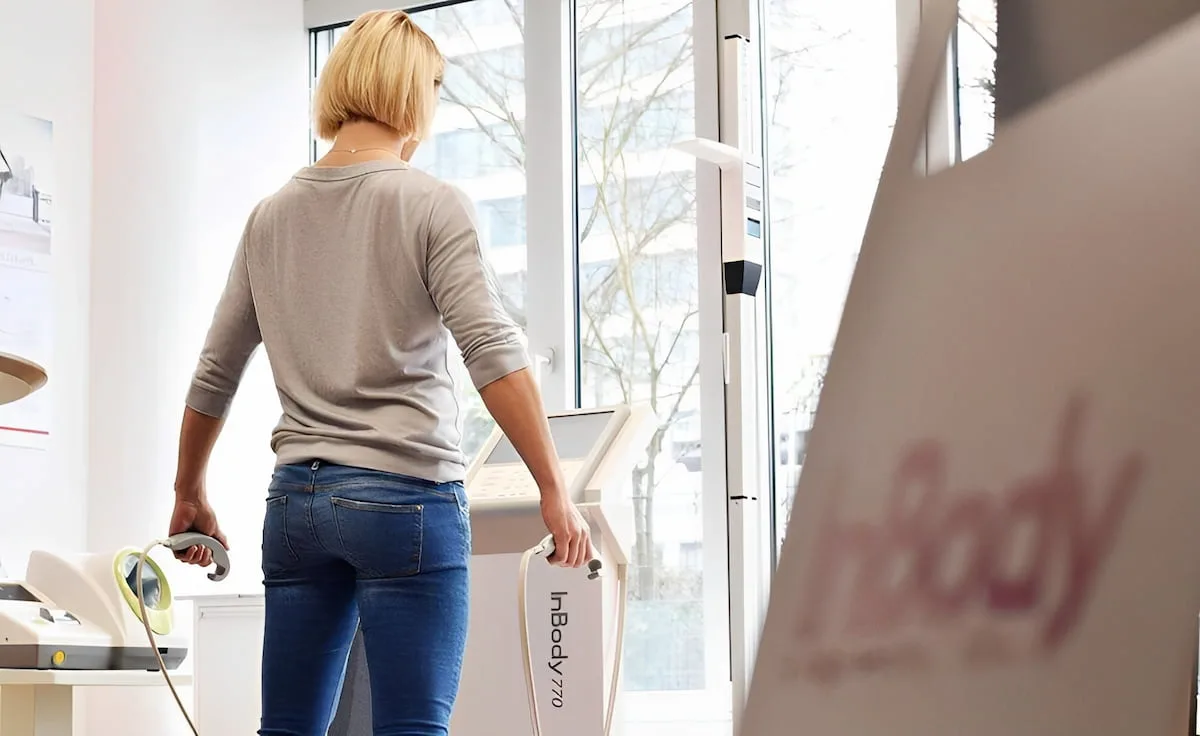
Walk into any modern gym, hospital wellness centre, or corporate health programme in India today, and you’ll find one piece of equipment that has quietly become the standard: a body composition analyser. The reason is simple: for understanding your health, what your body is made of matters more than how much it weighs.
This guide explains what body composition analysis is, why it has replaced BMI as the trusted health metric across India, what an InBody scan actually measures, and where you can get one near you.
What is body composition analysis?
Body composition analysis is the science of measuring what your body is actually made of: fat, muscle, water, and bone, rather than just how much you weigh. A single body composition test gives you 20 to 30 distinct measurements about your body, in 60 seconds, with no needles, no radiation, and no invasive procedures.
The most widely used body composition test in India today is the InBody scan, which uses bioelectrical impedance analysis (BIA) to map every component of your body in under a minute.
Why body composition matters more than weight

Two people, both 5’8″ and 75 kg, have the same BMI of 25.0. By BMI, they are identical. By body composition, they could not be more different.
Person A: 22% body fat, 30 kg muscle mass, visceral fat level 6, healthy ECW/TBW ratio. By every metabolic measure, this person is in good health.
Person B: 32% body fat, 22 kg muscle mass, visceral fat level 14, elevated ECW/TBW. This person has a metabolic syndrome risk, even though their BMI looks normal.
BMI cannot see the difference. Body composition analysis sees it instantly. This is why hospitals, fitness centres, and corporate wellness programmes have moved past BMI as the primary metric. It is also why the medical literature has been moving in the same direction for over 20 years.
The “skinny fat” problem in Indian populations

Indians are particularly vulnerable to a condition called skinny fat, with normal BMI but elevated visceral fat and low muscle mass. Multiple peer-reviewed studies have documented that South Asian populations carry more visceral fat at lower BMIs than Western populations. The result: BMI calls them “healthy” while their cardiovascular risk profile says otherwise.
Body composition analysis catches this. BMI cannot.
How body composition analysis works
Most modern body composition analysers, including the InBody, use Bioelectrical Impedance Analysis (BIA). The principle is straightforward: a tiny, safe electrical current is passed through your body. Different tissues conduct electricity differently. Muscle is mostly water and conducts well; fat is a poor conductor; bone is dense and offers high resistance. By measuring how the current responds across multiple frequencies and multiple body segments, the analyser maps out exactly how much of each tissue you have, and where.
Why InBody’s BIA is different
Older BIA scales, the kind built into bathroom weighing machines, use a single frequency of current and just two electrode points (your feet). They guess about your upper body fat distribution from a partial reading. The numbers wander between visits.
InBody analysers use Direct Segmental Multi-frequency BIA (DSM-BIA) with an 8-electrode tactile system. Each limb (left arm, right arm, left leg, right leg) and the trunk are measured separately, at multiple frequencies, with no empirical equations. The result: 98% correlation with DEXA in published validation studies, and consistent readings across thousands of patients in clinical settings.
What does a body composition analysis test measure?
A complete body composition test from a professional InBody analyser gives you all of the following:
1. Body Fat Percentage and Body Fat Mass
The total fat in your body is expressed both as a percentage of body weight and as kilograms. Modern analysers also break this down by body segment fat in each arm, each leg, and the trunk.
2. Skeletal Muscle Mass (SMM)
The muscle tissue you can train. Reported in kilograms and broken down by body segment. SMM is the single most important number for tracking strength training progress, fitness recovery, and ageing-related muscle loss (sarcopenia).
3. Visceral Fat Level (VFL)
The dangerous fat around your internal organs. Rated 1 to 20. Levels above 9 indicate elevated cardiovascular and metabolic risk; levels above 14 are clinically actionable. Visceral fat is independently linked to type 2 diabetes, fatty liver, and heart disease.
4. Total Body Water
Water is roughly 60% of body weight. A body composition test splits this into intracellular water (inside cells, where it should be) and extracellular water (outside cells, in blood and between tissues). The ratio between the two ECW/TBW is one of the most underused inflammation indicators in clinical medicine.
5. Basal Metabolic Rate (BMR)
The calories your body burns at rest. Calculated from your skeletal muscle mass rather than just height and weight, which is why BMR from an InBody scan is more accurate than a BMR formula.
6. Segmental Lean Analysis
Five separate readings: left arm, right arm, left leg, right leg, trunk for both muscle and fat. This is where rehab patients, athletes, and lifters get the most value: muscular imbalances and asymmetries become immediately visible.
7. InBody Score
A composite score from 0 to 100 summarising your overall body composition. Easiest single number to track between scans. If the score is above 70, then it is normal; if it is above 80, then you’re perfect.
Who needs Body Composition Analysis?
The honest answer: nearly everyone. The metric you’re tracking matters at every stage of life:
For people losing weight
The scale lies. You can lose 4 kg of muscle and gain 4 kg of fat, and the scale will say “no change.” Body composition analysis tells you what you actually lost, fat or muscle, so you can correct the diet or training that caused it.
For people building muscle
Strength training adds muscle at about 0.2–0.5 kg per month for most people. That is invisible on a scale. It is unmissable on a body composition scan, especially in segmental analysis.
For people over 40
Age-related muscle loss (sarcopenia) starts after age 30 and accelerates after 50. By age 70, the average sedentary adult has lost 30% of their peak muscle mass. Body composition analysis catches this early, when it is still reversible.
For people with Diabetes, PCOS, or Metabolic Syndrome
Visceral Fat and ECW/TBW imbalance are direct contributors to insulin resistance. Tracking these between visits gives endocrinologists actionable data that BMI cannot.
For Athletes
Segmental muscle balance, body water tracking, phase angle, and recovery monitoring all come from the same scan. Sports academies and elite training centres use the InBody 770s for athlete profiling.
For Hospital Patients
Bariatric surgery, oncology, dialysis, cardiac rehabilitation, and recovery from major illness all benefit from body composition tracking. Read more about InBody for hospitals and clinical use.
Body Composition Analysis vs BMI vs DEXA, which to use when?
| Measurement | What it tells you | Limitation | Time |
|---|---|---|---|
| BMI | Height vs weight ratio | Cannot tell muscle from fat | 1 second |
| Smart weighing scale | Rough body fat estimate | Single frequency, 4 electrodes, swings between readings | 10 seconds |
| InBody BIA scan | 30+ metrics, segmental analysis, validated against DEXA | Sensitive to hydration; avoid food/exercise just before | 60 seconds |
| DEXA scan | Body composition + bone density | Uses radiation, ₹3,000–5,000 per scan, 20 min, hospital only | 20 minutes |
| Hydrostatic weighing | Body Fat Percentage | Difficult to set up, no segmental data | 15 minutes |
For routine tracking, the InBody scan is the right choice for most people and most clinics. DEXA is reserved for situations where bone density also matters.
How accurate is Body Composition Analysis?
Accuracy depends entirely on the device. Smart weighing scales can be off by 5–10 percentage points on body fat. Professional InBody analysers, by contrast, achieve 98% correlation with DEXA in published validation studies.
The accuracy difference comes from three things: the number of frequencies measured, the number of electrode points (8-point tactile vs 2-point foot-only), and whether the analyser makes empirical assumptions about your body or measures each segment directly. InBody is built on the latter approach.
How to prepare for a body composition test
For best accuracy:
- Avoid food and drink for 2–3 hours before the test
- Avoid heavy exercise for 6 hours before
- Stay well hydrated the day before (don’t dehydrate yourself)
- Avoid alcohol and caffeine on the test day
- Use the bathroom before scanning
- Wear light clothing
- Remove metal accessories, watch, jewellery, belt buckle
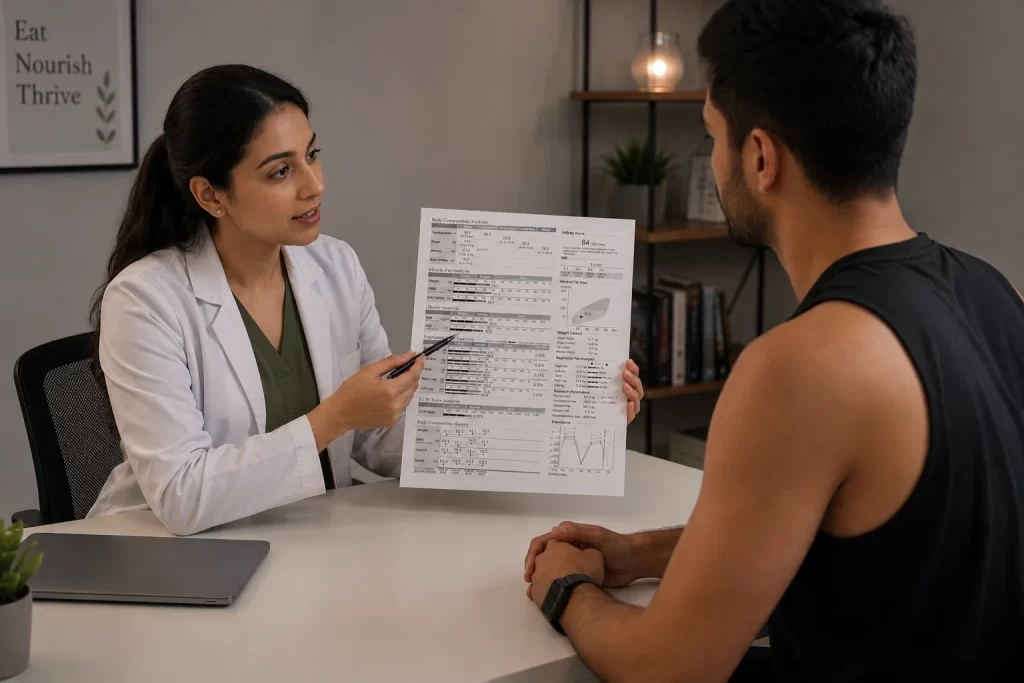
The scan itself takes 60 seconds. You stand on the device, hold the handles, and the result sheet prints automatically. To understand each section of the output, read our complete guide to reading your InBody Results Sheet.
How much does body composition analysis cost in India?
An InBody body composition test in India typically costs between ₹500 and ₹2,000 per scan. Hospitals may include it in a wellness or executive health package; gyms and standalone wellness studios charge per scan. Corporate wellness programmes often offer it free to employees.
For B2B buyers, gyms, hospitals, and corporates looking to install their own machine, see our pages on InBody for gyms and InBody for hospitals.
Where to get a body composition test in India
InBody India operates over 1,500 verified test centres across 100+ Indian cities. The fastest way to find one near you is to browse our test centre locator or check our city-specific guides:
- InBody scan centres in Mumbai
- InBody scan centres in Delhi NCR
- InBody scan centres in Bangalore
- InBody scan centres in Chennai
- InBody scan centres in Hyderabad
Frequently asked questions
Q. Is Body Composition Analysis safe?
Yes. BIA-based body composition analysis uses a tiny, safe electrical current that you cannot feel. There is no radiation, no needles, and no recovery time. Pregnant women and people with pacemakers should avoid BIA scans as a precaution.
Q. How often should I get a body composition test?
For most people, every 8–12 weeks is the right cadence. Athletes in training cycles may scan every 4 weeks. Clinical patients scan as their care plan requires.
Q. Can a body composition test detect diabetes or heart disease?
Not directly, but visceral fat level and ECW/TBW ratio are leading indicators that strongly correlate with metabolic and cardiovascular risk. Many endocrinologists and cardiologists use body composition data alongside blood tests for a complete picture.
Q. Why did my body fat percentage go up after a meal?
It probably didn’t. What changed was your hydration state. BIA scans are sensitive to recent food and water intake. Always scan in the same conditions (similar time of day, similar hydration) for comparable readings.
Q. Is InBody better than other body composition machines?
For most clinical and fitness applications, yes. InBody’s 8-electrode DSM-BIA technology and 98% DEXA correlation set it apart from single-frequency BIA scales. Professional alternatives like Tanita and SECA are credible but use different methodologies; InBody has the largest installed base in Indian hospitals and gyms.

Get a body composition test today.
If you have never had a body composition test, your next one will probably teach you more about your health than the last decade of bathroom scale readings combined. Find a verified InBody scan centre near you. Most centres offer same-day appointments, and the entire visit takes under 10 minutes.


Most trending articles

InBody vs DEXA vs Skinfold Calipers: Which Body Composition Test Is Right for You in India?
DEXA scans, InBody BIA, skinfold calipers — three different ways to measure body composition. Accuracy comparisons, cost in India, accessibility, and which method makes sense for your specific goal.

Skinny Fat in India: Why 40% of Normal Weight Indians Have Dangerously High Body Fat
India's hidden obesity epidemic. Skinny fat (TOFI — Thin Outside, Fat Inside) affects millions of normal-weight Indians. How body composition testing reveals what BMI hides — and the exact protocol to fix it.

Healthy Body Composition by Age for Indians: Reference Ranges at 20s, 30s, 40s, 50s+
Body composition reference ranges for Indian men and women by age. Find out if your body fat %, muscle mass, and visceral fat level are healthy for your age and what to do if they're not.