
Body Composition 6 min read
Does Muscle Weigh More Than Fat? The Truth About Density vs Weight
You started training six weeks ago. You feel stronger. Your clothes fit better. The mirror is on your side. Then you step on the bathroom scale, and it…
Reading about body composition? Find an InBody test centre near you →
You started training six weeks ago. You feel stronger. Your clothes fit better. The mirror is on your side. Then you step on the bathroom scale, and it has not moved — or worse, it has gone up.
You will hear the same explanation everywhere: “Muscle weighs more than fat.”
It is one of the most-repeated lines in fitness, and it is technically wrong. A kilogram of muscle weighs the same as a kilogram of fat. What is true is something more interesting, and understanding it changes how you should think about progress.
The actual truth: muscle is denser, not heavier
Muscle and fat are different tissues with different densities:
| Tissue | Density |
|---|---|
| Skeletal muscle | ~1.06 g/cm³ |
| Body fat | ~0.9 g/cm³ |
This means muscle takes up roughly 18% less volume than the same mass of fat. A kilogram of muscle fits into a smaller, denser shape than a kilogram of fat.
Practical translation: if you replace 3 kg of fat with 3 kg of muscle, the scale shows no change — but you look meaningfully leaner, your clothes get a size looser, and your body composition has improved dramatically.
This is why the scale is the worst single tool for tracking fitness progress. It cannot tell the difference between water, muscle, fat, glycogen, or food in your gut. It is one number with no resolution.
What body recomposition actually looks like on the scale
When you start strength training and protein-adequate eating after a sedentary phase, here is what typically happens in the first 12 weeks:
- Week 1–2: Scale weight up 1–2 kg. This is glycogen and water — your muscles are restocking. Not fat.
- Week 3–6: Scale weight roughly stable. Body fat % is dropping slowly. Muscle is being added at the same rate. Total mass unchanged.
- Week 6–12: Scale weight finally moves — usually 2–4 kg down — but with 1–2 kg of muscle added underneath. Net body fat loss is often 4–6 kg, even though the scale shows only 2–4 kg.
If you were only watching the scale, you would have concluded for the first 4–5 weeks that “this is not working.” It was working — your measurement tool was just blind to it.
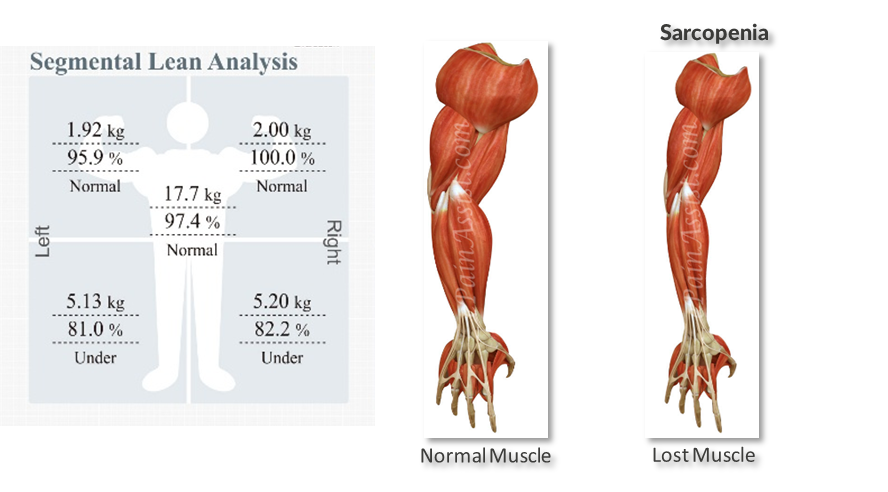
Why do beginners “gain weight” when starting strength training
Three reasons the scale goes up in the first few weeks of training, none of which are fat gain:
- Glycogen and water storage. Each gram of glycogen stored in muscle binds about 3 grams of water. As you start training, your muscles store more glycogen — adding 0.5–1.5 kg of pure water/glycogen weight in week one alone. This is a good sign.
- Inflammation and recovery fluid. Hard training creates micro-tears that the body repairs by drawing fluid into muscles. Temporary, harmless, often visible as “I look more swollen than usual.” This stabilises in 3–4 weeks.
- Lean body mass increase. Beginners actually do build measurable muscle in the first 8–12 weeks (“newbie gains”). A 70 kg sedentary person can typically add 1–2 kg of muscle in three months of consistent training and protein intake, significant for body composition, invisible to the bathroom scale.
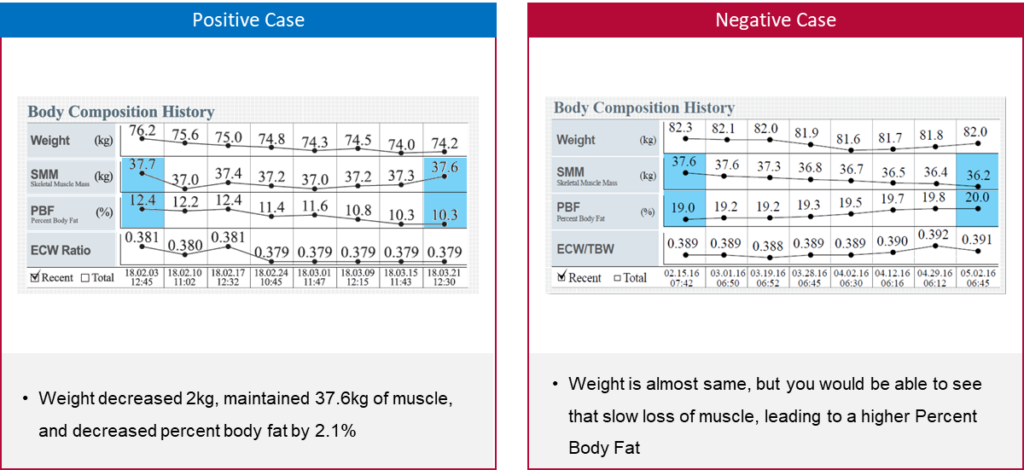
How to track real progress (instead of fighting the scale)
Smart trackers ignore the bathroom scale for the first 6–8 weeks of training and use these markers instead:
1. Body composition scan
Once every 4–8 weeks, a 60-second InBody scan shows you exactly how much of your body is muscle, fat, water, and visceral fat. The bathroom scale gives you one number; an InBody scan gives you 30+ data points, including segmental muscle, visceral fat level, and phase angle. More on body comp vs scale here.
2. Tape measure
Once every two weeks: waist, hips, thigh, arm, chest. Body recomposition shows up as inches lost from the waist and inches gained at the arm/chest, long before the scale moves. Use the same tape and time of day each time.
3. Same-clothes test
Pick one pair of jeans that fits today. Try them every two weeks. If they get looser at the waist, you are losing fat — even if the scale says otherwise.
4. Progress photos
Same lighting, same time of day, same posture. Every two weeks. Visual change is far more obvious in side-by-side comparison than in the mirror day-to-day.
5. Strength logs
Your lifts going up week over week is itself an indirect signal of muscle gain. If you have added 10 kg to your squat, your legs have meaningfully grown — whether the scale agrees or not.
So when DOES the scale tell the truth?
The scale is useful — but only in specific contexts:
- Over months, not days. A 7-day moving average of daily weights reveals trends. A single morning reading reveals nothing reliable.
- For people who are mostly losing fat without gaining much muscle (older adults on calorie restriction without strength training).
- For monitoring extreme cases — rapid weight loss in eating disorders, fluid retention in heart failure, etc.
- For fast feedback during a cut — if you are in a 500 kcal/day deficit, the trend line on the scale will catch up to your body composition tracker eventually.
For anyone training, the scale is the slowest and least informative measurement tool you own. Add body composition tracking and let the scale be background noise.
What about the popular “muscle weighs more than fat” image?
You have probably seen the photo: a softball-sized lump of yellow fat next to a denser red lump of muscle, both labelled “5 lbs.” It is misleading. They weigh the same — that is the point of the photo. The image shows that 5 lbs of fat takes up far more space than 5 lbs of muscle. The takeaway should be “volume differs,” not “muscle is heavier.”
Use the photo to remember density, not weight.
Frequently asked questions
Q. Does muscle really weigh more than fat?
No. A kilogram of muscle and a kilogram of fat both weigh one kilogram. Muscle is roughly 18% denser than fat, so the same mass of muscle takes up less space — making you look leaner at the same scale weight.
Q. Why am I gaining weight on the scale but losing inches?
You are recomposing your body. You are losing fat and gaining muscle simultaneously. Muscle takes up less volume than fat, which is why inches drop. This is the ideal training outcome. Trust the measurements (tape, photos, body comp scan) and ignore the scale for 2–3 months.
Q. How much muscle can I really build in a month?
Beginners (untrained): 0.5–1 kg of lean muscle per month is realistic. Intermediate (1+ years training): 0.25–0.5 kg per month. Advanced lifters: well under 0.25 kg per month and often near zero unless dietary or training variables change. Indian women average slightly lower; men slightly higher. Steroids dramatically change these numbers.
Q. If muscle and fat weigh the same, why does the gym scale say I lost only 1 kg in a month?
You almost certainly lost more fat than the 1 kg suggests, but added a similar amount of muscle, water, and glycogen. The scale is showing your net mass change, not your composition change. Get an InBody scan, and the actual story is usually 3–4 kg fat lost, 2–3 kg muscle gained.
Q. How can I be sure I am building muscle and not just fat?
Three signals: Your lifts are progressing (added weight week-over-week), your tape measurements at arms/chest/glutes are increasing while waist is stable or shrinking, and a body composition scan confirms skeletal muscle mass is going up. If all three agree, you are building muscle. If the scale is going up but the waist is also up, you are gaining fat.
Stop letting the scale tell you a story it cannot actually see. A 60-second InBody scan shows you exactly how much muscle and fat you have — so you know whether what you are doing is working, weeks before the bathroom scale catches up.

Most trending articles

Healthy Body Composition by Age for Indians: Reference Ranges at 20s, 30s, 40s, 50s+
Body composition reference ranges for Indian men and women by age. Find out if your body fat %, muscle mass, and visceral fat level are healthy for your age and what to do if they're not.
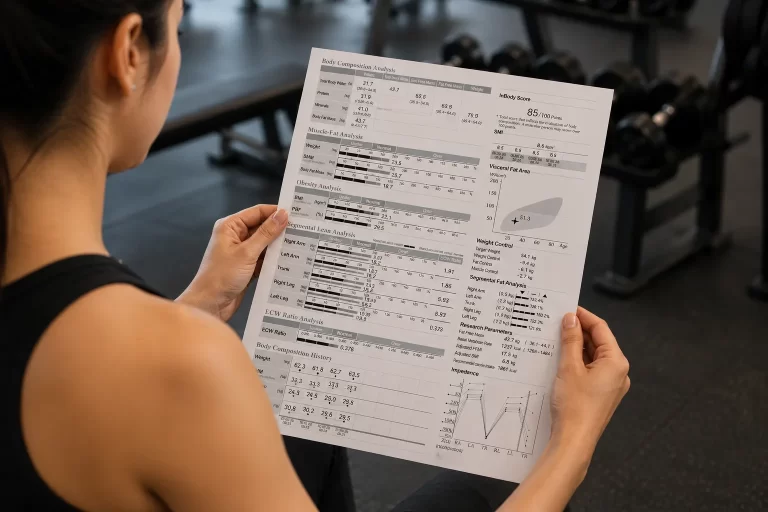
How to Read Your InBody Report: Every Number Explained Simply
Your InBody report has 15+ numbers. This guide explains what SMM, PBF, ECW/TBW ratio, visceral fat level, and segmental analysis mean — and what to actually do with each result.

Metabolic Age Explained: What It Reveals About Your Real Health (And How to Lower It)
Metabolic age vs chronological age. What it means, why many Indians in their 30s have the metabolism of a 50-year-old, and 5 evidence-based steps to reverse metabolic aging.