
Cardiac Health 9 min read
High Cholesterol in India: Why Statins Aren’t Enough If You Don’t Address Body Composition
25–30% of urban Indians have dyslipidemia. Statins reduce LDL but don't fix the visceral fat that drives it. How body composition is the missing piece in India's cholesterol management strategy.
Reading about body composition? Find an InBody test centre near you →
Why Your Cholesterol Numbers Keep Coming Back High — Even When You’re “Eating Healthy”
The conversation happens in cardiology and internal medicine clinics across India every day. A patient, often in their 40s or early 50s, presents with elevated LDL cholesterol and triglycerides at their annual blood test. They insist they’ve been careful with their diet. Their weight is in the normal or borderline range. The doctor prescribes a statin, advises dietary changes, and schedules a follow-up in three months.
Three months later, the LDL has come down — the statin is working. But the triglycerides are still elevated, the HDL is still low, and the patient’s visceral fat continues to accumulate invisibly, driving the same metabolic dysfunction that elevated the cholesterol in the first place.
The statin treated the number. It didn’t treat the cause. And in a significant proportion of cases, the cause is body composition — specifically, visceral fat.
India’s Dyslipidemia Epidemic in Numbers
Dyslipidemia — abnormal blood lipid levels — has reached epidemic proportions in India. According to ICMR data, 25-30% of urban Indians have abnormal lipid profiles. A 2021 population study across six Indian cities found that elevated total cholesterol affected 13.9% of the urban adult population, while borderline high cholesterol (160-199 mg/dL) affected an additional 29.5%. Elevated triglycerides — which are particularly linked to visceral fat — were found in 29.5% of participants.
These numbers have increased substantially over the last 20 years and show no sign of stabilising. India’s cardiologists are now treating dyslipidemia in patients in their early 30s at rates that would have been unusual a generation ago.
Understanding why requires understanding a mechanism that most patients — and some physicians — don’t fully appreciate: the direct metabolic link between visceral fat and lipid abnormalities.
The Biology: How Visceral Fat Drives Dyslipidemia
Visceral Fat Is Not Inert Storage
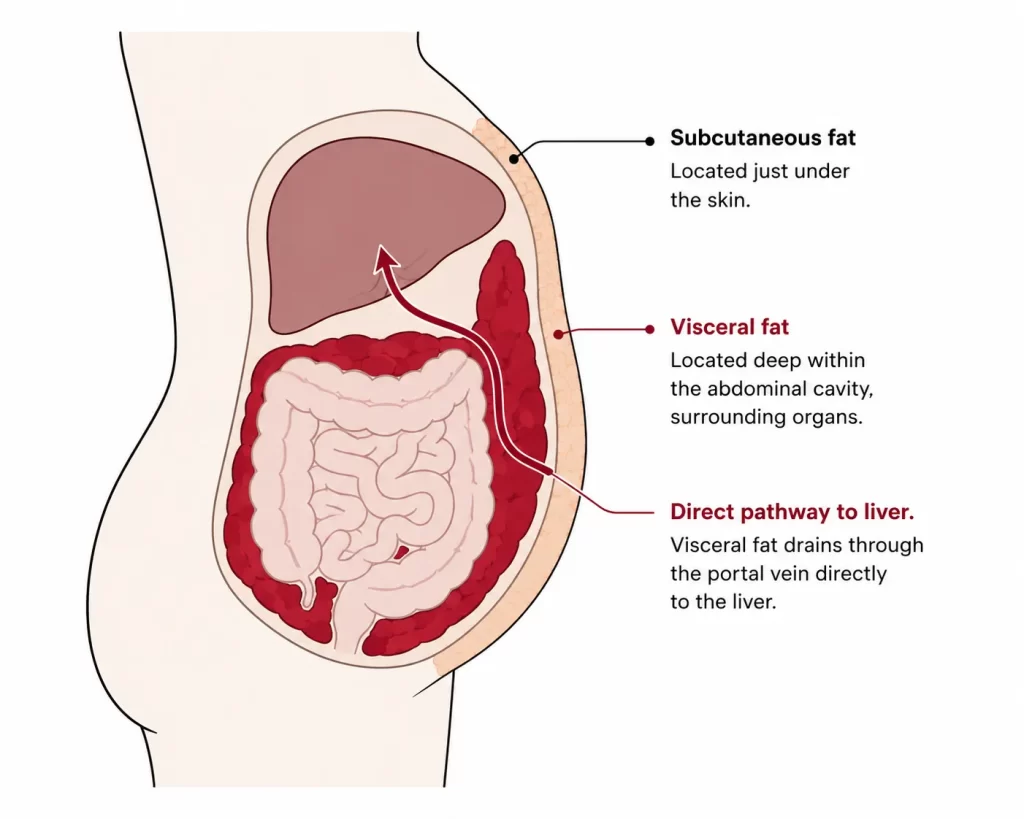
There is a fundamental distinction between subcutaneous fat (the fat under your skin, the fat you can pinch) and visceral fat (the fat stored around your abdominal organs — liver, intestines, pancreas). Subcutaneous fat is relatively inert metabolically. Visceral fat is highly metabolically active. This distinction matters enormously for cardiovascular risk.
Visceral adipose tissue continuously releases free fatty acids (FFAs) directly into the portal venous circulation — the blood supply that drains directly into the liver. This creates a constant flux of FFAs arriving at the liver that the organ must process. The liver responds to elevated FFA influx in several unfavourable ways.
The Portal Circulation Pathway to High Cholesterol
When the liver receives a constant high load of free fatty acids from visceral fat via portal blood, it responds by:
- Increasing synthesis and secretion of VLDL (Very Low-Density Lipoprotein) particles, which carry triglycerides into the bloodstream
- Downregulating the clearance of LDL particles, causing elevated LDL cholesterol
- Reducing HDL synthesis and accelerating HDL catabolism, lowering the “good” cholesterol
- Promoting hepatic insulin resistance, which further amplifies triglyceride production
This is why a person with high visceral fat will typically show a lipid profile characterised by: elevated LDL, elevated triglycerides, and low HDL — the classic atherogenic lipid pattern. And this is why the same person may eat a relatively careful diet and still have persistently abnormal lipids: the dietary contribution to cholesterol is being overwhelmed by the continuous metabolic activity of accumulated visceral fat.
Inflammation as an Amplifier
Visceral fat also secretes inflammatory cytokines — TNF-alpha, IL-6, and others — that further impair lipid metabolism and promote endothelial dysfunction. The ECW/TBW ratio on an InBody test, when elevated above 0.380, reflects this systemic inflammatory state. This is one reason why elevated ECW/TBW values in a body composition assessment should not be ignored — they may be a window into the same inflammatory process that is driving both visceral fat accumulation and lipid abnormalities.
Why the “Normal Weight, High Cholesterol” Pattern Is So Common in Indians
One of the most clinically important and underappreciated phenomena in Indian cardiology is the frequency of significant dyslipidemia in individuals with normal or near-normal BMI. Indian physicians see this constantly — a patient with a BMI of 22-24, apparently normal weight, presenting with triglycerides of 250 mg/dL and LDL of 160 mg/dL. It seems contradictory until you understand visceral fat distribution.
Indians, due to a combination of genetic predisposition, dietary pattern, and activity levels, have a well-documented tendency to preferentially accumulate visceral fat relative to subcutaneous fat — even at normal body weight. This is the “thin-fat” Indian phenotype. A person with a VFA (Visceral Fat Area) of 130-140 cm² can have a BMI of 23 and no visible abdominal obesity. Their cholesterol, however, will reflect the metabolic reality of that visceral fat load.
A 2020 study in the Journal of Association of Physicians of India found that Indian adults with VFA above 100 cm² — as measured by body composition analysis — had a 2.8-fold higher odds of atherogenic dyslipidemia compared to those with VFA below 80 cm², independent of BMI. The VFA measurement explained metabolic risk that BMI could not.
What Statins Do — and Don’t Do
To be clear: statins are effective, evidence-based medicines and are genuinely life-saving for patients with established cardiovascular disease, very high LDL, familial hypercholesterolaemia, or multiple risk factors. This article is not arguing against statin use where it is clinically indicated.
What statins do not do is reduce visceral fat. A patient on a statin whose VFA remains at 150 cm² has lower LDL numbers on their next blood test, but their portal circulation is still flooded with free fatty acids from visceral fat. Their triglycerides remain elevated. Their HDL remains low. Their cardiovascular risk — beyond LDL — is substantially unchanged. The statin has treated a downstream marker without addressing the upstream source.
A comprehensive approach to dyslipidemia in visceral-fat-driven cases requires treating the cause, not just the number.
The Triglyceride:HDL Ratio — A Better Risk Marker Than LDL Alone
Indian cardiologists and metabolic physicians are increasingly using the Triglyceride:HDL ratio as a more sensitive cardiovascular risk marker than LDL cholesterol alone — particularly for the Indian population. A ratio above 3.5 (using mg/dL units) is associated with elevated cardiovascular risk and is a strong indicator of insulin resistance and visceral fat excess.
This ratio is highly responsive to visceral fat reduction. When VFA decreases — through the interventions described below — triglycerides fall, HDL rises, and the ratio improves substantially. This improvement reflects a genuine reduction in metabolic risk, not just a medication-induced number change.
How Much VFA Reduction Is Needed — and What It Does to Lipids
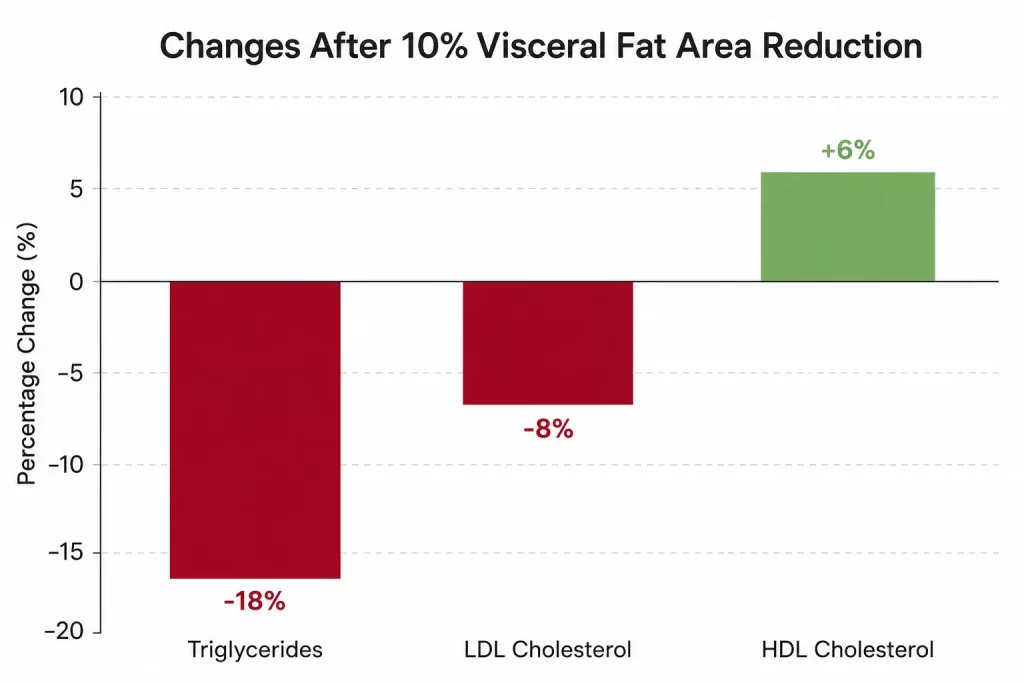
Research provides specific guidance on the relationship between VFA reduction and lipid improvement. A landmark study in the International Journal of Obesity found that:
- A 10% reduction in VFA was associated with significant reductions in triglycerides (average -18%), modest LDL reduction (-8%), and meaningful HDL increase (+6%)
- A 15-20% reduction in VFA produced lipid improvements comparable to low-dose statin therapy in patients with moderate dyslipidemia
- Patients who reduced VFA AND took statins showed better combined lipid profiles than those on statins alone
In practical terms: if your InBody test shows VFA of 150 cm², a reduction to 120-125 cm² — a 15-17% decrease — could substantially improve your triglyceride:HDL ratio, potentially reducing or eliminating the need for lipid-lowering medication in cases where statins are being used primarily for borderline-elevated values.
The Body Composition Approach to Managing Cholesterol
Resistance Training — The Most Effective VFA Reducer
Meta-analyses consistently find that resistance training is more effective than aerobic exercise alone for reducing visceral fat. A 2022 review in Obesity Reviews found that progressive resistance training (3 sessions per week, 45-60 minutes per session, over 12 weeks) reduced VFA by an average of 12-16% in previously sedentary adults, without significant dietary change. For Indian adults, where gym culture and structured resistance training have been historically less prevalent than in Western populations, this represents an underutilised lever for metabolic health improvement.
Diet: The Indian Context
For lipid management in India, dietary interventions with the strongest evidence for VFA reduction include:
- Reducing refined carbohydrates: White rice, maida-based foods, and sugary beverages are the primary drivers of triglyceride elevation in the Indian diet. Replacing refined carbohydrates with whole grains, legumes, and vegetables directly reduces VFA and triglycerides
- Increasing omega-3 fatty acids: Fish (particularly fatty fish like mackerel, salmon, and sardines) and flaxseed provide omega-3s that directly reduce triglyceride synthesis in the liver. For vegetarians, supplemental omega-3 from algae-derived DHA/EPA is effective
- Increasing dietary fibre: Soluble fibre (from oats, barley, psyllium husk — which has been used in Indian households for generations as isabgol) directly reduces LDL by binding bile acids in the intestine
- Moderate caloric restriction: A 300-500 kcal daily deficit, maintained over 12 weeks, drives meaningful VFA reduction when combined with resistance exercise
Monitoring Progress With InBody
The power of InBody testing for managing dyslipidemia lies in tracking body composition changes alongside blood lipid measurements. A patient who can watch their VFA decrease from 145 cm² to 120 cm² over 12 weeks — while seeing triglycerides fall on their blood test — has visible, motivating evidence that their lifestyle changes are working at the metabolic level. This feedback loop is a powerful driver of sustained behaviour change.
The InBody Score, which integrates both muscle and fat metrics, provides a single number that trends upward as the programme works — an intuitive progress indicator that most patients find more motivating than a list of blood values.
When Statins Are Genuinely Necessary
The body composition approach to dyslipidemia is not a replacement for medical management when it is clinically required. Statins are necessary and appropriate when:
- LDL is very high (above 190 mg/dL), particularly if familial hypercholesterolaemia is suspected
- The patient has established cardiovascular disease (prior heart attack, stroke, or confirmed coronary artery disease)
- Multiple cardiovascular risk factors are present and calculated 10-year risk is above 10%
- Lifestyle interventions over 3-6 months have not produced sufficient lipid improvement
In these situations, statins and body composition improvement work synergistically. The statin reduces LDL; the VFA reduction improves triglycerides and HDL and reduces systemic inflammation. Together, they produce better cardiovascular risk reduction than either intervention alone.
Know Your Visceral Fat — Before Your Lipid Panel Does the Talking
For anyone with a personal or family history of high cholesterol, or for those simply wanting to take a proactive approach to cardiovascular health, understanding your Visceral Fat Area through InBody testing gives you a direct window into the metabolic driver of lipid abnormalities. A VFA reading, combined with your lipid panel, tells a far more complete story than cholesterol numbers alone.
If your VFA is above 100 cm², you have a clear, actionable target. Reducing it through resistance training, dietary modification, and consistent monitoring gives your liver the relief it needs to normalise lipid metabolism — and gives you a much better chance of keeping cholesterol under control without lifelong medication dependence.
Take the first step. Find an InBody test centre near you, get your VFA measurement, and work with your physician or dietitian to build a programme that addresses your cholesterol at its root.
Frequently Asked Questions
Why aren't statins enough to manage cholesterol in India?
Statins effectively lower LDL cholesterol but don't address the underlying visceral fat that continues driving inflammation and dyslipidemia, meaning cardiovascular risk can persist even with "controlled" cholesterol numbers.
How common is high cholesterol among urban Indians?
Studies estimate 25-30% of urban Indians have dyslipidemia (abnormal cholesterol/lipid levels), a rate that has risen alongside sedentary lifestyles and dietary shifts.
How does body composition testing help manage cholesterol?
Tracking visceral fat alongside lipid panels helps identify whether a patient's cholesterol issue is being driven by fat distribution, giving doctors a target (fat reduction) beyond just medication adjustment.

Most trending articles

High Blood Pressure in India: Why 7 in 10 Indians Don’t Know They Have It (And What to Do Now)
India has 220 million undiagnosed hypertensives. How visceral fat drives blood pressure, the body composition connection, and how to monitor before it becomes a crisis.

How Hydration Affects Your Heart and Cardiovascular Health
Most people think hydration is only about drinking enough water to avoid thirst. But your body tells a much deeper story. Did you know your heart is one…

The Alarming Rise of Heart Attacks in Young Adults: What’s Driving It
For a long time, people thought heart attacks only happened to older folks. But in recent years, something scary has been happening. Increasingly young adults, even those in…