
Body Composition 7 min read
Phase Angle: Clinical Reference Guide for Indian Practitioners
Phase angle is one of the most useful — and most under-utilised — body composition metrics in Indian clinical practice. It is a derived signal of cellular health,…
Reading about body composition? Find an InBody test centre near you →
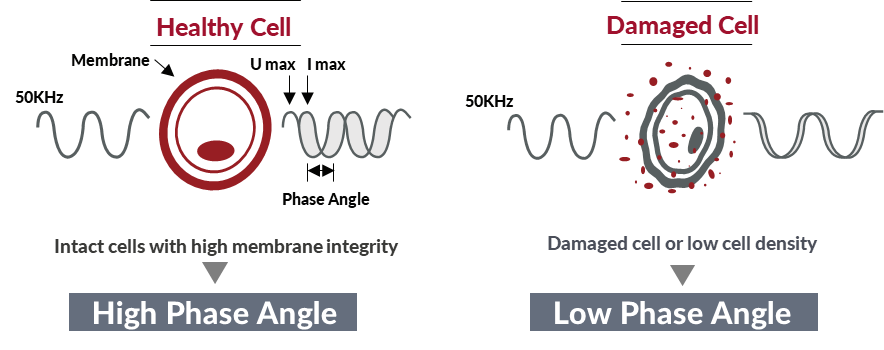
Phase angle is one of the most useful — and most under-utilised — body composition metrics in Indian clinical practice. It is a derived signal of cellular health, calculated from the bioelectrical impedance and reactance of body tissue. Higher phase angle = healthier, denser cell membranes with strong intracellular fluid retention. Lower phase angle = compromised cell integrity, inflammation, malnutrition, or systemic illness.
Most Indian clinicians see phase angle on their patients’ InBody result sheets and treat it as background information. The international clinical literature treats it differently — phase angle is now part of oncology nutrition assessment, sarcopenia staging, dialysis monitoring, post-surgical recovery tracking, and end-of-life prognostic scoring. This guide is the clinical reference: normal ranges, India-specific considerations, conditions where phase angle changes the management plan, and how to act on the number.
For a non-clinical explainer of phase angle, see this companion post. The current post is for clinicians, dietitians, and clinical nutritionists making patient-management decisions.
What phase angle actually measures
When a multi-frequency bioelectrical current passes through the body, it experiences two effects:
- Resistance (R): Opposition to current flow from fluids and tissues. Reflects total body water.
- Reactance (Xc): A capacitor-like effect created by intact cell membranes. Reflects cell mass and membrane integrity.
Phase angle is calculated as the arctangent of reactance / resistance, expressed in degrees. The geometric intuition: when cell membranes are healthy and dense (good cellular integrity), reactance is high relative to resistance, and phase angle is high. When cells are damaged, fluid-shifted, or absent (atrophy, inflammation, fluid overload, malnutrition), reactance drops and phase angle drops with it.
This is why phase angle is increasingly accepted as a non-invasive marker of cellular health. It moves before most biochemical markers in clinical decline, and it improves before most biochemical markers in recovery.
Phase angle normal ranges (degrees)
Phase angle varies by age, gender, and BMI. The following ranges are approximate references derived from multiple population studies — local reference values for Indian populations are still being established and should ideally be calibrated by individual hospital using their own InBody data.
| Age range | Men (degrees) | Women (degrees) |
|---|---|---|
| 18–29 | 7.0–8.5 | 6.0–7.5 |
| 30–39 | 6.5–8.0 | 5.8–7.2 |
| 40–49 | 6.0–7.5 | 5.5–7.0 |
| 50–59 | 5.5–7.0 | 5.2–6.7 |
| 60–69 | 5.0–6.5 | 4.8–6.2 |
| 70+ | 4.5–6.0 | 4.2–5.7 |
Clinical thresholds (rough guidance):
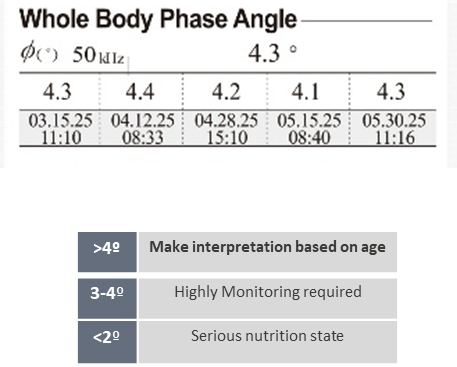
- Phase angle > 6.0: Generally healthy cellular status
- Phase angle 5.0–6.0: Borderline; investigate cause (age-related, mild illness, training stress)
- Phase angle 4.0–5.0: Compromised; correlates with malnutrition, chronic illness, post-surgical state, advanced sarcopenia
- Phase angle < 4.0: Severe compromise; prognostically significant in oncology, dialysis, ICU populations
Clinical applications by speciality
Oncology nutrition
Phase angle has been used in oncology for over two decades as a prognostic indicator. Low phase angle correlates with worse outcomes across multiple cancer types — particularly head and neck cancers, gastrointestinal cancers, and lymphoma. Trends over treatment cycles matter more than single readings. A phase angle dropping by > 0.5° over three cycles often precedes clinical deterioration that biochemical markers have not yet flagged.
Illustrative clinical pattern. A 58-year-old man undergoing chemotherapy for colorectal cancer. Baseline phase angle 6.2. Cycle 3: 5.7. Cycle 5: 5.1. Cycle 7: 4.6. The trajectory triggered an early nutritional intervention — protein-fortified supplementation, resistance exercise where tolerable, and a calorie-density boost. By cycle 12 phase angle had stabilised at 5.0 with improved performance status. More on body composition in lymphoma care.
Sarcopenia staging
The 2025 AWGS sarcopenia criteria for Asian populations now include phase angle as a supporting indicator alongside muscle mass and grip strength. Low phase angle + low skeletal muscle index + low grip strength = severe sarcopenia. Phase angle adds specificity to the muscle quality dimension — two patients with the same muscle mass can have meaningfully different functional muscle quality, and phase angle distinguishes them.
Full AWGS 2025 criteria summary.
Dialysis and renal medicine
Dialysis patients have notoriously difficult dry-weight calibration. Phase angle, combined with ECW/TBW ratio, provides a continuous signal of fluid status and cellular health between dialysis sessions. A drop in phase angle without a clear inflammatory cause often signals a need for dialysis-prescription adjustment.
Body composition in dialysis care.
Bariatric pre-op and post-op
Pre-bariatric phase angle should ideally be > 5.5 for a 40-year-old. Below this, prehab is indicated — resistance training and protein supplementation for 6–12 weeks before surgery. Post-bariatric, phase angle tracks recovery of cellular quality independently of weight loss; a healthy weight trajectory with declining phase angle indicates sarcopenic-outcome risk.
Sports medicine and elite athlete monitoring
Elite athletes typically run phase angle in the 7–9° range. Drops below baseline (e.g., from 8.2 to 7.4 over two weeks) without a clear training-load explanation indicate overtraining, inflammation, or impending illness. Several Indian sports academies now use phase angle as part of their daily readiness scoring.
Critical care and post-surgical recovery
ICU and post-surgical patients with phase angle below 4.5 have meaningfully worse 30-day and 90-day outcomes across multiple studies. Phase angle has been integrated into some Indian tertiary-care nutritional screening protocols as a complement to NUTRIC and GLIM criteria.
GLIM malnutrition criteria and body composition.
Causes of low phase angle
- Malnutrition (protein-energy malnutrition, micronutrient deficiencies)
- Chronic inflammation (autoimmune, infectious, cancer)
- Sarcopenia (age-related muscle loss with reduced cellular quality)
- Cachexia (cancer, COPD, advanced heart failure)
- Severe dehydration or fluid overload (different mechanisms, both drop phase angle)
- Post-surgical state (trauma response, inflammatory phase)
- Overtraining in athletes
- Untreated chronic disease (advanced kidney disease, advanced liver disease)
How to raise phase angle in a patient
The interventions depend on the underlying cause, but several routes apply broadly:
- Resistance training. The single most reliable phase angle intervention. Studies consistently show 0.3–0.7° increases over 8–12 weeks of resistance training in malnourished, elderly, or sarcopenic patients.
- Protein adequacy. Below 1.0 g/kg/day, phase angle stalls or declines. The clinical target is typically 1.2–1.5 g/kg/day in older adults, higher in active recovery, and tailored upward in oncology and post-surgical patients.
- Vitamin D correction. Vitamin D deficiency (rampant in Indian patients) suppresses muscle quality and modestly suppresses phase angle. Correct via supplementation per local guidelines.
- Anti-inflammatory management. If chronic inflammation is the driver, treating the inflammation is more effective than trying to drive phase angle directly. The number will follow the inflammation.
- Sleep + stress management. Cortisol-driven cellular stress can suppress phase angle. Restoring sleep often produces measurable phase angle gains within weeks.
What does NOT reliably raise phase angle
- Cardio alone (no consistent effect; sometimes neutral, sometimes mildly negative if combined with muscle loss)
- Calorie deficits without protein protection (often drops phase angle)
- Carbohydrate manipulation without protein adequacy
- Most supplements marketed for “cellular health” — collagen, glutamine, BCAAs alone
- Hydration alone (raises total body water but does not move phase angle)
Practical InBody settings and interpretation
For phase angle measurement, the InBody 570, 770S, and 970S are the appropriate machines. The 270S and 380 do not report phase angle. Home Dial models (H40, H30, H20) do not report phase angle. Why DSM-BIA is needed for phase angle.
For longitudinal patient monitoring, use the same machine for repeated measurements when possible. Inter-device variation, while small, can confound subtle phase-angle trends.
Scan conditions matter: post-prandial readings can artificially elevate phase angle by 0.2–0.3°. Standardise to 2-hour-fasted, pre-exercise, normally hydrated states for comparable longitudinal readings.
Frequently asked questions
Q. What is a normal phase angle for a healthy Indian adult?
For most Indian adults aged 30–50, the healthy range is roughly 5.5–7.5°. Younger and male tend higher; older and female tend lower. The reference table in this post gives age-and-gender-specific ranges. Indian-specific population reference values are still being formally established and may run modestly lower than published Western norms.
Q. How accurate is InBody phase angle measurement?
Phase angle measured by multi-frequency DSM-BIA (InBody 570, 770S, 970S) is reproducible and clinically validated across multiple disease populations. Inter-test reproducibility is <0.3° in clinical settings. Single-frequency consumer BIA scales cannot measure phase angle at all.
Q. Can phase angle change quickly?
Yes, in both directions. Acute illness, fluid shift, or post-surgical state can drop phase angle within days. Recovery from inflammation, sleep restoration, or initiation of resistance training can raise it within 2–6 weeks. Chronic improvements (sarcopenia reversal) take 8–12 weeks of consistent intervention.
Q. Should phase angle be used as a stand-alone diagnostic?
No. Phase angle is a useful complement to clinical assessment, biochemistry, and other body composition metrics. It is not a substitute for a full workup. Its strength is as a longitudinal monitoring signal in chronic disease and as an early warning in deterioration.
Q. Where can clinical training on phase angle interpretation be obtained?
InBody India provides training for hospitals and clinics that purchase professional InBody machines, covering phase angle interpretation alongside the full result sheet. Contact InBody India’s clinical team for training options and India-specific reference protocols.
Q. How does phase angle relate to muscle quality?
Muscle mass tells you how much muscle a person has. Phase angle complements this with information about the muscle quality — the integrity and cellular health of that mass. Two patients can have identical skeletal muscle mass but different phase angles, indicating different functional and prognostic implications.
For clinicians and dietitians evaluating phase angle integration into your practice — InBody’s professional 570, 770S, and 970S all report phase angle alongside the full body composition result sheet. Speak with our clinical team about phase angle protocols, training, and India-specific reference values for your patient population.

Most trending articles

Healthy Body Composition by Age for Indians: Reference Ranges at 20s, 30s, 40s, 50s+
Body composition reference ranges for Indian men and women by age. Find out if your body fat %, muscle mass, and visceral fat level are healthy for your age and what to do if they're not.

How to Read Your InBody Report: Every Number Explained Simply
Your InBody report has 15+ numbers. This guide explains what SMM, PBF, ECW/TBW ratio, visceral fat level, and segmental analysis mean — and what to actually do with each result.

Metabolic Age Explained: What It Reveals About Your Real Health (And How to Lower It)
Metabolic age vs chronological age. What it means, why many Indians in their 30s have the metabolism of a 50-year-old, and 5 evidence-based steps to reverse metabolic aging.