
Body Composition 10 min read
Professional vs Home Body Composition Analyzer: When to Buy Which (InBody India)
You are choosing between a professional body composition analyser and a home body composition scale, and both carry the InBody name. On one tab is the InBody 770S,…
Reading about body composition? Find an InBody test centre near you →
You are choosing between a professional body composition analyser and a home body composition scale, and both carry the InBody name. On one tab is the InBody 770S, a clinical-grade machine that hospitals and premium gyms install in a permanent corner. On the other hand is the InBody Dial H40, a sleek home scale that fits next to your bathroom basin. Both use BIA. Both measure body composition. So which one do you actually buy?
The honest answer depends on a single question: what will you do with the data? If you are running a clinic and a single number will guide a clinical decision, you need professional-grade accuracy. If you are an individual tracking your own progress over months, you need consistent measurement, not absolute precision. These are different jobs, and InBody builds different machines for them. This guide will help you pick the right tier professional or home without overspending or under-buying.
What “professional” and “home” actually mean (technically)
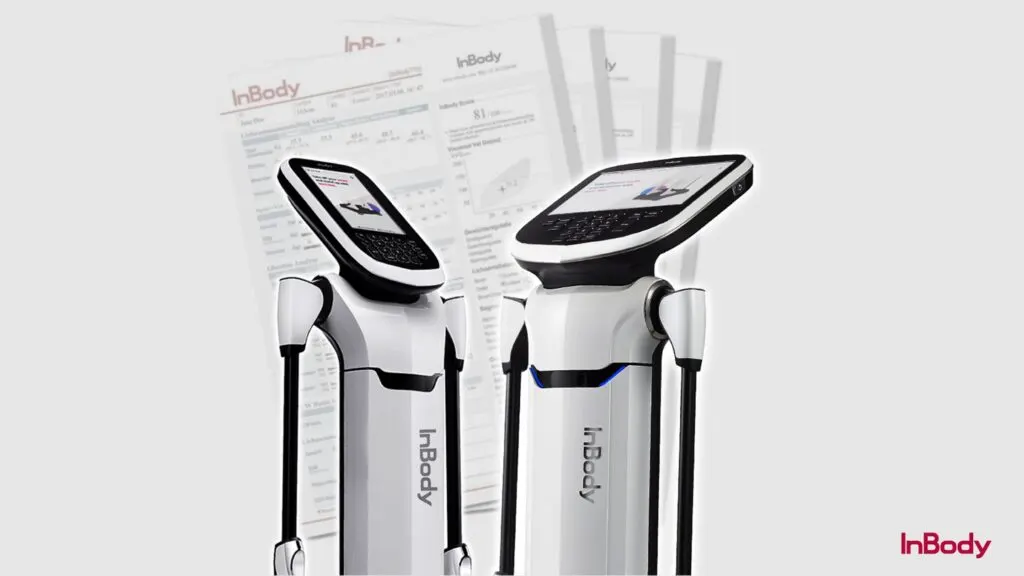
InBody’s professional range, the 270S, 380, 570, 770S, and 970S, uses Direct Segmental Measurement Multi-Frequency BIA (DSM-BIA). Eight tactile electrodes measure your arms, legs, and trunk independently. Most professional models run 4–6 frequencies (1, 5, 50, 250, 500, and 1000 kHz on the 770S and 970S), which lets the device distinguish intracellular from extracellular water, detect inflammation, and produce phase-angle readings.
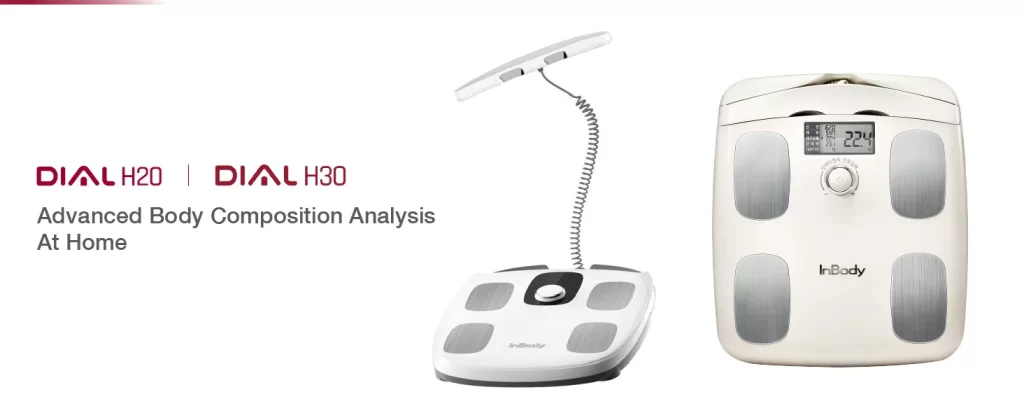
The home Dial range H40, H30, H20 uses a simpler 4-point tetrapolar BIA setup. You stand on the platform, hold a position, and the device estimates whole-body composition. There is no segmental breakdown of left arm versus right arm. There is no multi-frequency analysis. It runs single-frequency at 50 kHz, which is enough for trustworthy trend tracking but not for clinical interpretation.
The accuracy gap matters. The professional InBody range correlates 98.4% with DEXA scans in peer-reviewed validation studies. The home Dial range correlates well for trend tracking, but absolute single readings carry a margin of 2–3% body fat in either direction. For most individuals tracking themselves week to week, that margin is invisible. For a hospital making a sarcopenia diagnosis or applying the WHO body composition criteria, it is not.
The professional vs home comparison at a glance
| Feature | Professional (770S, 970S, 570, 380, 270S) | Home Dial (H40, H30, H20) |
|---|---|---|
| BIA type | DSM-BIA, 8-electrode tetrapolar | Single-frequency, 4-point tetrapolar |
| Frequencies | 1–6 frequencies (model dependent) | 50 kHz only |
| Segmental analysis | Yes, 5 segments measured independently | Whole-body estimate |
| Scan time | 15–60 seconds | ~30 seconds |
| Outputs per scan | 30+ metrics including phase angle, visceral fat, ECW/TBW | 10–15 metrics: body fat %, muscle mass, visceral fat estimate, BMR |
| DEXA correlation | 98.4% | Strong for trend tracking; ±2–3% absolute |
| Result sheet | Printed clinical result sheet | App display + cloud history |
| Cloud platform | LookinBody Web (multi-user clinical) | InBody app (personal) |
| Typical Indian use | Hospital, gym, clinic, corporate wellness, sports academy | Home, family, and individual tracking |
| Price band (India) | Lakhs (₹) see InBody India price list | Thousands (₹) consumer electronics tier |
When to choose a professional InBody
Buy a professional InBody (270S, 380, 570, 770S, or 970S) if any of the following describes you:
- You run a hospital, clinic, or diagnostic centre. Body composition data will support clinical decisions in diabetes management, oncology nutrition, dialysis dry-weight calibration, bariatric pre-op assessment, and sarcopenia screening. Single readings must be defensible. Accuracy is non-negotiable.
- You operate a gym or fitness studio. InBody scans become a paid service (typically ₹300–₹800 per scan in India), a member retention tool, and a sales driver for personal training and nutrition packages. A single InBody machine often pays itself back within 12–18 months from scan revenue alone.
- You run a corporate wellness programme. You are scanning hundreds of employees across an annual cycle. The data feeds insurance-claim trend analysis and risk stratification — especially relevant given ICMR-INDIAB findings on Indian metabolic risk. See InBody for corporate wellness.
- You are a clinical dietitian, sports nutritionist, or physiotherapist in private practice. Your differentiator is measurement. An InBody result sheet is what separates your service from generic diet advice; clients pay for the visible before-and-after.
- You run a sports academy or athletic-performance practice. Phase angle, segmental muscle balance, and ECW/TBW ratio matter for athlete monitoring, none of which a home scale measures.
In every case above, the buyer is making single-reading clinical or commercial decisions from the data. A 2% margin of error is not acceptable. The professional range is the only correct choice.
When a home InBody Dial is enough
Buy a home Dial (H40, H30, or H20) if you fit any of these descriptions:
- You are tracking yourself over months. You want to know if your training and diet are working. You will scan once or twice a week, look at trends across 8–12 weeks, and ignore day-to-day noise. The home Dial is purpose-built for this.
- You live in a household with multiple people who want to track. The H30 supports 4 users; the H40 supports 8. Each person has their own app profile, their own history, their own trend line.
- You already get an annual professional scan (at your gym, clinic, or annual health check), and you want a daily check-in tool in between. The home Dial cross-references against the professional reading.
- You are managing a chronic condition that responds to body-composition change, early-stage type 2 diabetes, fatty liver, insulin resistance, PCOS, and your clinician is tracking your progress on their professional InBody every 3–6 months. The home Dial gives you a daily signal between clinic visits.
- You are coming off GLP-1 medication (semaglutide, tirzepatide) and want to verify you are not losing muscle along with fat. Home Dial muscle-mass trend lines catch this faster than the bathroom scale.
The unifying pattern: same user, repeated readings, trend-focused. Under those conditions, a home Dial gives you most of the actionable signals at a fraction of the price.
A real-world decision example
Illustrative example composite based on typical buyer profiles.
A 41-year-old VP of HR at a 4,000-employee IT services company in Bangalore wants to upgrade her company’s annual health check. Their current vendor measures weight, BMI, and BP. She wants body composition added. Should she equip employees with home Dials, or set up two InBody 270S machines at office sites?
The answer is the 270S. Her use case requires single-reading interpretation across hundreds of employees, comparable data between individuals, and clinical defensibility if a flagged employee is referred to her in-house dietitian. Home Dials cannot give comparable cross-individual readings (different brand calibration would matter; cluster-level analysis needs DSM-BIA precision). The 270S pays back within 18 months in reduced diabetes claims and improved engagement scores. Wrong tier choice would have meant data she could not act on.
The same VP, for her personal use at home? An H40 makes perfect sense.
The “which model within the tier” quick decision
Inside the professional range
- InBody 270S entry portable. Great for corporate wellness, small clinics, mid-tier gyms, and dietitian practices. Most popular in India.
- InBody 380 high-volume gym workhorse. Wireless and tough.
- InBody 570 adds phase angle and intracellular/extracellular water. Sports science and intermediate clinical.
- InBody 770S full 6-frequency, premium clinical and athletic. Bariatric, oncology, and sports academies.
- InBody 970S flagship. Maximum clinical depth. Top hospitals.
- InBody S10 is designed for bedridden patients. Dialysis centres, palliative care, and ICU.
Full professional-tier model comparison here.
Inside the home Dial range
- InBody Dial H20 entry-level smart scale. Single-user focus. Best value.
- InBody Dial H30 family scale. 4 users, larger app integration. See the H20 vs H30 detailed comparison.
- InBody Dial H40 premium home Dial. 8 users, the most data per scan in the consumer range, the closest accuracy to professional models.
Full home-tier comparison and India pricing here.
Three common myths about the professional vs home choice
Myth 1: “A home Dial is accurate enough for everything.” False for single-reading clinical decisions. True for trend tracking on the same individual. The distinction matters because most people choose home Dials assuming the first; the device only reliably delivers the second.
Myth 2: “Getting one professional scan a year is all I need.” Partially false. A single annual scan misses everything between January and December. Body composition changes monthly. If you are working on a goal or managing a condition, you need at a minimum quarterly professional scans, ideally supplemented with home Dial trend tracking in between.
Myth 3: “Professional InBody models are over-spec for personal use.” Generally true unless you are running a private practice or have a household member with a clinical condition where data interpretation matters. For pure individual tracking, the home Dial gives you 80% of the actionable insight at 5% of the cost.
The decision in one paragraph
If a single body composition reading will guide a clinical decision, a business decision, or a sale to another person, buy professional. If you are tracking yourself or your family over time and using the data to adjust your own training and eating, buy a Home Dial. If you are doing both managing a condition, working with a clinician, and tracking daily own both, but get the professional scan from your clinic or InBody-equipped gym rather than buying one for personal use. That is almost always the right Indian answer.
Frequently asked questions
Q. How accurate is the InBody Dial H40 compared to the InBody 770S?
The 770S is the higher-accuracy device, 98.4% DEXA correlation, full segmental breakdown, and 6-frequency analysis. The H40 is single-frequency and whole-body, with absolute readings carrying a ±2–3% body fat margin. For tracking your own trend across 8–12 weeks, that margin is invisible. For a clinician making a diagnostic decision, the 770S is the correct tool.
Q. Can I trust a home body fat scale for tracking weight loss progress?
Yes, if you use it consistently at the same time of day, same hydration state, same scale, ideally the same foot position. Home Dials are reliable for trends. They become unreliable when you compare a Monday-morning reading on the H30 against a Saturday-evening reading on a different brand. The reading drift is in the comparison conditions, not the device.
Q. What is the price difference between a professional InBody and a home Dial?
Professional InBody machines in India sit in the lakhs range, the 270S being the entry point. Home Dials are in the thousands range. Current InBody India pricing for both ranges is here. The price gap reflects the engineering: 8 tactile electrodes plus multi-frequency analysis plus FDA-cleared clinical certification is fundamentally more expensive to build than a single-frequency 4-point platform.
Q. Do I still need a professional InBody scan if I already have a home Dial?
If you are managing a clinical condition or working with a dietitian or sports coach, yes, periodically. The professional scan gives you segmental muscle balance, visceral fat at clinical precision, phase angle, and ECW/TBW ratio. None of these appears on a home Dial. Pattern: home Dial for weekly trend, professional scan every 3–6 months for clinical depth.
Q. Which InBody is best for a household with multiple users?
The Dial H30 supports 4 users, and the H40 supports 8. Both keep separate profiles, separate histories, and separate trend lines through the InBody app. The H40 is the better choice if anyone in the household has a clinical condition (diabetes, PCOS, post-bariatric, GLP-1 use) because the additional metrics matter; the H30 is the right call for general family fitness tracking.
Q. Should a gym buy a professional InBody or just recommend members buy home Dials?
A gym should buy a professional InBody. The reason is not measurement quality; it is the business model. A gym that owns a professional InBody can charge ₹300–₹800 per scan, integrate scan results into personal-training packages, and use measurable progress to drive member retention. A gym whose members all have home scales captures none of that revenue and none of the retention lift. The machine typically pays itself back in 18 months.
Q. Is the Dial H40 accurate enough for someone managing diabetes at home?
For tracking your own visceral fat trend and muscle mass over months, yes, and that trend information is genuinely useful for diabetes management. But the H40 should not replace your endocrinologist’s professional scan every 3–6 months. The two work together: H40 for weekly check-ins, a professional scan for the clinical depth your physician interprets.
Not sure which tier is right for your situation? If you are evaluating for a hospital, gym, clinic, corporate wellness programme, or private practice, talk to our B2B team. We will recommend the model that fits your use case and budget. If you are buying for personal or family use, see the home Dial range and current India pricing. Already getting scans somewhere? Find an InBody test centre near you in India.

Most trending articles

Healthy Body Composition by Age for Indians: Reference Ranges at 20s, 30s, 40s, 50s+
Body composition reference ranges for Indian men and women by age. Find out if your body fat %, muscle mass, and visceral fat level are healthy for your age and what to do if they're not.
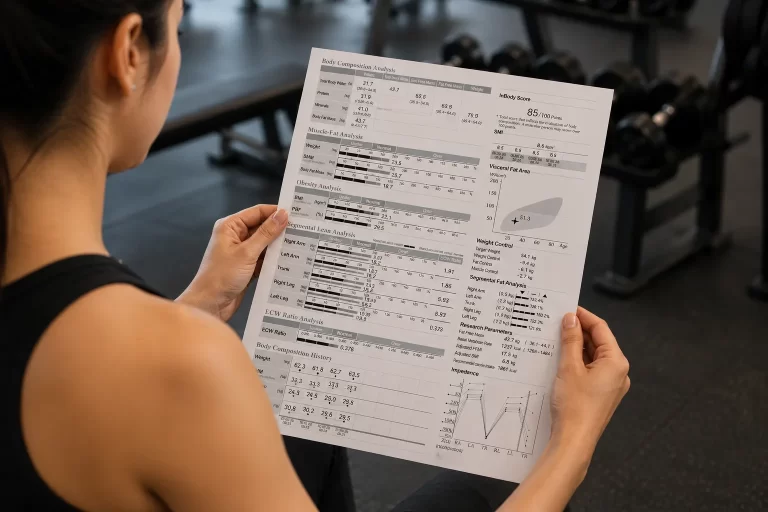
How to Read Your InBody Report: Every Number Explained Simply
Your InBody report has 15+ numbers. This guide explains what SMM, PBF, ECW/TBW ratio, visceral fat level, and segmental analysis mean — and what to actually do with each result.

Metabolic Age Explained: What It Reveals About Your Real Health (And How to Lower It)
Metabolic age vs chronological age. What it means, why many Indians in their 30s have the metabolism of a 50-year-old, and 5 evidence-based steps to reverse metabolic aging.