
Health 7 min read
PCOD Management in India — What Body Composition Tells You
PCOD affects 1 in 5 Indian women. "Lose weight" is the wrong first instruction. Here is what body composition adds — and a 6-month plan that actually works.
Reading about body composition? Find an InBody test centre near you →
Roughly 1 in 5 Indian women of reproductive age has PCOD or PCOS — among the highest prevalence in the world (AIIMS 2024 cohort data). Most of them have been told the same first instruction: “lose weight.” For about a third of them, this advice is unhelpful and for a meaningful share it is actively wrong, because their weight is not the problem. Their body composition is. Modern PCOD management takes the focus off the scale and puts it on three or four specific numbers — and the results, when measured correctly, are dramatically different.
PCOD ≠ PCOS — what most Indian women aren’t told
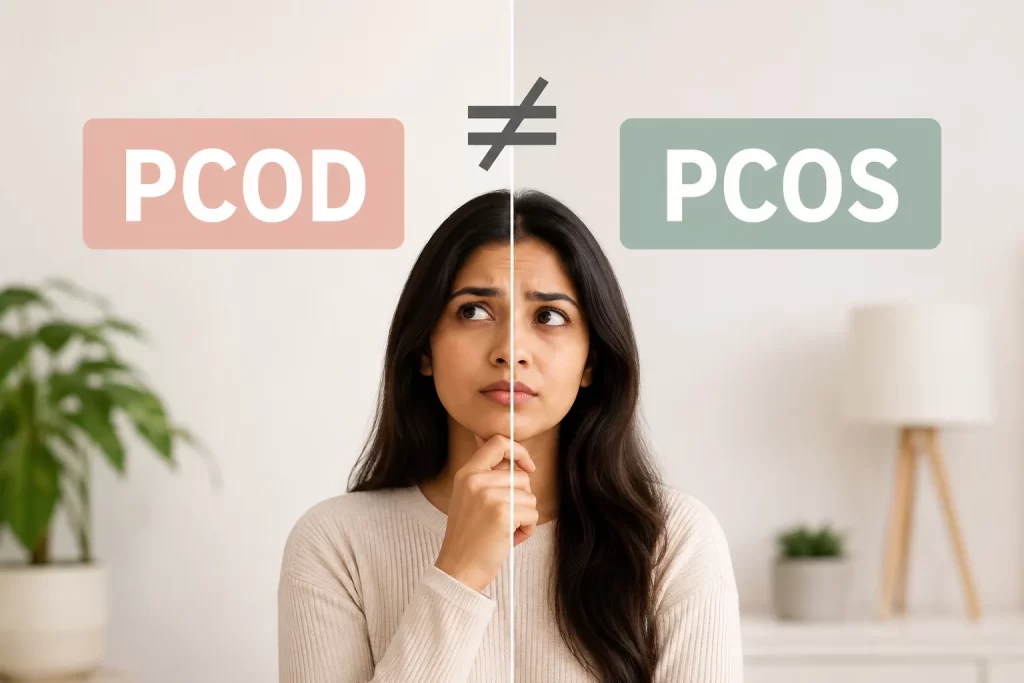
The terms PCOD and PCOS are often used interchangeably in India, but they refer to overlapping (not identical) conditions:
- PCOD (Polycystic Ovarian Disease) — a more functional, hormone-based condition. Ovaries release immature/partial eggs that become small cysts; cycles are irregular but ovulation often still occurs. Common, generally manageable with lifestyle and body composition correction.
- PCOS (Polycystic Ovarian Syndrome) — a metabolic-endocrine syndrome (Rotterdam criteria: 2 of 3 — irregular cycles, hyperandrogenism, polycystic ovaries on ultrasound). Often associated with insulin resistance, metabolic syndrome, and infertility. Needs endocrinology input.
Both share a common upstream driver in most Indian women: insulin resistance. And insulin resistance is the single most measurable thing on a body composition scan.
Key Takeaways
- 1 in 5 Indian women of reproductive age has PCOD/PCOS — one of the highest rates globally.
- “Lose weight” misses the point: PCOD is upstream of weight; insulin resistance and body composition come first.
- Visceral fat + skeletal muscle mass predict symptom severity better than BMI.
- 30% of Indian women with PCOD have a “normal” BMI — they often get the wrong first-line advice.
- A 6-month plan focused on body composition (not weight) puts most patients into symptom improvement.
Why “lose weight” is the wrong first instruction
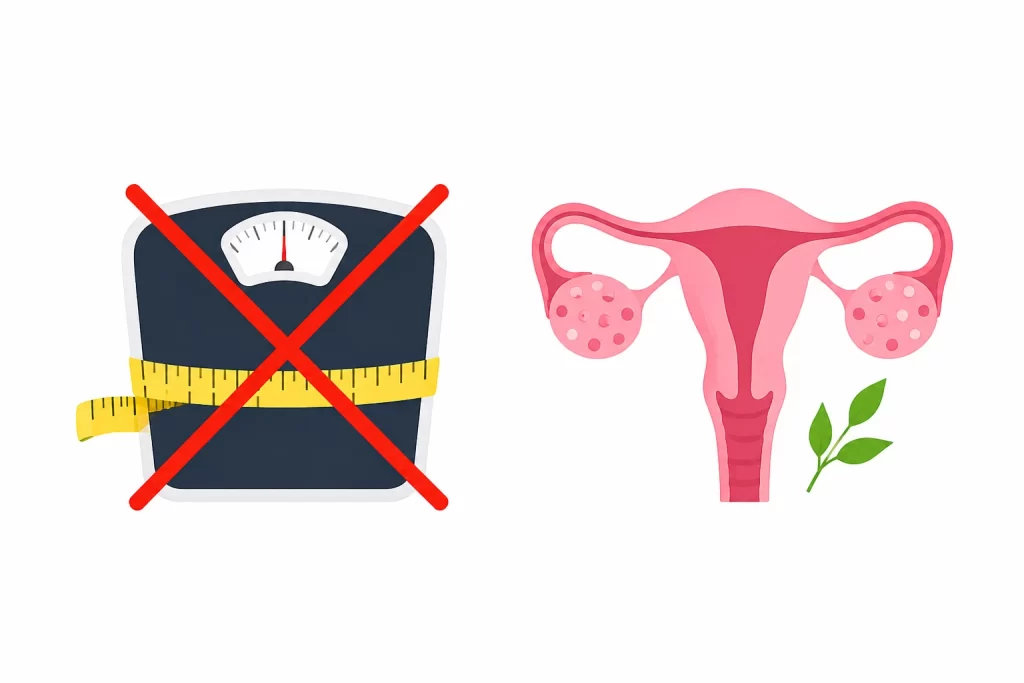
The standard PCOD prescription in Indian general-practice clinics goes: “Your weight is the problem. Lose 5–10% body weight. Symptoms will improve.” This advice is sometimes correct and often misleading. Three reasons:
It misses lean PCOD entirely. About 30% of Indian PCOD patients have a BMI under 25 — the “lean PCOD” or “thin PCOD” subset. Telling these women to “lose weight” is not just unhelpful; if they crash-diet, they lose muscle mass and worsen their underlying insulin resistance.
It rewards the wrong tissue loss. A patient who follows a low-calorie, low-protein crash diet may drop 4 kg on the scale — but 2 kg of that is muscle. Muscle is the body’s primary glucose-disposal tissue. Lose muscle, and insulin resistance gets worse, even as weight goes down.
It hides the visceral fat story. Many normal-weight Indian PCOD patients have high visceral fat (the dangerous abdominal-deep fat). Visceral fat is hormonally active and is the part that drives PCOD symptoms — but it does not show up cleanly on a scale.
The right first instruction is: measure your body composition, treat the insulin resistance, and let the weight reorganise itself.
Insulin resistance is the upstream problem
In most Indian PCOD patients, this sequence runs the show:
- Visceral fat accumulates (often without overall weight gain — see “thin-fat Indian” phenotype)
- Visceral fat releases inflammatory cytokines that interfere with insulin signalling
- Insulin resistance develops; the pancreas compensates by producing more insulin
- High circulating insulin stimulates the ovaries to produce more androgens (male hormones)
- Elevated androgens disrupt the menstrual cycle, drive acne and hair growth, and prevent ovulation
You will notice that “weight” is not anywhere in this chain. Visceral fat and insulin resistance are. The right tools for PCOD are the ones that measure those two things directly.
The 4 body composition markers that track PCOD better than BMI
- Visceral Fat Level (1–20). Target under 10. Most PCOD patients sit at 11–15 — even at normal BMI. This is the single most actionable number.
- Skeletal Muscle Mass (kg). The glucose-disposal infrastructure. Building 2–3 kg of muscle over 6–12 months meaningfully improves insulin sensitivity and often regularises cycles.
- Body Fat Percentage (Asian-adjusted). Healthy: under 30% for adult Indian women. Many “normal BMI” PCOD patients are at 32–38% — clinically overfat, biochemically explanatory.
- Phase Angle. Cell-membrane integrity marker. Reflects systemic inflammation. Tends to improve weeks before lab values do — early indicator that you are on the right track.
A typical case (illustrative)
Illustrative example — composite based on typical patient profiles.
A 27-year-old in New Delhi, BMI 23 (textbook “normal”). Diagnosed PCOD at 22, irregular cycles, acne, mild hirsutism. Her gynaecologist’s first advice was “lose 4 kg” — but she had no weight to lose. Body composition scan five years into the condition shows: visceral fat level 13 (high), skeletal muscle 19.2 kg (low for her height), body fat 34% (above Asian threshold despite normal BMI). The plan changes from “lose weight” to “lose 5 kg of fat, gain 3 kg of muscle, drop visceral fat to under 10.” Six months of two strength sessions per week, 1.3 g/kg protein from dal-paneer-egg-tofu, vitamin D correction (her level was 14 — deficient, very common in Indian women), and her cycles returned to 30–32 days. By month 9 she was off metformin. Total scale weight change: −1.5 kg. The scale barely moved. Everything else did.
What a 6-month PCOD plan actually looks like
For a typical Indian PCOD patient with body composition issues:
Month 1. Baseline body composition scan + standard PCOD blood panel (LH/FSH, insulin, fasting glucose, HbA1c, Vitamin D, TSH). Start: 1.2 g/kg protein per day, 2× 25-min resistance sessions per week, 10K steps/day, correct any Vitamin D deficiency.
Months 2–3. Phase angle improving on scan. Sleep regularising. Cycle still irregular but mood and energy better. Visceral fat trending down by 1–2 points.
Months 4–5. First cycle changes — most patients see length normalisation around month 4–5. Muscle mass up 1–1.5 kg. HbA1c (if elevated) starting to drop.
Month 6. Re-scan. Most patients show: visceral fat down 3–5 points, muscle up 2–3 kg, fat down 3–5 kg, cycles in the 25–35 day range. Decision point with your gynaecologist: continue current plan, escalate, or de-escalate medication.
This trajectory does not work for everyone — patients with severe insulin resistance, hypothyroidism, or genetic-component PCOS often need pharmacological support (metformin, inositol). But for a large share of PCOD patients in India, body-composition-led management gets to the symptom relief that “lose weight” never did. See also: Lean PCOS — symptoms and treatment in India.
When to escalate to medication
Body-composition-first does not mean medication-never. Escalate to your gynaecologist and possibly endocrinologist if:
- HbA1c is above 5.7 (pre-diabetic range) at baseline — metformin / inositol may be needed alongside lifestyle
- You have tried 6 months of consistent intervention and cycles are still irregular and androgens still elevated
- You are actively trying to conceive (fertility timeline matters; combined approach is standard)
- Mental-health symptoms (depression, anxiety) are interfering with adherence — treat these in parallel
The framing is: body composition correction is the foundation, medication is a layer on top — not a substitute.
Related reading: Visceral fat — normal range, risks, how to measure (India).
Find your nearest InBody test centre
A body composition scan takes 15 seconds and shows you the four numbers that actually predict PCOD severity: visceral fat, muscle mass, body fat %, and phase angle.
Frequently asked questions
Q. What is the difference between PCOD and PCOS in India?
PCOD is a functional hormonal condition where ovaries form small cysts, but ovulation often still occurs — usually manageable with lifestyle. PCOS is a metabolic-endocrine syndrome (Rotterdam criteria) with insulin resistance, androgens, and often infertility — needs endocrinology input. Both share insulin resistance as the upstream driver in most Indian women.
Q. Can I have PCOD if my BMI is normal?
Yes — about 30% of Indian PCOD patients have a BMI under 25 (“lean PCOD”). The issue is not your overall weight but your body composition: visceral fat is high, skeletal muscle is low, and insulin resistance is present despite a “healthy” BMI. A body composition scan reveals this when a scale alone cannot.
Q. Will losing weight cure my PCOD?
Sometimes, partially, in patients who are genuinely overweight and lose fat (not muscle). For lean PCOD patients, “lose weight” is the wrong target — the right target is “drop visceral fat and build muscle,” which often happens with very little net scale-weight change. The mechanism is insulin sensitivity, not weight.
Q. How often should I get a body composition scan if I have PCOD?
Every 3 months is the standard cadence — long enough to see real change, short enough to course-correct. Pair it with quarterly blood work (insulin, HbA1c, Vitamin D). Most Indian gynaecologists are now open to including the scan in PCOD follow-ups if you ask.
Q. Does resistance training help PCOD?
Yes — strongly. Building skeletal muscle improves insulin sensitivity, which is the upstream lever in PCOD. Two sessions per week of moderate resistance training (squats, hinges, push-ups, rows) is the dose that holds up in trials. Cardio alone does not produce the same effect — muscle mass change is what matters.
Q. What is the role of inositol in PCOD management?
Myo-inositol + D-chiro-inositol (40:1 ratio) has the strongest trial evidence for cycle regularisation and ovulation in PCOD — particularly in patients with insulin resistance. Many Indian gynaecologists now use it as first-line before metformin. It works synergistically with body composition correction. Discuss with your doctor before starting.
