
Health 10 min read
India’s Childhood Obesity Epidemic: Why Your Child’s Weight Is Lying to You
India has 14.4 million obese children — the world's second highest. BMI misclassifies 40% of Indian children. Body composition testing is transforming how paediatricians identify and manage childhood obesity in India.
Reading about body composition? Find an InBody test centre near you →
Your Child’s Weight Is Not the Whole Story — and It May Be Missing the Most Important Part
If you are a parent in urban India, you have probably watched your child’s lifestyle change dramatically over the last decade. Physical play has given way to screen time. Meals have shifted toward packaged foods and quick options. School days are longer, more sedentary, and more stressful. And yet when you take your child for a health check, the doctor looks at a weight-for-height chart, places them in a percentile category, and moves on.
That weight-based assessment is missing something critical — and for a growing number of Indian children, what it’s missing is the difference between appearing healthy and being metabolically at risk.
India now has 14.4 million obese children, the second highest number in the world after the United States. But the full extent of the problem is larger than these numbers suggest, because the tools being used to measure it — primarily BMI — systematically underestimate metabolic risk in Indian children.

The Scale of India’s Childhood Obesity Problem
The numbers are stark and should be understood in full context before we discuss what to do about them.
A 2023 Lancet study found that 12.5% of urban Indian children aged 5-19 are overweight or obese — a figure that has more than doubled since 2000. In major metro cities, the prevalence among school-age children in mid-to-high income groups is substantially higher. Research from AIIMS Delhi found rates of overweight and obesity reaching 35-40% among private school students in Delhi, Mumbai, and Chennai when using Indian-specific cut-offs.
More alarming than these numbers is the trajectory. India is on course to have the world’s largest population of children with metabolic disease complications within two decades, according to projections from the Indian Council of Medical Research (ICMR). Paediatric type 2 diabetes — previously almost unknown in India — is now being diagnosed in children as young as 12-15 years in urban centres. Paediatric hypertension affects an estimated 4-5% of Indian school-age children, up from less than 1% two decades ago.
These are not statistics about other people’s children. They describe the health landscape that Indian children in every major city are growing up in right now.
Why BMI Fails Indian Children
BMI is even less reliable for children than it is for adults — and it’s already poorly suited for Indian adults. There are several reasons for this failure.
BMI Cannot Distinguish Fat from Muscle
A child who is growing normally and building healthy muscle mass will show an increasing BMI. A child who is sedentary and accumulating body fat may show the same BMI increase. The number tells you weight relative to height; it says nothing about what that weight is made of. For a child who is developing normally, this distinction is everything.
The “Thin-Fat” Pattern Is Especially Common in Indian Children
Indian children, researchers have found, frequently display what is called the “thin-fat” phenotype — a body composition pattern characterised by normal or even low body weight and BMI, but elevated Percent Body Fat (PBF) and importantly, disproportionately high visceral fat relative to overall body size. Studies from the Pune Maternal Nutrition Study and subsequent research have consistently shown that Indian children have higher body fat percentages than European children at the same BMI.
This means an Indian child classified as “normal weight” by standard BMI charts may in fact have a body fat percentage that carries metabolic risk. The ICMR has recommended lower BMI thresholds for overweight and obesity in Indian children precisely because of this phenotype, but even these adjusted thresholds cannot capture the full picture that body composition measurement provides.
BMI Doesn’t Measure Where Fat Is Stored
Visceral fat — the dangerous metabolically active fat stored around abdominal organs — is not captured by BMI in any way. For Indian children, who tend to accumulate visceral fat preferentially, this is a critical blind spot. A child with a VFA (Visceral Fat Area) reading that would be concerning in an adult-equivalent analysis may have a completely “normal” BMI. The metabolic consequence is the same regardless of what the BMI chart says.
What Body Composition Testing Reveals About Indian Children’s Health
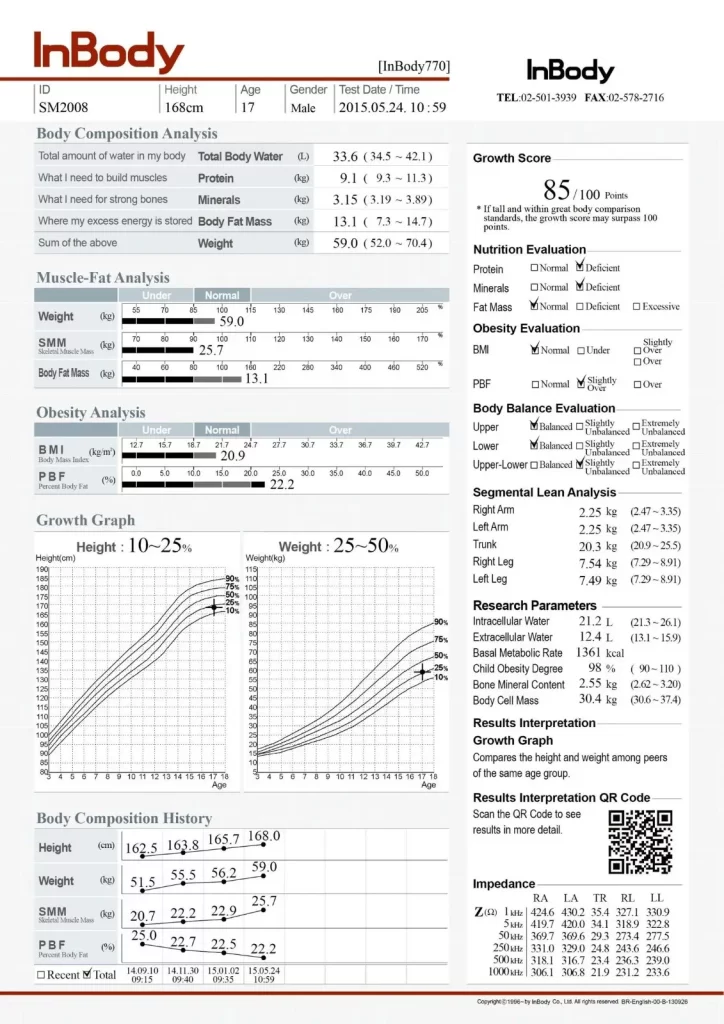
When paediatric clinicians and sports medicine physicians use body composition analysis rather than weight-based screening, the picture changes significantly — and more children who need help can be identified accurately.
Skeletal Muscle Mass in Children
Healthy muscle development during childhood is one of the most important predictors of adult metabolic health. Children with adequate Skeletal Muscle Mass (SMM) have better insulin sensitivity, stronger bones, healthier cardiovascular risk profiles, and importantly, better weight management outcomes throughout adolescence. When body composition analysis shows a child with low SMM relative to age- and height-based norms — a pattern common in very sedentary children — it identifies a specific intervention need that BMI would completely miss.
Paediatric Body Fat Reference Ranges
InBody devices used for paediatric assessment include age- and sex-specific reference ranges for Percent Body Fat. These ranges account for the natural changes in body composition that occur during childhood and adolescence. A healthy body fat range for a 10-year-old girl differs from the range appropriate for a 15-year-old. These paediatric-calibrated ranges allow for much more accurate risk stratification than BMI-for-age percentiles.
Early Detection of Metabolic Syndrome Precursors
Paediatric metabolic syndrome — the clustering of elevated blood sugar, blood pressure, triglycerides, and abdominal fat — is increasingly prevalent in Indian children. Body composition assessment can identify high visceral fat levels that are a core component of this syndrome before blood markers become overtly abnormal. This early window is the ideal time for intervention, when lifestyle changes can produce the most significant reversal of risk.
The Environment That Is Driving This — and What Parents Can Control
Screen Time and the Activity Collapse
Indian children aged 8-16 now average 4-6 hours of recreational screen time daily according to a 2023 survey by the Digital Wellbeing Foundation India. This has displaced physical activity that previous generations built naturally into their days. Even children who participate in organized sports often spend the majority of their non-school, non-sport hours sedentary in ways that previous generations simply did not.
The Canteen and Packaged Food Problem
School canteen menus in Indian urban schools have shifted heavily toward refined carbohydrates, ultra-processed snacks, and sugary beverages. A 2022 ICMR survey of school canteen offerings in metro cities found that 78% of items available were classified as “energy-dense, nutrient-poor” foods. Combined with the frequency of packaged snack consumption at home, many Indian children are consuming a diet optimised for fat storage rather than healthy development.
Academic Pressure and Sleep Disruption
India’s competitive academic environment means many school-age children are consistently sleep-deprived, particularly in the years approaching board examinations. Sleep restriction is a documented driver of childhood obesity — it elevates ghrelin (hunger hormone), suppresses leptin (satiety hormone), and increases cortisol, all of which promote fat storage and reduce muscle development. A child studying until midnight and waking at 6 AM is not just tired; they are operating under a hormonal profile that actively promotes unfavourable body composition changes.
A Sensitive Note: This Is Not About Shaming Children
Before going further, this point must be stated clearly. Childhood body composition is a health matter, not an appearance matter. The goal of body composition assessment for children is not to identify who “looks fat” or to make children self-conscious about their bodies. It is to give parents and physicians the information they need to support healthy development and catch metabolic risk before it becomes chronic disease.
Children should never be told their body fat percentage as a number to be ashamed of. They should understand — in age-appropriate terms — that their body is either in a healthy range or needs some changes to become healthier, the same way we discuss blood sugar or blood pressure. The conversation should always focus on energy, strength, what the body can do, and how they feel — not on appearance or weight.
Family-Based Approaches Work Better Than Child-Only Interventions

Research on childhood obesity intervention consistently finds that family-based programmes outperform child-only interventions. When parents change their eating habits alongside their children, when the whole family increases activity levels together, when body composition tracking is done as a family exercise, adherence is higher and outcomes are better.
This means that if body composition assessment reveals concerns about a child’s health, the most effective response is often for parents to get their own InBody assessment as well. Understanding your own Visceral Fat Area, Skeletal Muscle Mass, and Percent Body Fat creates a shared family framework for health improvement, rather than placing the entire burden of change on the child.
Practical Steps for Indian Families
Replace Scale-Watching With Composition Tracking
If your household currently measures children’s health by stepping on a scale regularly, consider replacing that habit with periodic body composition assessment. A quarterly or bi-annual InBody test provides meaningful data about whether a child is developing healthy muscle mass, keeping body fat in a healthy range, and not accumulating visceral fat — none of which a home scale can tell you.
Focus on Strength and Fitness, Not Weight
The most effective framing for child health at home is physical capability, not weight. Can your child run without losing breath? Are they getting stronger? Can they do a pull-up or climb a rope? Framing health in terms of what the body can do creates motivation and positive associations, rather than the negative relationship with body image that weight-focused conversations risk creating.
Sports That Build Muscle and Metabolic Health
Resistance-based activities and sports that involve both aerobic and strength components — swimming, football, basketball, martial arts, gymnastics, athletics — are particularly valuable for building healthy SMM in children. In the Indian school context, where structured PE time has declined in many schools, parents may need to actively create these opportunities outside school hours.
Red Flags That Warrant Medical Attention
Some body composition findings in children warrant prompt medical consultation rather than watchful waiting:
- Body fat percentage significantly above age-specific reference ranges for 2+ consecutive measurements
- Waist circumference above the 90th percentile for age (a proxy measure for visceral fat)
- Fatigue, frequent thirst, or frequent urination in an overweight child (potential early diabetes symptoms)
- Elevated blood pressure at a routine check combined with high body fat
- Significant weight gain over 3-6 months without obvious dietary change (may indicate hormonal issues)
Paediatric endocrinologists and metabolic medicine physicians in India’s major cities are increasingly equipped to use body composition data in clinical assessment. A referral to such a specialist, with InBody data in hand, gives the physician a much richer picture of the child’s metabolic status than weight and BMI alone provide.
Giving Indian Children a Healthier Start
India’s childhood obesity epidemic is serious, but it is not irreversible. Children’s bodies respond to healthy lifestyle interventions with remarkable speed compared to adults. A child who reduces sedentary time, improves diet quality, and builds physical activity habits can show meaningful positive changes in body composition — increasing Skeletal Muscle Mass, reducing Percent Body Fat, and improving the InBody Score — within months.
The first step is knowing where your child stands with data that actually matters. Body composition assessment provides that picture in a way that weight and BMI cannot.
InBody test centres are available across India, and body composition assessment for children can be done quickly, safely, and without any discomfort. Find an InBody centre near you and speak to a trained professional about getting a baseline body composition assessment for your child. Understanding the real picture is the foundation of every health decision that follows.
Frequently Asked Questions
How many children in India are affected by obesity?
India has an estimated 14.4 million obese children, the second-highest number globally after China, according to recent public health data.
Why does BMI misclassify children's weight status?
BMI doesn't distinguish between fat and muscle and doesn't account for differing growth patterns, meaning it can miss up to 40% of Indian children who have unhealthy body fat levels despite a "normal" BMI-for-age reading.
How is body composition testing changing childhood obesity diagnosis?
Pediatricians are increasingly using body composition metrics like body fat percentage and visceral fat alongside growth charts to catch at-risk children that BMI-only screening would otherwise miss.
