
Body Composition 7 min read
Body Fat Percentage by Life Stage: 20s, 30s, 40s, 50s, 60+ (India)
Your body fat percentage changes meaningfully across decades — not just because of lifestyle but because of biology. Hormonal shifts, muscle loss with age, metabolic rate decline, and…
Reading about body composition? Find an InBody test centre near you →
Your body fat percentage changes meaningfully across decades — not just because of lifestyle but because of biology. Hormonal shifts, muscle loss with age, metabolic rate decline, and life-stage demands (pregnancy, menopause, andropause) all change what a “healthy” body fat percentage looks like at each phase. The number that is athletic at 25 is unreasonable at 65, and the number that is fine at 65 would be a warning at 25.
This is the India-specific body fat percentage guide by life stage: 20s, 30s, 40s, 50s, 60+. Use it to set realistic goals appropriate to your biology, not aspirational ones imported from a 22-year-old’s Instagram. For the basic body fat percentage chart by gender and age, see the companion post. This post goes deeper on life-stage demands and decisions.
Your 20s: the foundation decade
In your 20s, your body composition is at its most malleable. Newbie gains for muscle are rapid; fat loss responds quickly to even modest calorie deficits; recovery from training is fast. This is the decade where most people either build the muscle reserve they will carry for the next 40 years, or fail to and pay metabolic costs from their 30s onward.
| Range | Indian men 20s | Indian women 20s |
|---|---|---|
| Athletic / fit | 10–15% | 17–22% |
| Healthy | 16–19% | 23–25% |
| Acceptable | 20–24% | 26–30% |
| Overweight | 25–29% | 31–35% |
| High risk | 30%+ | 36%+ |
The decade’s priority: build skeletal muscle aggressively. Strength training 3–5 days per week, protein at 1.6–2.2 g/kg/day, sleep prioritised. Indian-specific note: this decade is when the “skinny-fat” pattern entrenches if neglected. A 24-year-old at BMI 22 with low muscle mass is metabolically vulnerable already.
For women in their 20s, this is also the decade where strength training myths peak. Adding muscle in your 20s does not “make you bulky” — it raises your basal metabolic rate, improves insulin sensitivity, and protects against PCOS-related body composition issues. Lean PCOS in slim Indian women is increasingly common; strength training is a primary intervention.
Your 30s: the trade-off decade
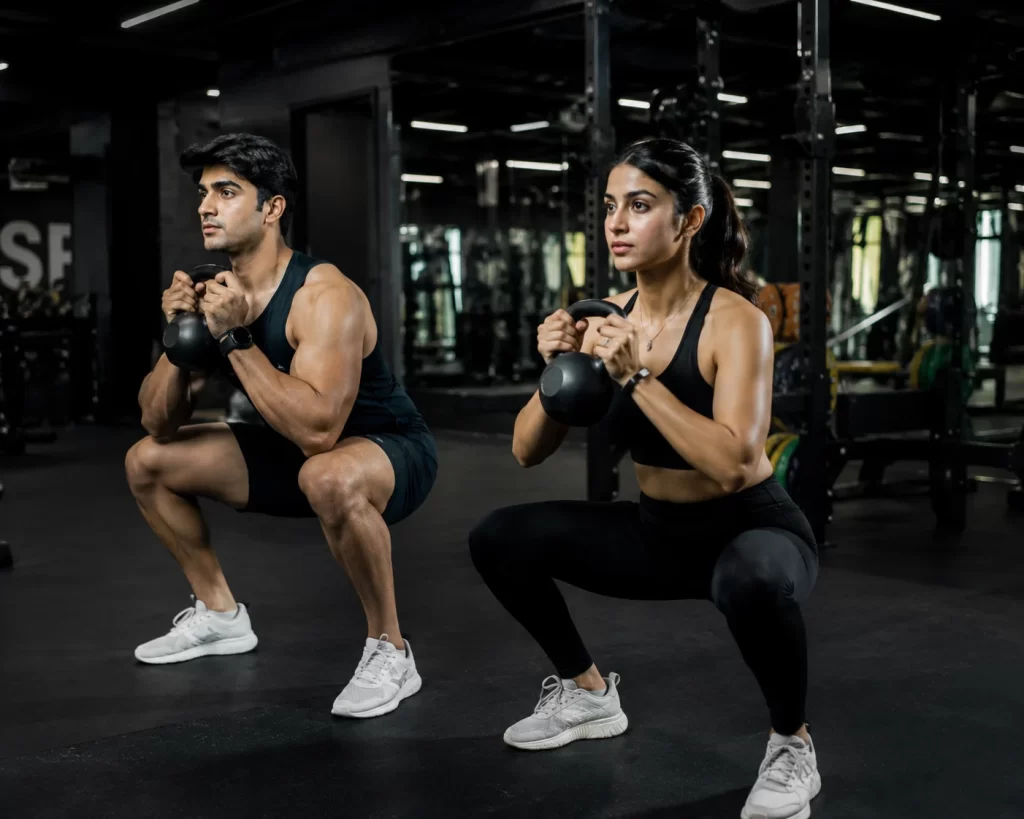
Your 30s is when “life” gets in the way. Career intensifies, kids arrive (or don’t), sleep becomes shorter, eating becomes more variable. Muscle gain becomes slower (0.25–0.5 kg per month vs 0.5–1 kg in your 20s). Fat gain becomes easier. Body composition either holds or starts a slow drift in the wrong direction — without any single dramatic event to point to.
| Range | Indian men 30s | Indian women 30s |
|---|---|---|
| Athletic / fit | 11–17% | 19–24% |
| Healthy | 18–21% | 25–28% |
| Acceptable | 22–26% | 29–32% |
| Overweight | 27–31% | 33–37% |
| High risk | 32%+ | 38%+ |
The decade’s priority: defend your muscle. Resistance training 3–4 days/week is non-negotiable. Calorie deficits without protein protection will cost you muscle you cannot easily rebuild later. Indian-specific note: this is the decade where male testosterone starts measurably declining and the average Indian male diet’s chronic protein deficit becomes consequential.
For women in their 30s, post-pregnancy body composition shifts are often the dominant variable. The scale rarely tells the story — measuring visceral fat, skeletal muscle, and ECW/TBW separately gives a clearer picture of what to actually work on.
Your 40s: the inflection decade
Your 40s is when the cost of accumulated decisions starts showing. Metabolic rate is measurably lower than in your 30s (mostly due to muscle loss, not “slowing metabolism”). Sarcopenia begins, slowly, especially for sedentary individuals. Hormonal shifts intensify — perimenopause for many women, andropause-like declines for some men.
| Range | Indian men 40s | Indian women 40s |
|---|---|---|
| Athletic / fit | 12–18% | 20–26% |
| Healthy | 19–22% | 27–30% |
| Acceptable | 23–27% | 31–34% |
| Overweight | 28–32% | 35–38% |
| High risk | 33%+ | 39%+ |
The decade’s priority: aggressive muscle preservation. If you have not been strength training, start now. The cost of doing nothing in your 40s shows up as compounded sarcopenia in your 50s and 60s. Indian-specific note: this is when metabolic syndrome prevalence climbs to roughly 1 in 3 urban Indian adults. Visceral fat tracking matters more than total body fat percentage from here on.
For women in their 40s, perimenopause typically begins. Estrogen fluctuations drive visceral fat redistribution — fat that used to sit on hips and thighs starts accumulating around the abdomen. Strength training and protein adequacy are the single most powerful interventions for managing this transition.

Your 50s: the prevention decade
Your 50s is when chronic disease risk becomes urgent. India’s average cardiovascular disease onset is roughly a decade earlier than Western populations; full-blown type 2 diabetes prevalence in urban India peaks in the 50s. Body composition is now a critical determinant of healthspan, not just appearance.
| Range | Indian men 50s | Indian women 50s |
|---|---|---|
| Athletic / fit | 13–19% | 22–28% |
| Healthy | 20–23% | 29–32% |
| Acceptable | 24–28% | 33–36% |
| Overweight | 29–33% | 37–40% |
| High risk | 34%+ | 41%+ |
The decade’s priority: body composition becomes a disease-risk lever, not a vanity metric. Visceral fat management and skeletal muscle preservation predict cardiovascular and metabolic disease trajectory more strongly than weight loss. For women, menopause is now in full effect — bone density, muscle mass, and visceral fat distribution all shift, and the interventions that work are clear: strength training, protein, vitamin D, and clinical management of hormonal symptoms where indicated.
Your 60s and beyond: the function decade
In your 60s, body fat percentage matters less than it did in earlier decades — what matters most is functional muscle mass and the ability to maintain independence. A 65-year-old at 28% body fat with strong leg muscles, good grip strength, and the ability to climb stairs without difficulty is in better shape than a 65-year-old at 22% body fat who is sarcopenic and frail.
| Range | Indian men 60+ | Indian women 60+ |
|---|---|---|
| Healthy | 21–25% | 30–33% |
| Acceptable | 26–30% | 34–37% |
| Overweight | 31–34% | 38–41% |
| High risk + sarcopenia concern | 35%+ OR low muscle mass at any body fat % | 42%+ OR low muscle mass at any body fat % |
The decade’s priority: functional muscle, fall prevention, independence. Sarcopenia screening matters more than body fat percentage. Strength training — yes, even at 65, 70, 75 — is the highest-leverage intervention. Research is unambiguous: older adults respond to resistance training with measurable gains in muscle mass and functional capacity.
For Indian seniors specifically, the AWGS 2025 sarcopenia criteria for Asian populations are the appropriate screening framework. Body fat percentage alone is no longer the right primary metric — skeletal muscle index, grip strength, and phase angle are the markers that matter.
Pregnancy and post-partum (special case)
Body fat percentage during and after pregnancy is its own framework. Standard charts do not apply during pregnancy. Post-partum, expect 12–18 months for body composition to fully return — and “return” should mean the same skeletal muscle mass and healthy visceral fat level, not necessarily the same scale weight.
Resistance training (cleared by your obstetrician), protein adequacy (challenging during breastfeeding but critical), and patience are the framework. Most post-pregnancy women hit aggressive scale-weight targets at the cost of muscle, which sets up sarcopenic obesity by mid-30s. Body composition tracking via InBody scan gives a fairer picture of post-partum recovery than the scale.
The decade-by-decade plan in one paragraph
Your 20s: build muscle aggressively and lay the foundation. Your 30s: defend it through life chaos. Your 40s: re-intensify because inflection is here. Your 50s: shift the conversation from body fat percentage to disease risk and visceral fat. Your 60+: prioritise functional muscle and independence over aesthetic body fat numbers. Resistance training is the only intervention that meaningfully helps across all five decades.
Frequently asked questions
Q. Does body fat percentage actually need to rise with age?
Modestly, yes. Some natural increase in essential and storage fat across decades is biologically expected. The aggressive “stay at 12% body fat at 55” goal is rarely realistic and usually costs muscle, sleep quality, and hormonal health. A 4–8 percentage-point natural increase across 30 years is acceptable; more than that signals sedentary drift, not biology.
Q. What’s the single most important body composition habit in any decade?
Resistance training, 3+ days per week, with progressive overload. It is the only intervention that defends muscle mass, supports insulin sensitivity, manages visceral fat, and improves functional capacity simultaneously across every decade.
Q. How often should I measure body fat percentage by decade?
20s and 30s: every 3 months if actively working on a goal; every 6 months if maintaining. 40s and 50s: every 2–3 months — this is when small drifts compound fastest. 60+: every 2–3 months alongside muscle mass and grip strength assessment.
Q. My InBody scan says I’m overweight but I look fine in the mirror. What gives?
This is the classic skinny-fat pattern. Common in Indians at BMI 22–24 who have not done resistance training. The mirror sees “thin.” The scan sees high body fat, low muscle, often high visceral fat. The scan is right. The mirror is using clothing as a confounder.
Q. Should women’s body fat targets be higher than the chart suggests through menopause?
The chart already accounts for menopausal age. The bigger issue is composition, not percentage. A 52-year-old woman at 30% body fat with strong muscle mass and visceral fat below level 10 is in good metabolic shape. The same 30% with weak muscle mass and visceral fat above 12 is not. Body fat percentage is a poor stand-alone metric for this life stage — use visceral fat and skeletal muscle index alongside it.
Setting body fat goals by decade requires knowing your baseline. A 60-second InBody scan gives you body fat percentage, skeletal muscle mass, visceral fat, and metabolic age — the full picture, not the bathroom scale’s one-number version. Find an InBody centre near you or see InBody home scales if you prefer weekly home tracking.

Most trending articles

Healthy Body Composition by Age for Indians: Reference Ranges at 20s, 30s, 40s, 50s+
Body composition reference ranges for Indian men and women by age. Find out if your body fat %, muscle mass, and visceral fat level are healthy for your age and what to do if they're not.
How to Read Your InBody Report: Every Number Explained Simply
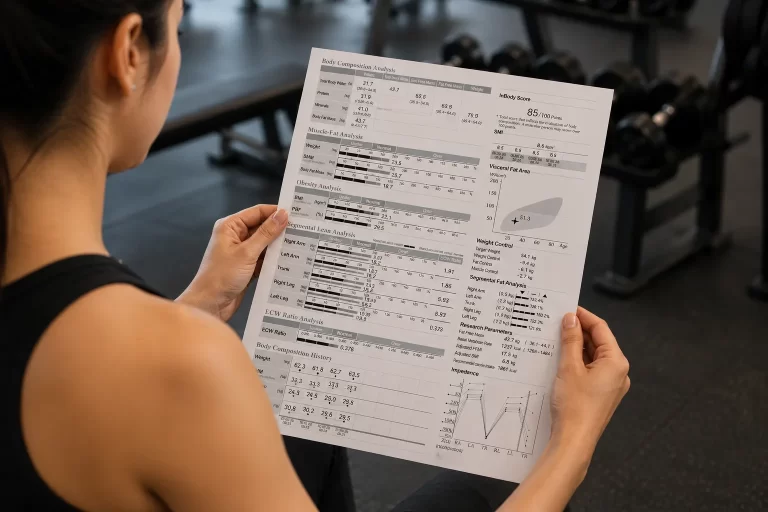
Your InBody report has 15+ numbers. This guide explains what SMM, PBF, ECW/TBW ratio, visceral fat level, and segmental analysis mean — and what to actually do with each result.

Metabolic Age Explained: What It Reveals About Your Real Health (And How to Lower It)
Metabolic age vs chronological age. What it means, why many Indians in their 30s have the metabolism of a 50-year-old, and 5 evidence-based steps to reverse metabolic aging.