
Fitness 10 min read
Body Recomposition Without a Gym: The Indian Home Workout Protocol That Actually Works
No gym? No equipment? The evidence-based home workout protocol for losing fat and gaining muscle simultaneously — with body composition benchmarks to track your progress every 8 weeks.
Reading about body composition? Find an InBody test centre near you →
You Do Not Need a Gym to Transform Your Body Composition
India has approximately 75,000 gyms for 1.4 billion people. That works out to roughly one gym for every 18,600 Indians — a gym density more than 20 times lower than the United States, and far below even comparable emerging economies. If you live outside a Tier 1 city, the nearest gym may be kilometres away, expensive relative to local income, or simply inhospitable — particularly for women who face real cultural and comfort barriers in most Indian gym environments.
And yet body recomposition — the process of simultaneously reducing fat mass and increasing skeletal muscle mass — is fully achievable without ever setting foot in a gym. The equipment is optional. The biology is not negotiable. If you apply the right stimulus, eat adequate protein, and measure your progress correctly, your body will respond the same way it would with gym access.
This article gives you the complete evidence-based framework for home-based body recomposition in the Indian context, including what actually moves the needle, what popular Indian fitness habits get wrong, and how to measure whether your home training is genuinely changing your body composition.
Why Most Indian Home Workout Attempts Fail
Before building the solution, it is worth understanding why the typical Indian home workout does not deliver body recomposition results. There are three primary reasons.
Reason 1: No Progressive Overload
The single most important principle in resistance training is progressive overload — the requirement that the stimulus placed on your muscles must increase over time. If you do the same 20 push-ups at the same pace three times a week for six months, your body adapts within the first 4–6 weeks and then stops changing. The stimulus is no longer challenging enough to drive muscle protein synthesis.
Most home workout routines in India consist of a fixed set of exercises at a fixed number of repetitions. People do their morning routine dutifully and wonder why nothing changes after the initial weeks. The problem is not effort — it is the absence of systematic progression.
Reason 2: Yoga Is Not a Body Recomposition Tool
India’s most popular home fitness activity is yoga, and it deserves enormous respect for its flexibility, balance, stress reduction, and mobility benefits. However, yoga — including most forms of power yoga practised at home — does not provide sufficient progressive mechanical tension on muscle fibres to drive the muscle protein synthesis required for meaningful body recomposition.
A 2021 analysis published in the Journal of Strength and Conditioning Research found that yoga interventions, while improving flexibility and reducing fat mass modestly through caloric expenditure, produced negligible increases in Skeletal Muscle Mass (SMM) compared to progressive resistance training programs. For Indians who practice yoga daily but do nothing else physically, InBody tests often reveal the classic pattern: low-normal SMM, moderate PBF, and the metabolic fragility that comes from an undermuscled body.
Reason 3: Protein Intake Is Too Low
Body recomposition requires building muscle while losing fat. Building muscle requires dietary protein — specifically, adequate leucine-rich protein at regular intervals throughout the day. The typical Indian home diet, built around roti, rice, sabzi, and dal, provides 40–55g of protein daily for most adults. Research on body recomposition consistently identifies a target of 1.6–2.2g of protein per kg of body weight. For a 60 kg Indian adult, that is 96–132g daily — roughly twice what the average Indian consumes.
Without adequate protein, even the perfect home workout program will yield frustratingly modest results.
The Science of Bodyweight Progressive Overload

The good news is that bodyweight training, when applied with progressive overload principles, is mechanically capable of providing sufficient stimulus for significant body recomposition. Here is the framework, exercise category by category.
Push (Chest, Shoulders, Triceps)
The push-up is the foundational exercise, and it has far more progressive potential than most people realise. The progression from easiest to most demanding:
- Incline push-ups (hands on table or wall) → building foundational strength
- Standard push-ups → building base capacity
- Close-grip push-ups → greater tricep demand
- Decline push-ups (feet on chair) → shifts load to upper chest and shoulders
- Pike push-ups (inverted V position) → approximates overhead press mechanics
- Archer push-ups → approaches single-arm intensity
- Single-arm push-up progressions → advanced strength stimulus
Each level provides a meaningfully harder stimulus than the previous. Moving from incline push-ups to standard push-ups to decline push-ups over 8–12 weeks provides progressive overload that can drive real muscle development in the pushing muscles.
Pull (Back, Biceps)
Pulling movements are the hardest to replicate at home because they require something to pull against. They are also the most neglected in Indian home workouts — which is precisely why Indian adults typically have disproportionately weak upper backs, poor posture, and underdeveloped biceps relative to pushing muscles.
Practical home solutions:
- Door-frame rows: Stand facing an open door, grip both sides of the frame at chest height, lean back, and pull your chest to the door. Adjust difficulty by leaning further back.
- Bedsheet rows / towel rows: Loop a bedsheet around a door handle, hold an end in each hand, lean back, and row. Increasing the lean angle increases difficulty.
- Table rows / under-table rows: Lie under a sturdy table, grip the edge, and pull your chest up to the table surface. One of the most effective bodyweight row variations.
- A pull-up bar: Sold online across India for ₹500–800, fitting a standard door frame, a pull-up bar is the single highest-value piece of home fitness equipment available. The pull-up progression (band-assisted → negatives → full pull-ups → weighted pull-ups) provides years of progressive overload potential.
Squat (Quads, Glutes, Hamstrings)
The lower body responds well to bodyweight training because the legs are large muscle groups that can handle high training volumes and a wide progression range:
- Assisted squats (holding a door frame for balance) → learning the pattern
- Air squats → building base volume
- Pause squats (3-second hold at bottom) → increases time under tension
- Jump squats → introduces power and cardiovascular demand
- Bulgarian split squats (rear foot on chair) → significantly harder, near single-leg demand
- Pistol squat progressions → advanced single-leg strength
Hinge (Hamstrings, Glutes, Lower Back)
Hip hinge movements — approximating the deadlift pattern — are critical for posterior chain development and metabolic health but are almost completely absent from typical Indian home workouts:
- Good mornings (hands behind head, hinge at hips) → learning the hinge pattern
- Single-leg Romanian deadlifts (unloaded) → balance + strength challenge
- Nordic curl progressions (feet anchored under sofa) → hamstring development
- Glute bridges and single-leg glute bridges → accessible but effective
A Practical 4-Week Starter Schedule for Indian Homes
The following schedule requires zero equipment (though a pull-up bar is strongly recommended). Each session takes 30–40 minutes.
Monday – Push + Core
- Push-up variation: 4 sets to 2 reps short of failure
- Pike push-ups: 3 sets
- Plank: 3 x 30–45 seconds
- Dead bug: 3 x 10 reps per side
Tuesday – Active Recovery
- 20–30 minute brisk walk or light yoga
Wednesday – Squat + Hinge
- Squat variation: 4 sets to 2 reps short of failure
- Bulgarian split squat: 3 sets per side
- Single-leg glute bridge: 3 sets per side
- Single-leg RDL: 3 sets per side
Thursday – Rest or Walk
Friday – Pull + Core
- Row variation (door frame/table): 4 sets
- Pull-ups or negatives (if bar available): 3 sets
- Hollow body hold: 3 x 20 seconds
- Reverse plank: 3 x 30 seconds
Saturday – Full Body Circuit
- 5 rounds: 10 push-ups + 10 squats + 8 rows + 30 second rest
Sunday – Rest
Each week, the goal is to either do one more repetition, one more set, or advance to a harder variation. This is progressive overload in practice.
Protein Targets from Indian Food Sources
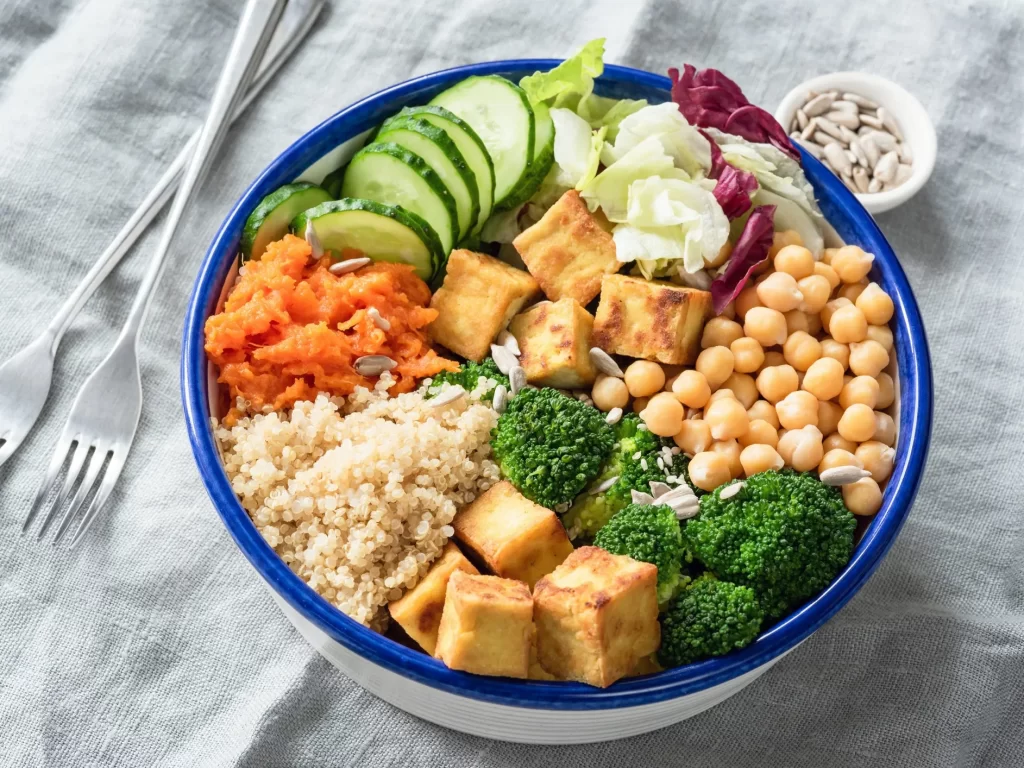
Achieving 1.6g of protein per kg of body weight from Indian food requires planning but is genuinely possible, especially with some strategic choices:
- Curd (dahi): 100g of full-fat curd provides 3.5g protein; Greek-style hung curd provides 8–10g
- Paneer: 100g provides 18g protein (also calorie-dense at ~260 kcal)
- Rajma / Chana / Dal: Cooked, provide 7–9g per 100g — excellent combined with other sources
- Eggs: 6–7g protein per egg, one of the most complete amino acid profiles available
- Chicken breast: 31g per 100g cooked — for non-vegetarians, the highest-return protein source
- Roasted chana (sattu): 22g per 100g — underutilised but excellent protein density
- Tofu: 8g per 100g — better than most people assume, especially firm varieties
- Soya chunks: 52g per 100g dry weight — the highest-protein plant food available in Indian kitchens
A realistic high-protein day for a 65 kg vegetarian Indian might look like: 4 eggs at breakfast (24g), 200g paneer at lunch (36g), 200g dal at dinner (18g), 100g hung curd as snack (10g), and a handful of roasted chana (11g) — totalling approximately 99g, close to the 1.6g/kg target. With some strategic additions like soya chunks or a quality protein supplement, the target becomes reliably achievable.
What InBody Progress Looks Like Over 3 Months of Home Training
Body recomposition is slower than pure weight loss or pure muscle gain, but the InBody metrics tell a clear story over time. Based on clinical outcomes from body composition testing programs across India, a typical motivated beginner following a progressive home training protocol with adequate protein can expect:
At 4 weeks: Minimal scale change, but InBody may already show a 0.3–0.5 kg increase in SMM and a 0.5–0.8 kg reduction in fat mass. The InBody Score typically improves by 3–5 points. This early data is highly motivating because the scale shows nothing while the body composition test shows real change.
At 8 weeks: SMM gain of 0.8–1.5 kg is common. Fat mass reduction of 1–2 kg if protein and mild caloric deficit are maintained. VFA may begin to show measurable reduction. PBF typically drops 2–3 percentage points. The ECW/TBW ratio tends to improve as metabolic health responds to training.
At 12 weeks: For most beginners, this is where the visual change becomes undeniable to others. SMM gains of 1.5–2.5 kg, fat loss of 2–4 kg, InBody Score in the 75–85 range if it started in the 60s. VFA reduction becomes clinically significant if it was elevated at baseline.
These outcomes are not guaranteed — individual response varies based on age, hormonal status, sleep quality, and dietary adherence. But they are what the data consistently shows for adherent beginners. The key word is “adherent” — progressive overload, adequate protein, and 8-week testing checkpoints.
Using InBody Testing as Your Progress Checkpoint
One of the structural challenges of home training is the absence of feedback systems that gyms sometimes provide. Without a personal trainer, a community, or visible progress benchmarks, many people abandon their home workout routines because they “don’t feel like anything is working.”
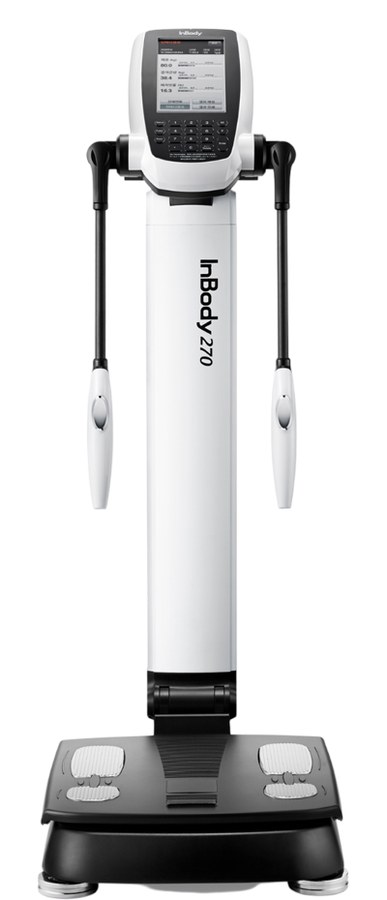
Body composition testing every 8 weeks solves this problem. An InBody test takes under two minutes and gives you the objective data to answer the most important question: Is my body actually changing?
If your SMM is rising and fat mass is falling, your protocol is working — continue and progress. If SMM is stagnant, the problem is usually protein intake or insufficient progressive overload — adjust accordingly. If fat mass is not falling, total caloric intake likely needs attention. The test does not lie, and it removes the guesswork that causes most home training programs to stall.
Start Measuring, Not Just Moving
Millions of Indians are working out at home right now — doing push-ups, yoga, cycling on stationary bikes, following YouTube routines. Most of them do not know whether their body composition is actually changing because they are measuring with a weighing scale that cannot tell the difference between muscle and fat.
A body composition test at your nearest InBody centre gives you the complete picture: your Skeletal Muscle Mass (SMM), Percent Body Fat (PBF), Visceral Fat Area (VFA), ECW/TBW ratio, and InBody Score. Test at the start of your home training program, and again every 8 weeks. Let the data drive your decisions, not the scale and not your reflection on a good or bad day.
Find your nearest InBody test centre at inbody.in/locations. Walk in, get tested in under two minutes, and walk out with the data that makes your home training program actually work.
Frequently Asked Questions
Can you build muscle and lose fat without a gym?
Yes — bodyweight training (push-ups, squats, lunges, planks) combined with resistance bands can build meaningful muscle and support fat loss when paired with adequate protein intake and progressive overload.
How do you progressively overload without weights?
By increasing reps, slowing down the tempo, reducing rest time, or moving to a harder exercise variation (e.g., regular to single-leg squats) — all of which increase difficulty without needing external weight.
How often should I retest my body composition during a home workout program?
Every 8 weeks is a practical interval to see meaningful, trackable changes in muscle mass and fat percentage without over-testing or getting discouraged by short-term fluctuations.

Most trending articles
Body Composition Testing ROI for Indian Gyms: The Real Case
Members quit because the scale stops moving. Where the return actually comes from, the 5 operational failures that kill it, and how to measure it honestly.
BMI Machine for Gym in India: What to Buy and What to Skip
BMI needs no machine at all. What Indian gym owners actually need is a body composition analyser — the spec that matters, and the one that wrecks trust.
शरीर दुबला-पतला क्यों होता है? असली कारण जो ज़्यादातर लोग नहीं जानते
पतला दिखना हेल्दी होने की गारंटी नहीं है। जानें शरीर दुबला-पतला होने के असली कारण, 'Skinny Fat' का साइंस, और सिर्फ खाना बढ़ाने की बजाय क्या करना चाहिए।