
Health 8 min read
How to Care for Aging Parents — The Muscle-Loss Test
"Amma is losing weight" is rarely good news. Sarcopenia kills Indian elderly silently. Here is what to watch for, what to measure, and what you can change in 90 days.
Reading about body composition? Find an InBody test centre near you →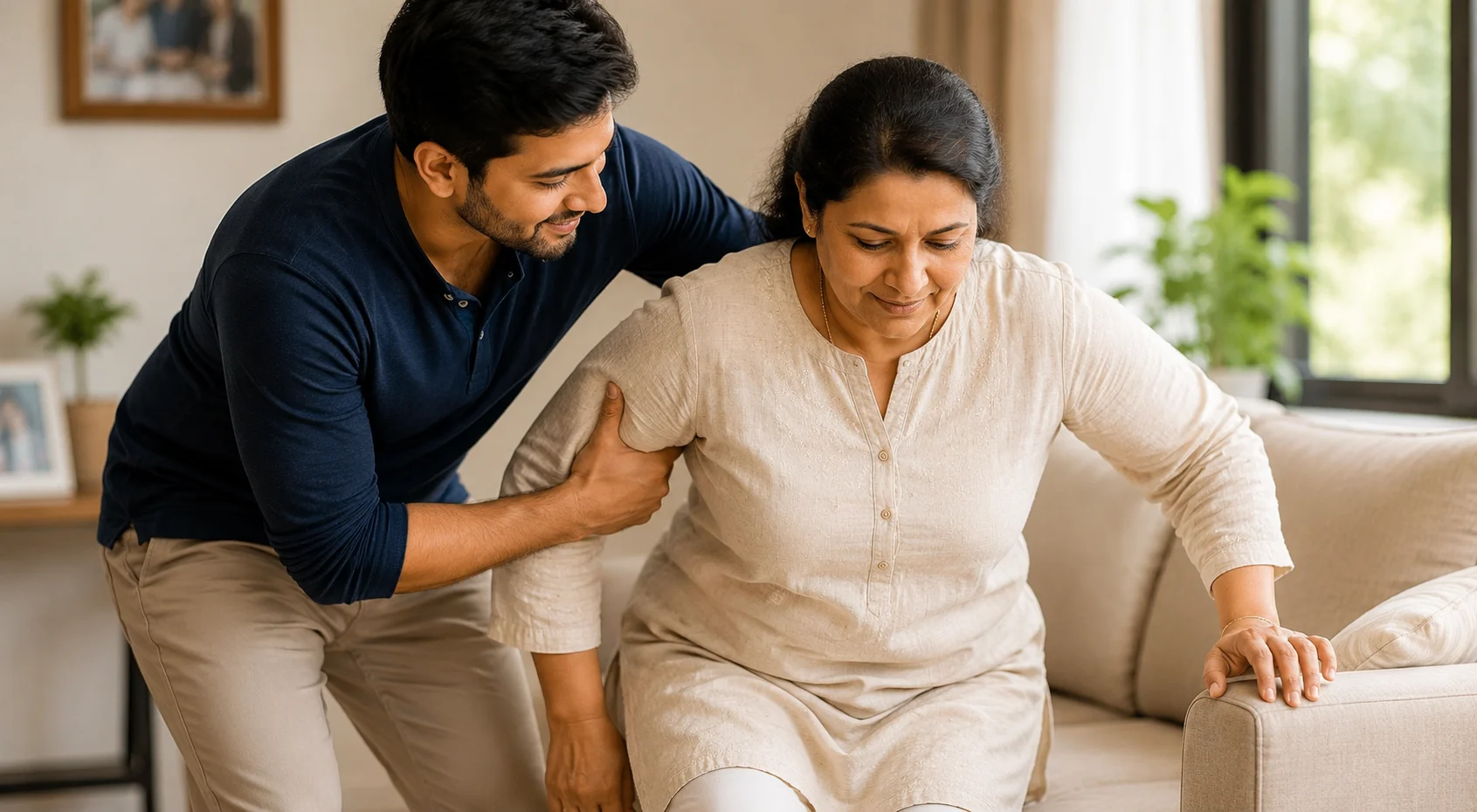
If you are reading this from Bangalore, worrying about your parents in Kolkata, or from California, worrying about your parents in Coimbatore, you are not alone. The single most common health-deterioration pattern in Indian elderly is one that most families completely miss: silent muscle loss. Your father has lost 4 kg in the last year and “looks weaker.” Your mother is eating less and feels tired all the time. These are not “just old age.” They are sarcopenia, and they are the most important thing to catch if you want your parents to live independently for another decade. Knowing how to care for aging parents in India starts with understanding why their muscles are disappearing and what to do about it.
Why “amma is losing weight” is rarely good news
In Indian family conversations, weight loss in elderly parents is often welcomed: “Mummy looks lighter, very good.” But after age 60, unintentional weight loss in an elderly person is rarely fat loss; it is muscle loss. And muscle loss has consequences that fat loss does not:
- Falls. Each 1 kg of leg muscle lost increases fall risk by roughly 10%. Hip fractures in Indian elderly have a 1-year mortality of about 25%.
- Slower recovery from any hospitalisation. Sarcopenic patients spend on average 60% longer in hospital after a surgery or pneumonia, and have higher readmission rates.
- Immune compromise. Skeletal muscle is a reservoir for amino acids the immune system uses to fight infection. Less muscle = weaker response to flu, dengue, COVID, urinary tract infections.
- Loss of independence. The threshold for “needs help with daily activities” is muscle-driven, not age-driven. Sarcopenia accelerates the transition from independent → assisted → dependent by 5–10 years.
“Amma is losing weight” is the symptom. Sarcopenia is the disease. And it is treatable — but only if it is identified, which most Indian elderly checkups never do.
Key Takeaways
- Unintentional weight loss in Indian elderly is almost always muscle loss, not fat loss.
- AWGS 2019 (Asian Working Group for Sarcopenia) has specific Asian cut-offs — Western thresholds underdiagnose Indian patients.
- Three home signs predict sarcopenia: grip weakness, slower walking speed, difficulty rising from a chair.
- Indian vegetarian elderly are at especially high risk due to chronic protein under-consumption.
- A 90-day intervention (protein + resistance + Vit D / B12) reverses early-stage sarcopenia in most Indian patients.
Sarcopenia — the muscle loss most Indian families miss

Sarcopenia is the age-related, progressive loss of skeletal muscle mass, strength and function. After age 50, the average adult loses 1–2% of muscle mass per year. By age 70, sedentary Indian adults have often lost 25–30% of their peak muscle mass. By 80, half.
The Indian elderly are unusually vulnerable to sarcopenia for three reasons:
1. The vegetarian protein gap. Most Indian elderly eat 0.6–0.8 g protein per kg body weight per day. The threshold for muscle maintenance after age 65 is 1.2 g/kg/day. Most are under-eating protein by 40%.
2. Vitamin D deficiency. Indian adults over 60 have a >70% deficiency rate (NIN Hyderabad data). Vitamin D is required for muscle protein synthesis. Deficient = your body cannot build new muscle even if you give it protein.
3. Cultural deconditioning. “Rest, beta. You are old.” Sit less, walk less, lift never. Bed-rest after even minor illnesses. This is the single most damaging cultural pattern for Indian elderly muscle.
Catch sarcopenia early and it is reversible. Catch it late and it cascades into frailty, falls, and dependency.
Three signs you can watch for at home
Before you book a clinical visit, the three home signs that predict sarcopenia in Indian elderly are:
- Grip weakness. Can your parent open a sealed pickle jar without help? If not, that is a measurable grip-strength deficit. (Clinical threshold for sarcopenia per AWGS 2019: men under 28 kg grip strength, women under 18 kg.)
- Slower walking. Time them walking a known distance — say, 6 metres from the front door to the gate. Under 1.0 m/s (so >6 seconds for 6 metres) is the AWGS slow-walking threshold for sarcopenia.
- Difficulty rising from a chair. Can they stand up from a regular dining chair without using their arms? Five times in a row, under 12 seconds? If not, that is functionally lower-body weakness — a major sarcopenia marker.
If your parent fails any one of these, get a body composition scan to confirm. If they fail two, escalate to a geriatrician.
AWGS 2019 — the Asian-specific sarcopenia criteria
This matters because the global standard for sarcopenia uses cut-offs derived from European/American populations. The Asian Working Group for Sarcopenia (AWGS) published Asia-specific thresholds in 2019, used at AIIMS, PGI, CMC Vellore, and the major Indian geriatric units:
| Criterion | Men | Women |
|---|---|---|
| Appendicular Skeletal Muscle Index (kg/m²) — by BIA | < 7.0 | < 5.7 |
| Grip strength (kg) | < 28 | < 18 |
| Gait speed (m/s) | < 1.0 | |
| 5-times Chair Stand (seconds) | > 12 | |
Diagnosis = low muscle mass plus either low grip OR low physical performance. Severe sarcopenia = all three.
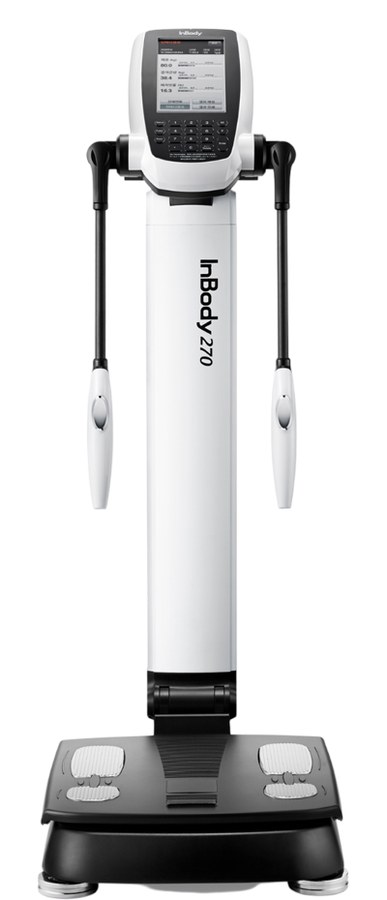
An InBody scan delivers the muscle-mass number in 15 seconds; the grip and gait tests take another 2 minutes. Together, this is a full AWGS workup, something the average Indian elderly health checkup completely skips. Find your nearest InBody test centre.
A typical case (illustrative)
Illustrative example — composite based on typical patient profiles.
A 32-year-old NRI in Boston, calling her brother in Pune: “Papa has lost weight, looks tired, says he is fine.” Father is 68, a retired bank manager, BMI 22, walks every morning, “no complaints.” Body composition scan at the family GP shows skeletal muscle index 6.5 kg/m² (sarcopenic by AWGS), grip strength 22 kg (sarcopenic), gait speed 0.85 m/s (slow). Father has dropped 3 kg in 18 months — all muscle. The intervention is not difficult: 1.3 g/kg protein per day (dal, paneer, eggs, occasional whey shake), vitamin D 60K IU weekly for 8 weeks, then maintenance, B12 monthly injection (he was at 180 — deficient), three days a week of light resistance work with a trainer who specialises in elderly clients. 90 days later: muscle mass up 1.1 kg, grip strength up to 27 kg, gait speed at 1.05 m/s. He is no longer sarcopenic. Twelve months later, he climbs the stairs at his daughter’s wedding without help. None of this would have been possible without identifying the muscle-loss number first.
What you can change in 90 days
If sarcopenia is caught at early or moderate stage, the 90-day reversal protocol that works in most Indian elderly patients:
Protein (the foundation). 1.2–1.4 g/kg body weight per day, split across 3 meals plus 1 snack. For a 65 kg patient: ~80 g/day. Indian vegetarian sources: dal (12 g per cup), paneer (28 g per 100 g), curd (4 g per 100 g), milk (8 g per cup), eggs (6 g each if non-veg), tofu (10 g per 100 g), soya chunks (15 g per ½ cup cooked). Most elderly need a 25 g whey or plant-protein supplement once a day to hit the threshold — talk to a dietitian.
Resistance training (the lever). Three sessions per week, 25 minutes each, with a trainer who knows elderly clients. Body-weight squats from a chair, wall push-ups, dumbbell rows, glute bridges, light dumbbell shoulder press. The goal is mechanical load on muscle, not cardio.
Vitamin D + B12 correction (the unlock). Get baseline labs. If Vit D < 30 ng/mL: 60,000 IU weekly × 8 weeks under medical supervision, then 1,000–2,000 IU daily maintenance. If B12 < 300 pg/mL: monthly injection or daily methylcobalamin under medical guidance. Without these, protein and exercise do not build muscle efficiently.
Re-scan at day 90. Track muscle mass, grip strength, and gait speed. Most patients show measurable improvement; those who don’t either need higher protein, longer correction time, or have an underlying issue (thyroid, kidney, malignancy screen) that should be ruled out.
Read also: Phase angle clinical reference guide for India.
Book a body composition scan for your parent
A 15-second scan + a 2-minute grip-and-walk test = full AWGS 2019 sarcopenia workup. Catch it early; reverse it; protect their independence for another decade.
Frequently asked questions
Q. My parents’ weight has dropped 4 kg in 6 months. Should I be worried?
Yes. Unintentional weight loss of more than 5% body weight in 6 months in an elderly person is a clinical red flag. The most likely explanations: sarcopenia (most common), undiagnosed depression, thyroid problem, gastrointestinal issue, or, in rare cases, malignancy screen-worthy. Get a body composition scan AND a basic blood panel; do not assume “it’s just age.”
Q. Is sarcopenia reversible in elderly Indians?
Early and moderate sarcopenia: yes, usually fully reversible within 6–12 months of the right intervention (protein + resistance + Vit D / B12 correction). Severe sarcopenia (especially with established frailty): partially reversible function improves, but full muscle restoration may not. The key is catching it before frailty sets in.
Q. Can my vegetarian parent get enough protein for muscle maintenance?
Yes, with effort. A traditional Indian vegetarian elderly diet typically delivers 35–55 g protein per day, well under the 80–90 g needed at age 65+. With deliberate addition of paneer, curd, milk, dal, soya, and one daily protein shake, the target is reachable. A registered dietitian can map this to your kitchen.
Q. Are body composition scans safe for elderly patients with pacemakers?
InBody devices use very low-current (microamp) bioimpedance measurements, which are generally considered safe for most pacemakers. Still, the manufacturer’s official guidance is to avoid use in patients with implanted electronic devices unless cleared by a cardiologist. Check with your parents’ cardiologist before scanning.
Q. What is the difference between sarcopenia and general “old age weakness”?
Sarcopenia is the specific, measurable loss of skeletal muscle mass and function — defined by AWGS 2019 cut-offs. “Old age weakness” is a vague description that often hides sarcopenia. The difference matters because sarcopenia has specific interventions; “old age” has none.
Q. Should I get my parent’s scan done at a clinic or buy a home device?
Both work. A clinic-grade scanner (InBody 270/380/770) at a hospital or premium gym is the medical reference used every 3 months. A home device (InBody Dial H40) gives weekly trend data between clinic visits. For elderly parents, the home option is useful because it removes the friction of getting them to the clinic each month.
