
women health 6 min read
PMOS explained — and why metabolism matters for Indian women
PCOS was renamed PMOS in 2026. For the 1 in 5 Indian women living with it, the shift from ovarian to metabolic framing changes what to measure, what to fix, and how fast it gets better.
Reading about body composition? Find an InBody test centre near you →
PMOS stands for Polyendocrine Metabolic Ovarian Syndrome, and for a condition that affects roughly 1 in 5 women of reproductive age in India, it remains poorly understood and badly diagnosed.
The average Indian woman with PMOS sees three or more health professionals and waits over two years before a clear diagnosis. Many never get one at all. They get prescribed birth-control pills for irregular cycles, told to “lose weight” without a body-composition baseline, and discharged.
Part of the problem was always the name. Despite being called Polycystic Ovary Syndrome, PCOS isn’t really about cysts — it’s a metabolic and hormonal condition that often, but not always, involves the ovaries. That’s why in May 2026, it was officially renamed PMOS — Polyendocrine Metabolic Ovarian Syndrome.
That shift in framing — from an ovarian condition to a metabolic one — is what changes thinking and approach. It’s also what makes PMOS unusually responsive to the things you can measure and change.
What is PMOS?
PMOS presents differently in different women. Three signals show up across the literature and our partner clinic data:
- Irregular or absent ovulation — cycles longer than 35 days, or fewer than eight cycles a year
- Elevated androgens — visible as adult acne, hirsutism (excess facial/body hair), or scalp hair thinning
- Polycystic ovarian morphology — 12+ follicles on each ovary on ultrasound, or an ovarian volume above 10 mL
The 2023 International Evidence-Based Guidelines require two of those three, with other causes ruled out (thyroid disorders, hyperprolactinaemia, late-onset CAH). The 2026 rename added a fourth optional axis: metabolic markers — fasting insulin, HbA1c, waist-to-height ratio, and visceral fat — reflecting decades of evidence that PMOS is driven by insulin resistance at its core.
Key Takeaways
- PCOS was renamed PMOS in May 2026 — the shift reframes it as a metabolic, not ovarian, condition
- Indian women have ~2× the prevalence and earlier onset than the global average
- Insulin resistance is the engine; visceral fat and muscle mass are the levers
- Body composition — not BMI — is the right thing to measure and track
Why does this hit Indian women harder?
Indian women carry a disproportionate share of the global PMOS burden, and the reasons are structural, not behavioural.
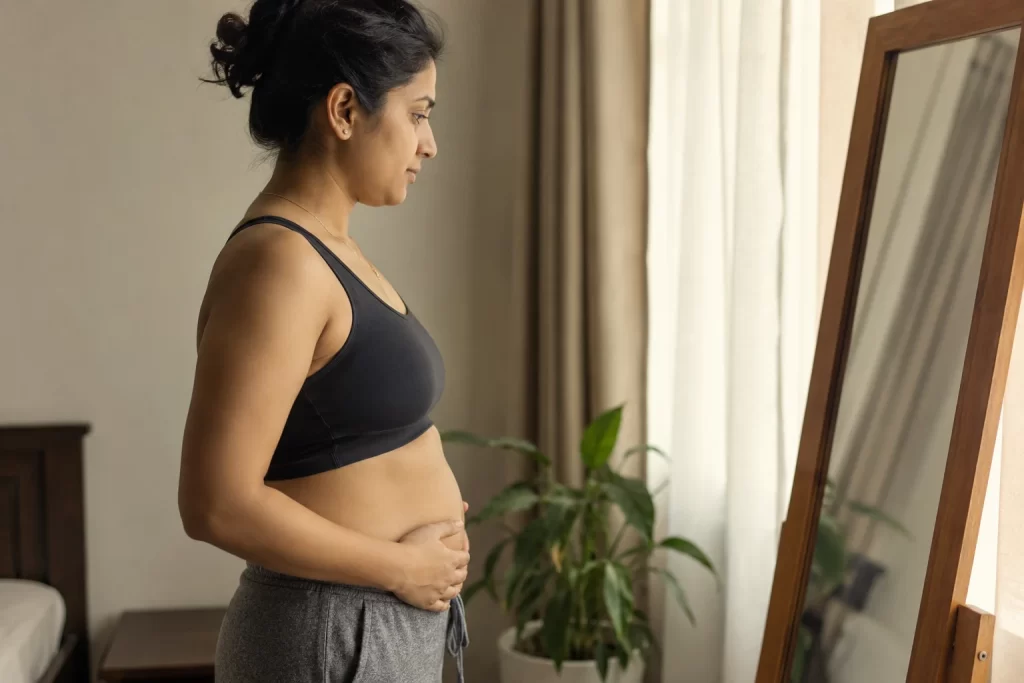
The South Asian phenotype documented across decades of research describes a body that stores more visceral fat (around the organs) at any given BMI than European or East Asian populations. An Indian woman at a “healthy” BMI of 23 can carry the visceral fat profile of a European woman at BMI 27. That extra metabolic fat is biologically active; it secretes inflammatory signals that drive insulin resistance and, in turn, androgen excess.
- 1 in 5 Indian women of reproductive age with PMOS
- 2.3× Higher prevalence than the global average
- 22 yrs Median age at first symptom in India
- 4.4× Lifetime diabetes risk vs. unaffected women
Layer onto that an everyday diet built around refined carbohydrates, white rice, parathas, biscuits, sweetened chai and a largely sedentary urban lifestyle, and you have an environment that converts a mild genetic predisposition into a clinical diagnosis. PMOS in India is, in this sense, a population-level metabolic problem wearing an ovarian costume.
PMOS in India is a population-level metabolic problem wearing an ovarian costume.
How it’s diagnosed
The Rotterdam criteria are still the global standard, but the 2026 PMOS update adds explicit metabolic screening. Your evaluation should include:
- Detailed cycle history — length, regularity, anovulatory months
- Clinical androgen assessment — Ferriman-Gallwey score, acne grading
- Biochemistry — total and free testosterone, DHEAS, SHBG, LH/FSH ratio
- Pelvic ultrasound (transvaginal where appropriate) for follicle count and ovarian volume
- Metabolic panel — fasting glucose, fasting insulin, HOMA-IR, HbA1c, lipid panel
- Body composition scan — visceral fat level, skeletal muscle mass index, body fat percentage, phase angle
- AMH if fertility is in the picture
The last two items were optional. The new framing treats them as central.
The metabolic engine
The mechanism is now well-mapped. Insulin resistance — cells responding poorly to insulin’s signal — pushes the pancreas to produce more insulin to compensate. Chronic hyperinsulinaemia does two things in the ovary: it stimulates androgen production directly, and it suppresses sex-hormone binding globulin (SHBG), which means more free testosterone is biologically active.
The result is the cascade most women with PMOS recognise: irregular ovulation, weight that sits stubbornly around the midsection, acne, hair changes, and a creeping rise in metabolic risk markers years before diabetes formally appears.
The good news in this mechanism: insulin resistance is highly responsive to two interventions — resistance training (which creates a muscular sink for blood glucose) and lower glycaemic-load eating. Most women see measurable improvement in fasting insulin within 8–12 weeks of consistent practice.
What you can actually measure
Here is where most PMOS care goes wrong in India today. The follow-up after a PMOS diagnosis is almost always a weight check on a bathroom scale — a tool that cannot distinguish a kilo of fat from a kilo of muscle, and is blind to where fat sits in the body.
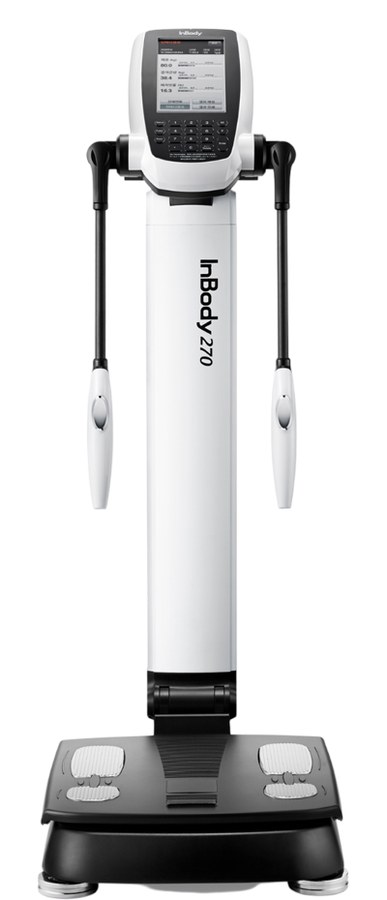
An InBody body composition scan takes 60 seconds and gives you the four numbers that actually move with treatment:
- Visceral fat area — the metabolically active fat around your organs. The number that should fall.
- Skeletal muscle mass index — your insulin sink. The number that should rise.
- Body fat percentage — together with muscle, the only honest read on body composition.
- Phase angle — a marker of cellular health and recovery that tracks with metabolic improvement.
Re-scan every 4–6 weeks. The bathroom scale may move very little. The composition will transform — and so will your cycles, energy, and blood markers.
Get a baseline body composition scan.
Walk into any of 1,400+ partner clinics, gyms, and hospitals across India. 60 seconds, no needles, full segmental report.
A 3-step protocol that works
Step 1 — Measure
Get the metabolic panel and the body composition scan. Without a baseline, you cannot tell whether anything is changing — and PMOS care that doesn’t track real numbers tends to drift into vague advice.
Step 2 — Lift
Resistance training, three sessions per week, compound movements (squat, hinge, push, pull, carry), progressively heavier. This is the single most impactful lever for insulin sensitivity in PMOS — more than cardio, more than steps, more than calorie restriction. Indian women remain dramatically under-represented in strength training; reversing that is therapeutic.
Step 3 — Eat for the glucose curve
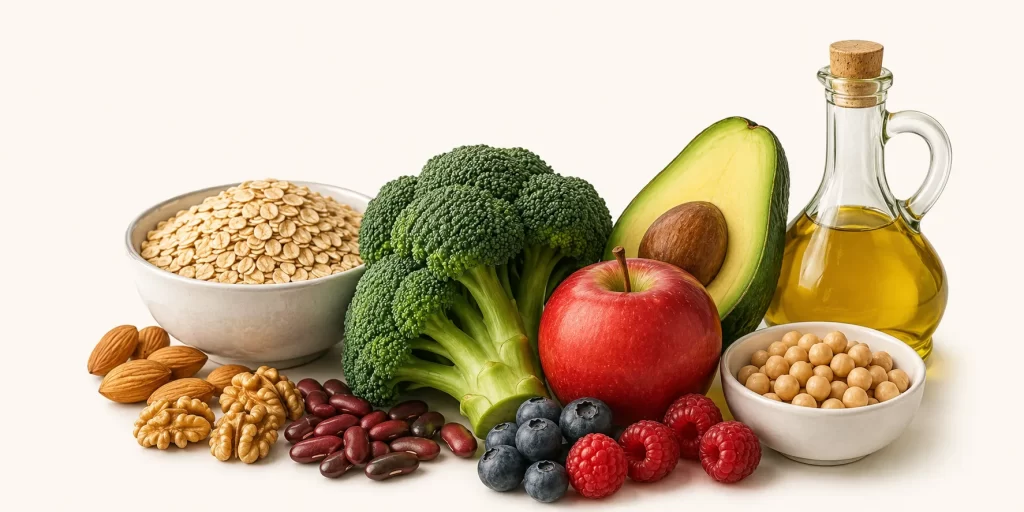
Anchor each meal around protein (1.4–1.6 g/kg of body weight daily), fibre, and slower carbohydrates. Most Indian women eat 0.6–0.8 g/kg protein, less than half of what their muscles need to grow. A 65 kg woman targeting recovery is looking at ~100 g protein/day, which works out to ~2 eggs, 150 g dal/legumes, 150 g paneer or chicken, and a whey scoop — not extreme, just intentional.
The long-term picture
Untreated PMOS carries a real long-term risk: type 2 diabetes (4.4× higher lifetime risk), endometrial hyperplasia, cardiovascular disease, and infertility. None of these is inevitable. In our partner clinic’s data tracking over 6,000 Indian women on consistent body-composition-led protocols across 2024–25, two-thirds saw HOMA-IR return to normal within six months, and cycle regularity was restored in roughly the same window.
The reframe to PMOS is not just a name change. It’s a public-health message: this is a metabolic condition that responds to metabolic interventions, and the numbers that matter live below the BMI line.
Conclusion
PMOS has long been a poorly understood condition that millions of Indian women have struggled to both manage and diagnose. Reframing it as a metabolic condition has the potential to shorten time to diagnosis and meaningfully improve the effectiveness of treatment — especially when paired with the body composition measurement infrastructure now widely available across India.
Start with a scan. Lift things. Eat enough protein. The cysts, the cycles, and the bloodwork tend to follow.
Reflects the 2023 International Evidence-Based PCOS Guidelines and the 2026 PMOS rename consensus. Educational, not a replacement for personalised assessment from your doctor or gynaecologist.

Most trending articles
Fertility Treatment & Body Composition: What Visceral Fat Research Means for IVF Outcomes in India [2026]
Real, published research links visceral fat—not just BMI—to fertility and IVF outcomes. A gentle, evidence-based guide for anyone navigating fertility treatment in India.
Anemia and Body Composition: Why 57% of Indian Women Struggle to Build Muscle Without Knowing Why
57% of Indian women are anaemic (NFHS-5). Discover how iron-deficiency anemia quietly stalls muscle growth and drains energy — and when to get tested.
Menopause and Body Composition: Why Indian Women Gain Visceral Fat After 45 — And How to Stop It
Menopause causes Indian women to gain 3–5kg of visceral fat in 2–3 years. Estrogen's role in fat distribution, muscle preservation, and metabolic rate — and the evidence-based protocol for body recomposition during perimenopause.