
Health 8 min read
Type 2 Diabetes & Body Composition (India 2026 Guide)
India has 101 million diabetics, and many are "thin." Body composition explains what BMI and HbA1c miss — and what to actually track for control and remission.
Reading about body composition? Find an InBody test centre near you →
India has the largest type 2 diabetes population on earth — 101 million adults, per the ICMR-INDIAB 2023 study. What is less talked about: a large share of these patients are not overweight on the standard BMI scale. They look fine. Their lab values say otherwise. Understanding the relationship between type 2 diabetes and body composition is what changes “managing diabetes” into something close to remission for many Indians.
Why do thin Indians get diabetes — the South Asian phenotype
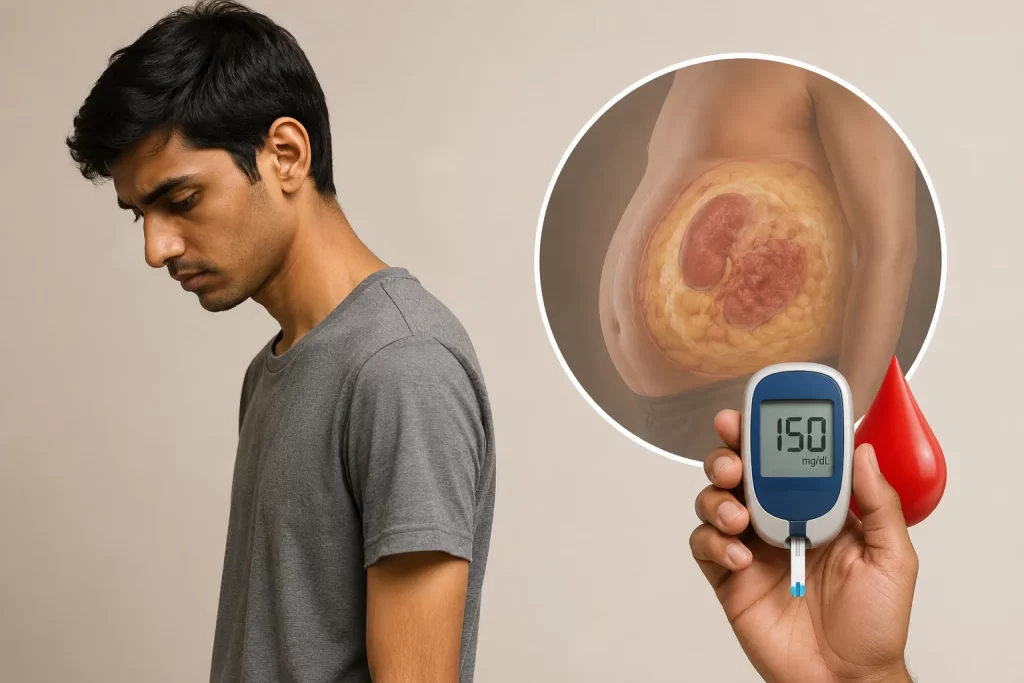
An Indian adult with a BMI of 23 carries the same diabetes risk as a Caucasian adult with a BMI of 27. This is not opinion — it is the basis of the World Health Organization’s Asia-specific BMI cut-offs, and it is why the Indian Council of Medical Research uses different thresholds for “normal weight,” “overweight,” and “obese” than American guidelines do.
The reason is a body composition pattern called the “South Asian phenotype” or “thin-fat Indian.” Compared to a Western adult of identical weight, the average South Asian has:
- 10–20% more visceral fat (the dangerous fat around the liver and pancreas)
- 15–20% less skeletal muscle mass per kg of body weight
- 3–4× the rate of fatty liver disease (NAFLD) at the same BMI
These three things together are what make insulin resistance — and eventually type 2 diabetes — show up at a much lower body weight in Indians than in Europeans. A weighing scale will completely miss this. A body composition scan will catch it years earlier.
Key Takeaways
- 1 in 11 Indian adults (≈101M) has type 2 diabetes — and many are “thin” on BMI alone.
- Visceral fat and skeletal muscle mass predict insulin sensitivity better than BMI or weight.
- Every 1 kg of skeletal muscle gained improves insulin sensitivity by ~3% — measurable, repeatable.
- Resistance training beats walking for HbA1c in clinical trials in Indian patients (the muscle-pump effect on glucose).
- Remission is possible for many Indians within 24 months if body composition is corrected — not just blood sugar.
The muscle-insulin link your doctor may not have explained
Skeletal muscle is the largest insulin-sensitive tissue in the human body. Roughly 80% of the glucose your body removes from the blood after a meal is taken up by skeletal muscle. Less muscle, less glucose disposal capacity, higher post-meal blood sugar.
This relationship is biologically simple and dramatic. Studies in Indian patients show that for every 1 kg increase in appendicular skeletal muscle mass (arms + legs), insulin sensitivity improves by about 3%, and HbA1c drops by an average of 0.1–0.15 points. Stack 4 kg of muscle on a sarcopenic Indian diabetic and you are looking at a potential HbA1c drop of 0.4–0.6 — comparable to adding a medication.
This is also why “I walk for an hour every day and my sugars are still high” is such a common Indian patient complaint. Walking burns calories. It does not build skeletal muscle. The glucose-disposal infrastructure is muscle, and you build muscle by lifting things, not by walking.
What body composition adds that HbA1c alone misses
HbA1c is an excellent measure of where your blood sugar has averaged over the past 90 days. It is a result. It does not tell you why the result is what it is, or what to change to make it better.
A body composition scan adds four pieces of information HbA1c cannot:
- Skeletal muscle mass (kg). The infrastructure for glucose disposal.
- Visceral fat level (1–20). The hormonal source of insulin resistance.
- Skeletal muscle index (SMI, kg/m²). Whether muscle relative to height meets the AWGS 2019 Asian sarcopenia threshold.
- Phase angle. A whole-body cellular health number that predicts complication risk and recovery capacity.
Two patients can have the same HbA1c of 7.5 — one with healthy muscle and low visceral fat (good prognosis, often reversible), one with low muscle and high visceral fat (high complication risk, much harder to manage). The first patient needs a 6-month strength-training programme. The second needs the same programme plus hepatologist input on NAFLD. Same blood marker; completely different action plan.
The 4 body composition numbers every Indian diabetic should know
- Skeletal Muscle Mass (kg). Track every 3 months. Going up = winning, even if HbA1c moves slowly.
- Visceral Fat Level (1–20). Target: under level 10. Most newly diagnosed Indian diabetics sit at 12–16.
- Body Fat % (with Asian thresholds). Healthy range: men <22%, women <30%. Important: many Indian diabetics are “obese” on body-fat-% scales even with normal BMI.
- Skeletal Muscle Index (SMI). AWGS 2019 Asian sarcopenia cut-off: men <7.0 kg/m², women <5.7 kg/m². Diabetics below the cut-off have 3× the complication risk of those above.
A typical case (illustrative)
Illustrative example — composite based on typical patient profiles.
A 47-year-old in Hyderabad. HbA1c 7.2 at diagnosis, dropped to 6.8 with medication. His endocrinologist adds InBody scanning to follow-ups. After 8 months of twice-weekly resistance training plus a protein-corrected Indian diet (an extra 20–25 g protein per day, no carb crash, two strength sessions a week), his skeletal muscle mass is up 1.8 kg, visceral fat is down 4 points, and HbA1c is at 5.9. He is off one of his two medications. The blood markers improved because the body composition improved — not the other way around. This sequence is replicable in many Indian type 2 diabetics whose disease was caught before significant beta-cell loss.
Where strength training fits — and why walking isn’t enough

Walking is good for cardiovascular fitness, mood, sleep, and modest calorie burn. Walking is not a glucose-control intervention in the way most Indians use it (60-minute steady-state walks). The reason: glucose uptake into muscle depends on muscle contraction intensity as well as duration. Resistance training (sets of 8–15 repetitions at meaningful loads) triggers GLUT4 translocation in muscle cells — the glucose-pump mechanism — for 24–48 hours after the session. Walking does not.
For Indian type 2 diabetics, the dosage that holds up in trials is: 2 sessions per week, 25–35 minutes per session, 6–8 compound movements (squat, hinge, push, pull, carry). That is roughly 70 minutes per week of resistance work, plus whatever walking or yoga you already do for the rest.
If you have never lifted anything in your life, start with body-weight squats, wall push-ups, and dumbbell rows. If you have access to a gym, ask the trainer for a “diabetic-focused strength programme” — most decent trainers in metro India now know this protocol. A clinic-grade scan once every 3 months gives you the feedback loop. Find your nearest InBody test centre.
What this looks like over 12 months
For a newly diagnosed Indian type 2 diabetic who commits to body-composition-led management:
- Month 3: First measurable changes — visceral fat down 1–2 points, muscle mass holding (not dropping).
- Month 6: SMM up 0.8–1.2 kg, visceral fat down 3–4 points, HbA1c down 0.5–0.8.
- Month 9: Phase angle improving. Some patients reducing medication under their physician’s supervision.
- Month 12: Many patients in glycaemic remission (HbA1c <6.5 off medication) if caught early. Even those who still need medication are on lower doses with fewer side effects.
This trajectory is the rule, not the exception, when body composition is treated as the primary intervention and blood sugar is treated as the result. It does not work for everyone — patients with long-standing beta-cell loss have a different ceiling — but for the millions of Indians diagnosed in the last 5 years, this is the more useful frame than “stay on Metformin and walk more.”
Read more: Metabolic syndrome in India — causes, diagnosis, reverse.
Find your nearest InBody test centre
A 15-second scan shows your skeletal muscle mass, visceral fat level, body fat %, and phase angle — the four numbers that matter most for type 2 diabetes management.
Frequently asked questions
Q. Can type 2 diabetes really be reversed by improving body composition?
For Indian patients diagnosed within the last 5 years and not yet on insulin, “glycaemic remission” (HbA1c under 6.5 off medication) is achievable for a meaningful share — single-digit to mid-teens percentage in real-world Indian clinic data. The intervention pattern: ≥6 kg fat loss (especially visceral), ≥2 kg muscle gain, sustained for 12+ months. It is not magic; it is mechanism.
Q. What if my BMI is “normal” but I still have type 2 diabetes?
Very common in India — the “thin-fat diabetic” phenotype. Your BMI is fine but your visceral fat is high and your muscle mass is low. The body composition scan reveals this in under a minute. The treatment is the same as for an “obese” diabetic — strength training + protein-corrected diet — but the scale will not show your progress, which is why a scan-based feedback loop matters more for thin-fat diabetics than for anyone else.
Q. How often should I do a body composition scan if I have type 2 diabetes?
Every 3 months is the right cadence for most patients — it matches the HbA1c retest interval. More frequently than that and you are picking up noise; less frequently and you cannot tell whether your changes are working in time to adjust. Some Indian endocrinologists now include the scan automatically in quarterly follow-up.
Q. Is resistance training safe if I have diabetic neuropathy or retinopathy?
Yes, with conditions. Neuropathy: avoid heavy loading on feet (deadlifts, heavy squats) — use machines and seated work instead. Retinopathy: avoid Valsalva (breath-holding) and explosive efforts — use moderate loads with controlled tempo. Check with your endocrinologist and an exercise physiologist familiar with diabetic complications before starting. Safe protocols exist for almost every situation.
Q. What protein intake should an Indian type 2 diabetic aim for?
1.2–1.6 g/kg body weight per day, split across 3–4 meals. For a 70 kg patient that is 85–110 g/day. Indian vegetarian sources: dal, paneer, curd, eggs (if not pure-veg), tofu, sprouts, soya chunks. Most newly diagnosed Indian diabetics eat 35–50 g/day on traditional rotation menus — well below the threshold for muscle building. A registered dietitian can map this to your kitchen.
Q. Can I track this at home, or do I need a clinic scan?
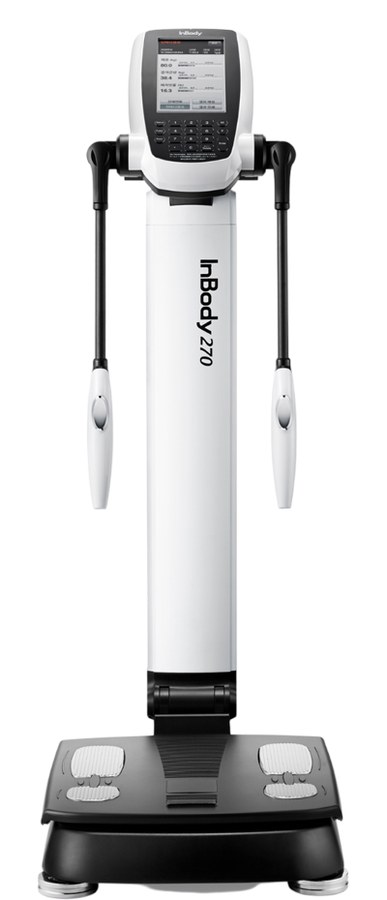
Both work; they answer different questions. A clinic-grade scanner (InBody 270/380/770) at a hospital or premium gym is the medical-grade reference — use it every 3 months. A home device (like InBody Dial H40) gives you weekly trend data between clinic visits, useful for spotting trajectory changes early. The home device is not a replacement for the clinical scan; it is a feedback layer between them.
