
Body Composition 7 min read
BCA vs BMI: Which Test Tells the Truth About Your Health?
In the world of fitness and health, knowing one’s physical constitution is becoming more important. Two methods widely used to evaluate a person’s condition are Body Mass Index (BMI)…
Reading about body composition? Find an InBody test centre near you →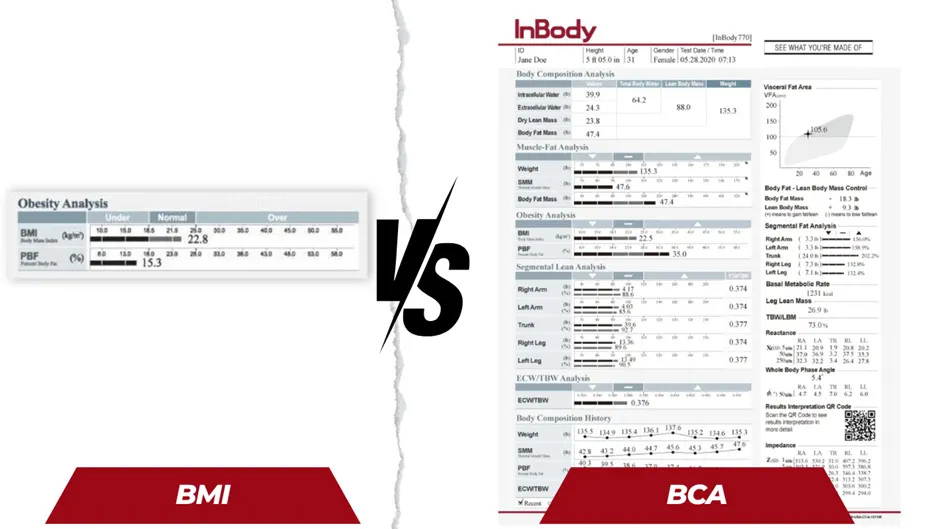
In the world of fitness and health, knowing one’s physical constitution is becoming more important. Two methods widely used to evaluate a person’s condition are Body Mass Index (BMI) and body composition analysis. While the BMI machine has been a long-standing standard measurement, body composition analysis provides an in-depth and individualized analysis, making it an excellent tool for evaluating general health and risk factors.
BMI, a measure based on an individual’s height and weight, has been the preferred way to find out whether people are underweight, normal weight, overweight or obese. However, the metric’s simple approach doesn’t consider vital factors that may profoundly affect the overall fitness and health of an individual.
One of the biggest problems with BMI is the inability to distinguish between the fat mass and the lean muscle mass. This means that people who have a large proportion of muscle, for instance, people who do regular strength training, could be mistakenly classified as overweight or obese based only on their BMI despite having a low percentage of body fat and an excellent fitness level overall. On the other hand, those with a significant percentage of body fat but comparatively less muscle mass could fall within the “normal” BMI range, hiding the health risks that are associated with fat accumulation. Pooled data suggest that standard BMI cut-offs for obesity miss about half of the people who have excess body fat.[1][2]
In addition, BMI does not consider the distribution of body fat, an aspect that has been associated with multiple health hazards. Research shows that people who carry excess abdominal fat, particularly visceral fat (the fat around the internal organs), have a greater chance of developing diseases such as heart disease and type 2 diabetes than people who store fat in other parts of the body, like the thighs or hips.[3][4][5] This information isn’t captured by a BMI calculation.
The analysis of body composition, on the contrary, gives a more detailed evaluation of a person’s physical makeup. This technique estimates the proportions of fat mass, lean muscle mass, and bone mass in the body, and provides valuable information about health risks and fitness levels.
One of the major benefits of body composition analysis is its ability to distinguish more precisely between fat mass and lean muscle. This is vital for people who do regular strength training or play sports that require substantial muscular development. If they know how their bodies are built, they can make sure they are gaining muscle while keeping body fat at a healthy level, something BMI alone cannot show.
In addition, body composition analysis may identify people who are categorized as “normal weight” by BMI but have a higher percentage of body fat, a condition known as “normal-weight obesity.” They could be at higher risk of health issues like heart disease and metabolic disorders despite having a “normal” BMI.[6] Without a body composition assessment and risk assessment, these health issues may not be found, which can lead to a false feeling of security and insufficient prevention steps. For example, among 2,404 adults with type 2 diabetes in Taiwan who were measured with an InBody 770, 71.5% were obese by body-fat percentage compared with 32.4% by BMI.[7]
If you’re looking to shed weight or increase your fitness levels, body composition analysis is a useful tool. By seeing changes in body composition over time, you can track your progress and check that you are losing fat while maintaining or even increasing your lean muscle mass. Weight loss through diet alone usually reduces muscle mass as well, which exercise and adequate protein can help limit.[8] This approach helps support sustainable and healthy weight loss while maintaining a healthy body composition, which is important to overall health and well-being.
Furthermore, analysing body composition can offer valuable insight into the management of specific health conditions. For those with age-related muscle loss (sarcopenia) or muscle loss associated with chronic illness, monitoring body composition may help healthcare professionals tailor interventions to maintain or increase lean muscle mass, which is vital for overall health, functional independence and quality of life.[9]
While body composition analysis can provide more complete information about the state of health, it is important to keep in mind that it should not be considered a full substitute for BMI. Instead, both measurements can be used together, with BMI as an overall screening tool[10] and body composition assessment giving a more detailed and personalised picture.
For those who want more information about their overall health and risks, body composition analysis is a useful addition. By analysing the relative proportions of fat mass, lean muscle mass and bone mass, body composition analysis can help identify the health risks associated with excess body fat or low muscle mass, which helps individuals work toward their fitness targets and supports the management of health conditions in a more targeted way.
It is vital to talk with licensed medical experts or certified fitness specialists who can accurately interpret the data on body composition and provide specific recommendations based on the individual’s specific situation, goals and conditions. They can help develop customized strategies to tackle problems and enhance overall health and well-being.
Conclusion
Although BMI is a well-established method of assessing weight, its weaknesses are becoming clearer due to advances in fitness and health research. Body composition analysis provides a more detailed evaluation of a person’s health by estimating the distribution of muscle and fat mass throughout the body. Through this approach, people and health professionals can make more informed choices about overall health, fitness, and the management of diseases, which may lead to better outcomes and quality of life. In our search for the best health and well-being, it is worth appreciating body composition analysis as an effective tool to help build a healthier, more robust, and more durable future.

Find an InBody Scanner Near You
Know Your Numbers
Stop guessing. Measure it.
An InBody scan tells you exactly how much fat, muscle and water your body carries in 60 seconds. Used by 1,500+ hospitals and gyms across India.
Related: Body Fat Percentage — Normal Ranges for Indians | Compare InBody Models | Find an InBody Test Centre Near You
References
- Okorodudu DO, Jumean MF, Montori VM, Romero-Corral A, Somers VK, Erwin PJ, et al. Diagnostic performance of body mass index to identify obesity as defined by body adiposity: a systematic review and meta-analysis. Int J Obes (Lond). 2010;34(5):791-799. PubMed · DOI
- Romero-Corral A, Somers VK, Sierra-Johnson J, Thomas RJ, Collazo-Clavell ML, Korinek J, et al. Accuracy of body mass index in diagnosing obesity in the adult general population. Int J Obes (Lond). 2008;32(6):959-966. PubMed · DOI
- Karpe F, Pinnick KE. Biology of upper-body and lower-body adipose tissue: link to whole-body phenotypes. Nat Rev Endocrinol. 2015;11(2):90-100. PubMed · DOI
- Neeland IJ, Ross R, Després JP, Matsuzawa Y, Yamashita S, Shai I, et al. Visceral and ectopic fat, atherosclerosis, and cardiometabolic disease: a position statement. Lancet Diabetes Endocrinol. 2019;7(9):715-725. PubMed · DOI
- Gupta P, Lanca C, Gan ATL, Soh P, Thakur S, Tao Y, et al. The Association between Body Composition using Dual energy X-ray Absorptiometry and Type-2 Diabetes: A Systematic Review and Meta-Analysis of Observational studies. Sci Rep. 2019;9:12634. PubMed · DOI
- Romero-Corral A, Somers VK, Sierra-Johnson J, Korenfeld Y, Boarin S, Korinek J, et al. Normal weight obesity: a risk factor for cardiometabolic dysregulation and cardiovascular mortality. Eur Heart J. 2010;31(6):737-746. PubMed · DOI
- Lin CL, Yu NC, Wu HC, Lee YY, Lin WC, Chiu IY, et al. Association of Body Composition with Type 2 Diabetes: A Retrospective Chart Review Study. Int J Environ Res Public Health. 2021;18(9):4421. PubMed · DOI
- Cava E, Yeat NC, Mittendorfer B. Preserving Healthy Muscle during Weight Loss. Adv Nutr. 2017;8(3):511-519. PubMed · DOI
- Cruz-Jentoft AJ, Bahat G, Bauer J, Boirie Y, Bruyère O, Cederholm T, et al. Sarcopenia: revised European consensus on definition and diagnosis. Age Ageing. 2019;48(1):16-31. PubMed · DOI
- Centers for Disease Control and Prevention. Adult BMI Categories (describes BMI as a screening tool to be considered alongside other health factors). CDC page (accessed 1 October 2026)

Most trending articles
Student Fitness Screening in India: A Guide for Schools
CBSE HPE, Fit India and Khelo India rely on BMI. How schools and colleges can add body composition screening safely, with child caveats and DPDP consent.
Creatine and Your Body Composition Scan: What Changes
Creatine raises body water and lean mass readings within a week on BIA and DXA. What the studies show and how to time your scans to read progress honestly.
Fitness Testing and Body Composition for Sports Academies
A practical fitness testing battery for Indian sports academies: body composition, grip, jumps, sprints, Yo-Yo, Khelo India context and youth maturation.