
Fitness 13 min read
Intermittent Fasting in India: What Body Composition Testing Actually Reveals About 16:8
Millions of Indians are doing 16:8 intermittent fasting. But is it preserving muscle or burning it? Body composition data reveals who IF works for, who it backfires on, and how to protect your muscle while fasting.
Reading about body composition? Find an InBody test centre near you →
Intermittent Fasting Is Everywhere in India — But Are You Actually Losing Fat or Just Weight?
Walk into any gym, office cafeteria, or WhatsApp group in urban India and you will find someone doing intermittent fasting. The 16:8 protocol — eating within an 8-hour window, fasting for 16 — has become the dominant diet strategy of the last five years, replacing calorie counting as the go-to approach for Indians trying to lose weight. Apps like Zero and HealthifyMe report millions of Indian users tracking fasting windows. Fitness influencers on Instagram swear by it. Nutritionists recommend it. CEOs credit it for their transformation.
And yet, clinical body composition data tells a more complicated story.
When Indians undergo InBody analysis before and after a sustained period of intermittent fasting, the results are frequently surprising — and not always in the way people hope. Many lose weight on the scale. Fewer lose fat in the visceral compartment where it matters most. A significant subset lose something they cannot afford to lose: skeletal muscle mass.
This article breaks down what body composition testing actually reveals about intermittent fasting in the Indian context — and why that context changes everything.
India Has a Head Start: Traditional Fasting Is Already in Our Culture
One reason intermittent fasting has gained such rapid traction in India is that it does not feel foreign. Indians have been practicing structured periods of abstinence from food for millennia. Ekadashi fasting — observed twice a month on the 11th lunar day — is practiced by tens of millions of Hindus. Navratri, observed twice a year, involves 9-day fasting cycles. Ramadan sees over 200 million Indian Muslims abstaining from food and water from sunrise to sunset, which in Indian summers can mean 14–16-hour fasts. Karva Chauth, Mahashivratri, Solah Somvar — the list of fasting traditions is long and deeply embedded in daily life.
What the modern intermittent fasting movement has done is reframe this cultural practice through a metabolic lens, giving people a scientific framework to understand what their bodies are doing during these windows. That reframing is genuinely useful. But it has also created a false sense of familiarity: the assumption that because we have always fasted, we automatically know how to fast for body recomposition. That assumption is where problems begin.
The South Asian Paradox: Why Indian Bodies Respond Differently to Caloric Restriction

To understand why intermittent fasting produces different outcomes in Indians, you need to understand the South Asian paradox — sometimes called the thin-fat phenotype. Research published in journals including Diabetologia, The Lancet, and Diabetes Care has consistently shown that South Asians carry more body fat at lower BMI compared to European populations. An Indian man with a BMI of 23 — classified as “normal” — may carry visceral fat levels and metabolic risk equivalent to a European man at BMI 27.
The CARRS study, which tracked cardiometabolic risk across India and Pakistan, found that urban Indian adults had alarmingly high rates of metabolic syndrome even at moderate weights. Data from the NFHS-5 (National Family Health Survey 2019-21) shows that 24% of Indian women and 22.9% of Indian men are overweight or obese by BMI — but body fat percentage studies suggest the true proportion of Indians with excess fat mass is considerably higher.
The flip side of the thin-fat phenotype is equally important: many Indians have lower absolute Skeletal Muscle Mass (SMM) than their weight or BMI would suggest. This is not simply about being thin. It reflects decades of dietary patterns — high carbohydrate intake, low protein intake, and historically low resistance exercise engagement — that have resulted in a population that is simultaneously fat-overstored and muscle-understored.
This is the body that intermittent fasting interacts with. And the interaction is not always favorable.
What the Scale Shows vs. What Body Composition Testing Reveals
The most important insight body composition analysis provides in the context of intermittent fasting is the distinction between weight loss and fat loss — two phenomena the scale cannot separate.
When someone begins a 16:8 protocol, they typically lose weight within the first two to three weeks. This weight loss is real, but it is compositionally mixed. It includes:
- Glycogen depletion (each gram of glycogen is stored with approximately 3 grams of water)
- Reduction in gut contents from reduced meal frequency
- Genuine fat oxidation, including some reduction in visceral fat
- In many cases, particularly when protein intake is insufficient, a measurable reduction in lean body mass including skeletal muscle
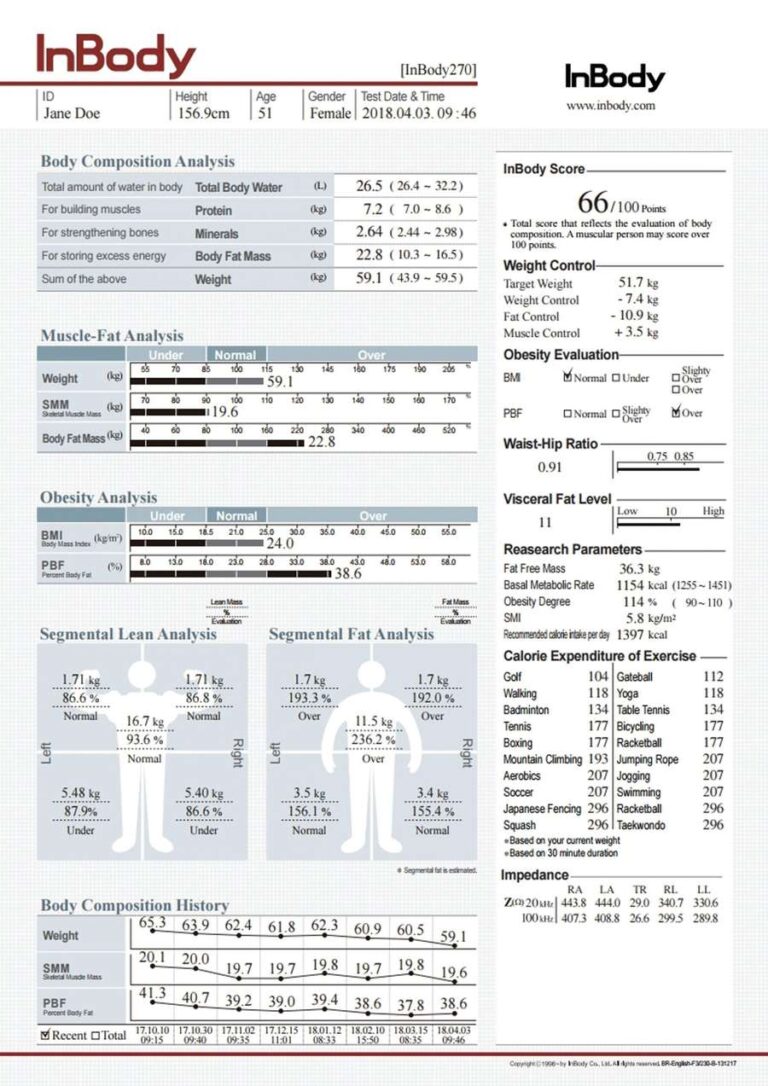
An InBody scan captures all of these compartments separately. The key metrics are Skeletal Muscle Mass (SMM), Percent Body Fat (PBF), Visceral Fat Area (VFA), and body water distribution as reflected in the ECW/TBW (Extracellular Water to Total Body Water) ratio. A scan that shows a 3kg weight reduction with preserved SMM and reduced PBF is a very different outcome from a 3kg reduction where 1.5kg came from muscle — even though the scale reads identically.
In clinical practice across Indian InBody assessment centers, a common pattern in individuals who fast without adequate protein is a phenomenon called “skinny fat progression”: weight goes down, but PBF percentage either stays flat or increases because the denominator (body weight) falls faster than the fat mass. The person looks leaner, feels lighter, and believes the diet is working — while their metabolic health may actually be worsening.
16:8 vs. OMAD: The Muscle Mass Equation
Not all intermittent fasting protocols carry equal risk for muscle loss. The 16:8 protocol — fasting from, say, 8pm to 12pm the next day, then eating from 12pm to 8pm — allows for two or three reasonably sized meals. In principle, this window is sufficient to hit protein targets if a person is intentional about it.
OMAD (One Meal A Day) is a different matter. Compressing all food intake into a single sitting makes it physiologically difficult to consume adequate protein — the human gut has limits on how much protein it can digest and absorb in a single meal, with research suggesting that protein synthesis stimulation plateaus somewhere above 40–50 grams per sitting for most individuals. An OMAD practitioner eating a single 700-calorie Indian meal — a common pattern seen in female OMAD adherents in India — may consume only 20–30 grams of protein in that meal, leaving the body in a chronically muscle-catabolic state over weeks and months.
Serial InBody scans on OMAD practitioners who do not track protein consistently show declining SMM readings over 8–12 week periods, even as their VFA and PBF trend downward. This is the classic “weight loss at any cost” trajectory, and it is metabolically counterproductive: muscle is the primary driver of resting metabolic rate. Less muscle means a slower metabolism, making long-term weight maintenance harder.
The Protein Crisis Hidden Inside Indian Intermittent Fasting
Here is a statistic that should change how every Indian thinks about their eating window: data from ICMR-NIN (Indian Council of Medical Research – National Institute of Nutrition) nutritional surveys indicate that average protein intake among Indian adults is approximately 47 grams per day — well below the recommended 0.8–1g per kg of body weight, and dramatically below the 1.2–1.6g per kg that sports nutritionists recommend for active individuals trying to preserve or build muscle during a caloric deficit.
For a 65kg Indian adult, even the conservative RDA suggests 52 grams of protein per day. The active recommendation is 78–104 grams. Most Indians consuming traditional diets are not close to either figure.
Intermittent fasting compounds this problem by reducing meal frequency. If you were previously eating 47 grams of protein across three meals and two snacks, and you now compress that into a 6–8 hour window while total food intake drops due to appetite suppression (a known effect of IF), your protein intake may fall to 30–35 grams. At this level, muscle catabolism during the fasting state is not just likely — it is nearly certain over the medium term.
This is particularly acute for vegetarian Indians. The majority of India’s population is either vegetarian or low-meat consumers. Vegetarian protein sources — dal, paneer, curd, legumes — are nutritionally excellent but require deliberate effort to scale up to meaningful quantities. Two rotis with dal provide perhaps 12–15 grams of protein. A bowl of curd adds another 5–7 grams. Getting to 80 grams of protein from a vegetarian eating window requires systematic planning that most casual IF practitioners are not doing.
The consequence, visible in body composition data, is that vegetarian Indian IF practitioners frequently show accelerated lean mass loss compared to non-vegetarians doing the same protocol — not because vegetarianism is inherently inferior for muscle preservation, but because vegetarian practitioners are less likely to actively optimize their protein intake within a shortened eating window.
When Intermittent Fasting Works: The Body Composition Profile That Responds Best
The clinical picture is not uniformly negative. For a specific body composition profile, intermittent fasting is remarkably effective — and the InBody metrics that predict a good response are identifiable before a person even begins the protocol.
The ideal IF candidate, from a body composition standpoint, looks like this:
- High PBF relative to weight — typically above 28% for women, above 22% for men in Indian reference ranges
- Elevated VFA — a Visceral Fat Area above 100 cm² (InBody threshold for high visceral fat risk)
- Adequate SMM — muscle mass in the normal-to-high range for their height and frame
- Normal or low ECW/TBW ratio — indicating good cellular hydration without chronic inflammation or fluid retention
In this profile, the body has abundant fuel stored in fat tissue, adequate metabolic muscle to sustain resting energy expenditure, and the hormonal architecture to successfully shift to fat oxidation during fasting periods. These individuals consistently show meaningful VFA reduction and PBF decline over 8–12 weeks of 16:8, with preserved SMM — provided protein intake is adequate.
Research published in Cell Metabolism (Sutton et al., 2018) showed that early time-restricted feeding improved insulin sensitivity independent of weight loss in men with prediabetes. For Indians — who have among the world’s highest rates of insulin resistance and type 2 diabetes — this metabolic benefit is particularly significant. India has approximately 101 million people with diabetes and 136 million with prediabetes as of 2023 estimates. IF’s insulin-sensitizing mechanism, which operates partly through enhanced insulin receptor signaling during the fasting window, is directly relevant to this population.
When Intermittent Fasting Backfires: Red Flags in the Data
The profile where IF consistently underperforms — and where body composition data tells a cautionary story — is the already-lean-but-high-fat Indian who is also low in muscle. This is the thin-fat phenotype in its most metabolically vulnerable form:
- BMI in the 21–24 range (appears “normal”)
- PBF above 28% (hidden excess fat)
- SMM below age-matched reference ranges (insufficient muscle)
- VFA elevated (visceral fat disproportionate to total weight)
When this individual enters a 16:8 protocol without resistance training and without deliberate protein loading, the fasting window pulls energy from the most available source: muscle tissue. Over 12 weeks, sequential InBody scans may show SMM dropping by 1–2kg while PBF changes minimally. The person has become lighter but metabolically worse — lower muscle mass means lower insulin-mediated glucose disposal, meaning their blood sugar regulation has actually deteriorated.
This is not a theoretical risk. It is a pattern seen repeatedly in body composition assessments of Indians who have done 3–6 months of IF without strength training or protein optimization.
VFA Reduction: The Most Clinically Meaningful IF Outcome
Among all the body composition changes measurable with InBody, Visceral Fat Area (VFA) reduction during intermittent fasting carries the most clinical weight. Visceral fat — fat stored around the abdominal organs including the liver, pancreas, and intestines — is metabolically active tissue. It secretes inflammatory cytokines, contributes to insulin resistance, and is directly associated with cardiovascular disease risk, non-alcoholic fatty liver disease (NAFLD), and type 2 diabetes.
Indians are disproportionately affected by visceral fat accumulation. Studies comparing Indian and European adults at matched BMI levels consistently find higher VFA in Indian cohorts. This is partly genetic, partly related to dietary patterns high in refined carbohydrates, and partly related to historically sedentary lifestyles in urban professional populations.
The good news: visceral fat is metabolically active and responds relatively quickly to caloric restriction. Studies on time-restricted eating show VFA reduction measurable within 4–8 weeks of consistent protocol adherence. This is where IF earns its strongest evidence base — not in total weight loss, but in the selective reduction of the fat depot that matters most for Indian metabolic health. An InBody scan that shows VFA dropping from 140 cm² to 100 cm² over 10 weeks — even if total weight loss is modest — represents a clinically meaningful improvement in cardiometabolic risk.
ECW/TBW Ratio and the Inflammation Signal
One of the less-discussed but highly informative metrics on an InBody report is the ECW/TBW ratio — Extracellular Water as a proportion of Total Body Water. In a healthy, well-hydrated body with low systemic inflammation, this ratio sits in a narrow band around 0.380. Values above 0.390 are associated with chronic inflammation, fluid retention, and cellular stress — conditions common in metabolically dysregulated individuals.
What intermittent fasting does to the ECW/TBW ratio when implemented correctly is notable. Studies on caloric restriction and time-restricted eating show reductions in systemic inflammatory markers — CRP, IL-6, TNF-alpha — over 8–12 weeks. At the body composition level, this anti-inflammatory effect registers as a normalization of the ECW/TBW ratio: less extracellular fluid accumulation, better intracellular hydration, improved cellular environment for nutrient transport and muscle protein synthesis.
Indians with high VFA and insulin resistance frequently present with elevated ECW/TBW ratios — reflecting the chronic low-grade inflammatory state that visceral adiposity creates. Serial InBody assessments in well-executed IF protocols consistently show ECW/TBW normalization tracking alongside VFA reduction, providing a composite picture of improving metabolic health that goes far beyond what weight alone can show.
How to Do IF Correctly for Body Recomposition in the Indian Context
The evidence, taken together, points to a specific approach for Indians who want intermittent fasting to improve body composition rather than simply reduce scale weight.
Protect and build muscle with resistance training
No dietary intervention alone can prevent muscle loss in a caloric deficit over the long term. Resistance training — whether gym-based progressive overload or structured bodyweight training — is the primary stimulus for muscle protein synthesis. Without it, IF becomes a tool for weight loss, not body recomposition. Aim for at least three sessions per week.
Front-load protein in the eating window
If you are doing 16:8 with two meals, each meal needs to deliver 30–40 grams of protein. For vegetarians: paneer, Greek-style thick curd (not regular dahi), protein-rich dal combinations like rajma or chana, tofu, and supplemental whey or plant-based protein if needed. For non-vegetarians: eggs, chicken, fish, and dairy provide high biological-value protein that supports SMM maintenance.
Break the fast strategically
Breaking a 16-hour fast with a high-carbohydrate meal — the common Indian pattern of fruit, chai, and poha — blunts the fat-oxidation benefit of the fast and creates an insulin spike before any protein is consumed. Breaking the fast with a protein-rich meal first (eggs, curd, paneer) and following with carbohydrates supports better nutrient partitioning and muscle preservation.
Track body composition, not just weight
Monthly InBody assessments during an IF protocol provide data that cannot be obtained any other way. Watching SMM, PBF, VFA, and ECW/TBW ratio across multiple timepoints allows for real-time course correction. If SMM is dropping, the protocol needs adjustment — more protein, more resistance training, or a less aggressive fasting window. If VFA is dropping and SMM is stable, the protocol is working. The scale alone cannot tell you which scenario you are in.
Know Your Baseline Before You Fast
If you are considering intermittent fasting — or if you have been doing it for weeks or months without knowing what it is actually doing to your body composition — the most valuable first step is a baseline InBody assessment. Knowing your SMM, PBF, VFA, and ECW/TBW ratio before you begin gives you the data to set the right protocol, identify your risk profile, and measure genuine progress rather than just scale movement.
Intermittent fasting can be a powerful tool for improving metabolic health in Indians — particularly for reducing the visceral fat accumulation that underlies so much of the diabetes and cardiovascular disease burden in this country. But it is a tool that works very differently depending on the body composition it starts with and the protein intake it is paired with. Without that data, you are guessing.
InBody assessments are available at over 800 certified centers across India — clinics, hospitals, gyms, and wellness centers. Find the nearest assessment center at inbody.in/locations/ and get a complete picture of your SMM, PBF, VFA, and ECW/TBW ratio before your next fasting cycle begins. Your scale will thank you — but more importantly, your metabolic health will.
Frequently Asked Questions
Does 16:8 intermittent fasting cause muscle loss?
It can, if protein intake and resistance training aren't prioritized during the eating window — body composition data shows some people lose meaningful muscle on 16:8 while others preserve it fully, and the difference usually comes down to protein timing and strength training.
Who does intermittent fasting work best for?
People who can hit adequate daily protein within a shorter eating window and who don't experience disordered eating patterns around restriction tend to see the best fat-loss-to-muscle-preservation ratio.
How do you know if IF is working for you specifically?
A body composition retest after 8-12 weeks showing fat loss with stable or increased muscle mass indicates it's working; if muscle mass is dropping alongside weight, the approach needs adjustment.

Most trending articles

वज़न बढ़ाने के लिए क्या खाएं? सही डाइट प्लान (सिर्फ ज़्यादा खाना नहीं)
सिर्फ ज़्यादा खाने से मांसपेशी नहीं बनती, चर्बी बढ़ सकती है। सही कैलोरी सरप्लस, प्रोटीन और डाइट प्लान जो वज़न को सही तरीके से बढ़ाए — पूरी जानकारी हिंदी में।
भारत में प्रोटीन कितना ज़रूरी है? असली आंकड़े और सही फॉर्मूला
IMRB के एक सर्वे में लगभग 73% भारतीय आहार प्रोटीन-कम पाए गए। सही प्रोटीन टारगेट कैसे निकालें और किन फूड्स से पूरा करें — पूरी जानकारी हिंदी में।
Weight Loss या Fat Loss: असली फर्क क्या है?
वज़न घटना और चर्बी घटना एक चीज़ नहीं है। तेज़ी से वज़न घटाने पर मांसपेशी क्यों चली जाती है, और असली फर्क कैसे पता करें — हिंदी में पूरी जानकारी।