
Body Composition 7 min read
How to Improve Your InBody Score: The 90-Day Playbook
Your last InBody scan gave you a score of 72. You know that is “good” but not great. You want to be at 85 by the end of…
Reading about body composition? Find an InBody test centre near you →
Your last InBody scan gave you a score of 72. You know that is “good” but not great. You want to be at 85 by the end of the year. The question is — what actually moves the number?
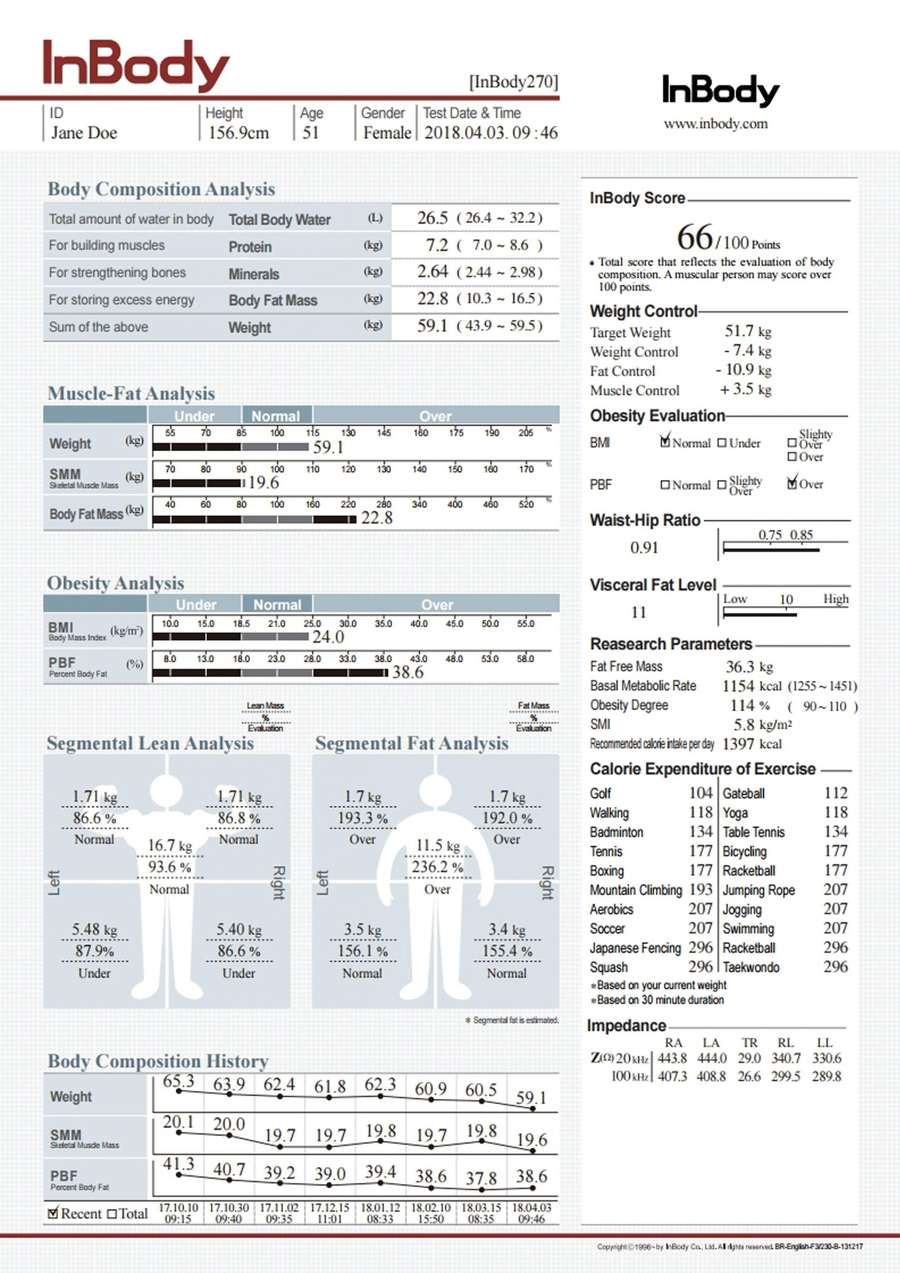
The InBody Score is a single-number summary of your body composition, on a scale where 70 is average for adults, 80 is athletic, and 90+ is elite. It is calculated from your fat-free mass, body fat percentage, and muscle distribution. The full explainer post covers what each range means. This post is different — it is a 90-day playbook for actually raising your score, based on the levers that genuinely move it.
The two inputs that drive your InBody Score
The score formula is dominated by two body composition variables:
- Skeletal muscle mass relative to your height and gender (higher = better)
- Body fat percentage relative to your gender and age (closer to athletic range = better)
A third variable — segmental muscle balance — modifies the score modestly. If your left arm has significantly less muscle than your right (common in right-handed people), the score takes a small hit.
The implication: to raise your InBody Score, you must build skeletal muscle AND reduce excess body fat. Doing only one almost always underdelivers. The biggest mistake people make: they try to “diet down” their score upward and end up losing both fat AND muscle, so the score barely moves.
How fast can the InBody Score actually rise?
Realistic 90-day expectations, holding everything else constant:
| Starting Score | Realistic 90-day gain | Realistic 6-month gain |
|---|---|---|
| 50–60 (very low) | +8–12 points | +15–20 points |
| 60–70 (below average) | +5–8 points | +10–15 points |
| 70–80 (average–good) | +3–5 points | +7–10 points |
| 80–90 (athletic) | +1–3 points | +3–6 points |
| 90+ (elite) | +0.5–1 point | +1–2 points |
The lower your starting point, the faster the score moves — because beginners gain muscle quickly (newbie gains) and lose fat quickly. Once you are above 80, every additional point requires meaningfully harder work.
The 90-day playbook
Week 1: Establish the baseline
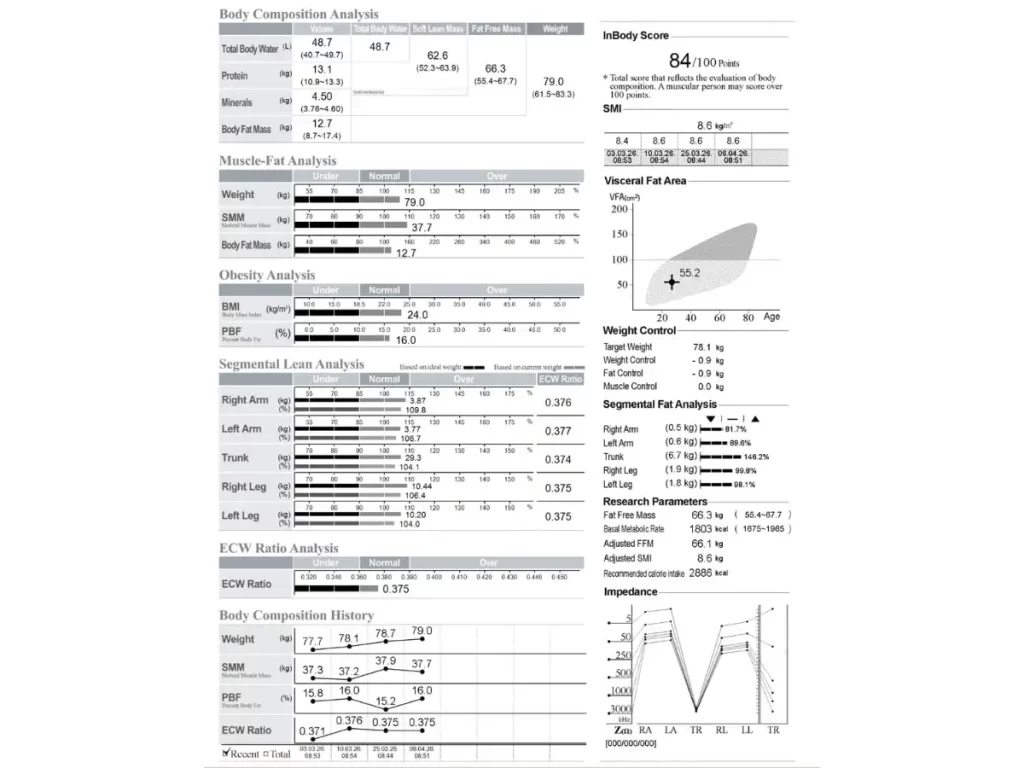
- Get a baseline InBody scan. Note: score, skeletal muscle mass (in kg), body fat percentage, body fat mass (in kg), segmental muscle balance, ECW/TBW ratio.
- Tape-measure 5 sites: waist (at navel), chest (across nipples), upper arm (relaxed), thigh (mid), hip (widest).
- Photo: same lighting, same time of morning, three angles. You will repeat this Day 30, 60, 90.
- Honest food log for 5 days — average daily protein grams and total calories. This is the most important number you will calculate.
Weeks 2–12: The two engines
Engine 1: Build skeletal muscle (the biggest score lever)
- Resistance training 3–4 sessions per week. Each session: 30–60 minutes. Focus on compound movements — squat, deadlift, bench press, overhead press, row, pull-up.
- Progressive overload: each week, add either 2.5 kg to a lift or 1 rep at the same weight. Track every session.
- Train each major muscle group at least twice per week.
- Realistic muscle gain rate: 0.5–1 kg per month for beginners, 0.25–0.5 kg per month for intermediates. This shows up as 1–2 kg of skeletal muscle on the scan over 90 days.

Engine 2: Lose excess body fat (the second-biggest lever)
- Calorie deficit of 300–500 kcal per day. NOT more. Aggressive deficits cannibalise muscle.
- Protein at 1.6–2.2 g per kg bodyweight per day. For most Indians, this means doubling current intake. Full protein guide.
- Walk 7,000–10,000 steps daily. Cardio outside of this is optional; not central.
- Realistic fat loss rate: 0.5–1% of body weight per week, or roughly 2–4 kg per month. Over 90 days, that’s 6–12 kg of body fat down — typically lowering body fat percentage by 4–8 points.
Day 30 check-in
Re-scan, re-measure, re-photo. Expected results if executing well:
- Skeletal muscle: +0.5 to +1 kg
- Body fat: -2 to -4 kg
- Body fat %: -1 to -3 points
- InBody Score: +2 to +5 points
If you are below these numbers, the most likely culprits are: protein intake below target, training without progressive overload, or “cheat days” cancelling out the weekly deficit. Adjust before Week 5.
Day 60 + Day 90 check-ins
Same scan + measurement protocol. Trend should continue. If progress plateaus, the usual culprits are sleep debt (cortisol elevation), under-eating protein, or training without enough volume.
What does NOT raise your InBody Score
Common mistakes that look productive but barely move the score:
- Cardio-only programmes. Will reduce body fat modestly but also reduce muscle — net score gain is small or zero.
- Severe calorie restriction. Drops weight including muscle. Body fat percentage moves but skeletal muscle mass drops — the two cancel out in the score.
- Daily yoga or Pilates alone. Excellent for mobility and stress; minimal effect on skeletal muscle mass measured by an InBody scan.
- “Toning” programmes (high reps, light weights). Build muscular endurance more than mass. The score sees mass, not endurance.
- Supplements without training. Creatine, protein powder, BCAAs only work if the training stimulus is present. Without training, they are expensive food.
- Detox cleanses, juice fasts, intermittent fasting without protein protection. Drop weight (mostly water and muscle), do nothing meaningful for the score.
An illustrative 90-day arc
Illustrative example — composite based on typical patient profiles.
A 34-year-old marketing director in Mumbai. Baseline InBody Score: 64. Body fat 28%. Skeletal muscle 28.4 kg. Goal: 75 by end of 90 days. Programme: 4 strength sessions weekly (push/pull/legs/full-body), protein at 1.8 g/kg (130 g daily), 8,500 steps average, 7 hours sleep. Day 30: score 69, body fat 25.5%, skeletal muscle 29.1 kg. Day 60: score 72, body fat 23%, skeletal muscle 29.7 kg. Day 90: score 75 (target hit), body fat 21.5%, skeletal muscle 30.2 kg. Net: +11 points, -6.5 points body fat, +1.8 kg muscle. Bathroom scale: down 3 kg. The scale told 5% of the story.
Edge cases — when score gains stall
You are female and over 40. Muscle gain rates slow due to hormonal shifts. Realistic 90-day score gain: 3–5 points instead of 5–8. Solution: protein at the upper end (2.0–2.2 g/kg), creatine supplementation, prioritise heavy compound lifts. Read more on women’s body composition through menopause.
You are over 60. Score gains are still achievable but slower. Sarcopenia is real and resistance training is the antidote. Realistic 90-day gain: 2–4 points. Patience and consistency matter more than intensity.
You are post-bariatric or post-GLP-1. Risk of sarcopenic outcome is elevated. Resistance training is non-negotiable. More on muscle preservation during GLP-1 use.
You have a clinical condition (PCOS, hypothyroid, diabetes). Score gains may need clinical interpretation. The number can still move; the rate depends on disease management.
Frequently asked questions
Q. How is the InBody Score actually calculated?
It is a weighted formula combining your fat-free mass relative to a reference population (your gender and height), your body fat percentage relative to ideal ranges, and your segmental muscle balance. Higher fat-free mass + healthier body fat percentage = higher score. The exact formula is proprietary to InBody but the inputs are visible on every result sheet.
Q. What is a good InBody Score?
70 is the population average for adults. 80 indicates athletic body composition. 90+ is elite — typically physique competitors, serious endurance athletes, and the lean-mass-heavy subset of the population. Most Indians scanning for the first time score 55–75. The goal for most is to climb steadily into the 80s and hold there.
Q. Can my InBody Score drop even though I am exercising more?
Yes, in three common scenarios. (1) You did mostly cardio and lost muscle along with fat. (2) You are under-eating protein. (3) You are over-training and showing elevated ECW/TBW from inflammation, which slightly drops the score. Diagnose with a follow-up scan and adjust.
Q. How often should I scan to track InBody Score?
Every 4–8 weeks is the sweet spot. More frequent than 2 weeks adds noise without signal. Less frequent than 12 weeks loses momentum-tracking. Pair each scan with same-day tape measurements and progress photos for triangulation.
Q. Can I trust the InBody Score from a home Dial vs a hospital InBody?
The home Dial range (H40, H30, H20) gives a score that is reliable for your own trend tracking over time. The professional InBody range (270S through 970S) gives a score that is reliable both for trend tracking AND for cross-individual comparison. More on professional vs home comparison.
Want to start your 90-day score climb? Step one is a baseline. A 60-second InBody scan gives you your current score, skeletal muscle mass, body fat percentage, and segmental balance — the numbers you will track every 30 days. Book your baseline InBody scan, then come back to this post to set your 90-day target.

Most trending articles
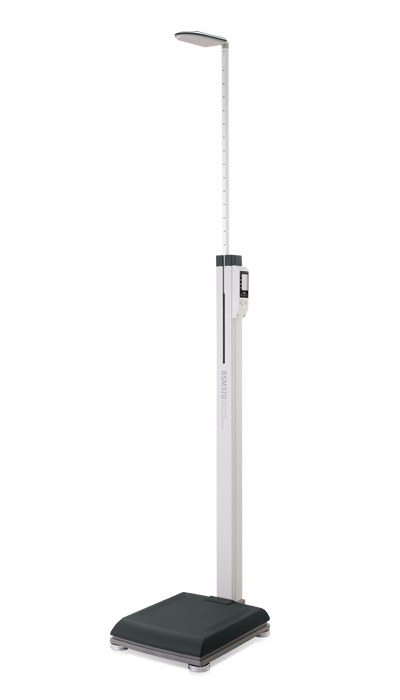
Student Fitness Screening in India: A Guide for Schools
CBSE HPE, Fit India and Khelo India rely on BMI. How schools and colleges can add body composition screening safely, with child caveats and DPDP consent.
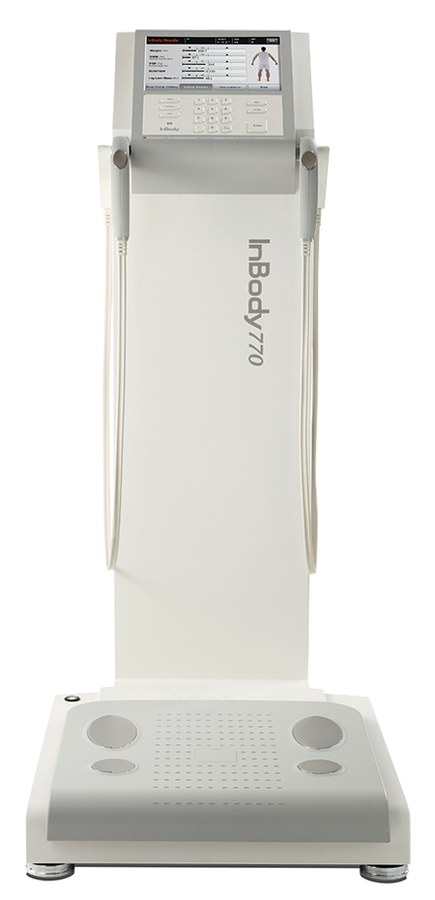
Creatine and Your Body Composition Scan: What Changes
Creatine raises body water and lean mass readings within a week on BIA and DXA. What the studies show and how to time your scans to read progress honestly.
Fitness Testing and Body Composition for Sports Academies
A practical fitness testing battery for Indian sports academies: body composition, grip, jumps, sprints, Yo-Yo, Khelo India context and youth maturation.