
Body Composition 5 min read
How to Prepare for a Body Composition Test: Full Checklist
Hydration moves your result. What to do in the 24 hours and 3 hours before, what happens during the scan, and the arm-position mistake that ruins readings.
Reading about body composition? Find an InBody test centre near you →
How to Prepare for a Body Composition Test (And What Actually Happens)
A body composition test is one of the least demanding assessments in healthcare. You stay clothed, nothing is injected, there is no radiation, and the measurement itself takes about 60 seconds.
What it does require is consistency. Bioelectrical impedance responds to your hydration state, and hydration moves throughout the day with food, fluid, exercise and sleep. Get the conditions right and your result is genuinely comparable to your next one. Get them wrong and you will spend eight weeks wondering why you apparently lost two kilograms of muscle over a weekend.
Here is exactly what to do beforehand, what happens during, and how to make the number mean something afterwards.
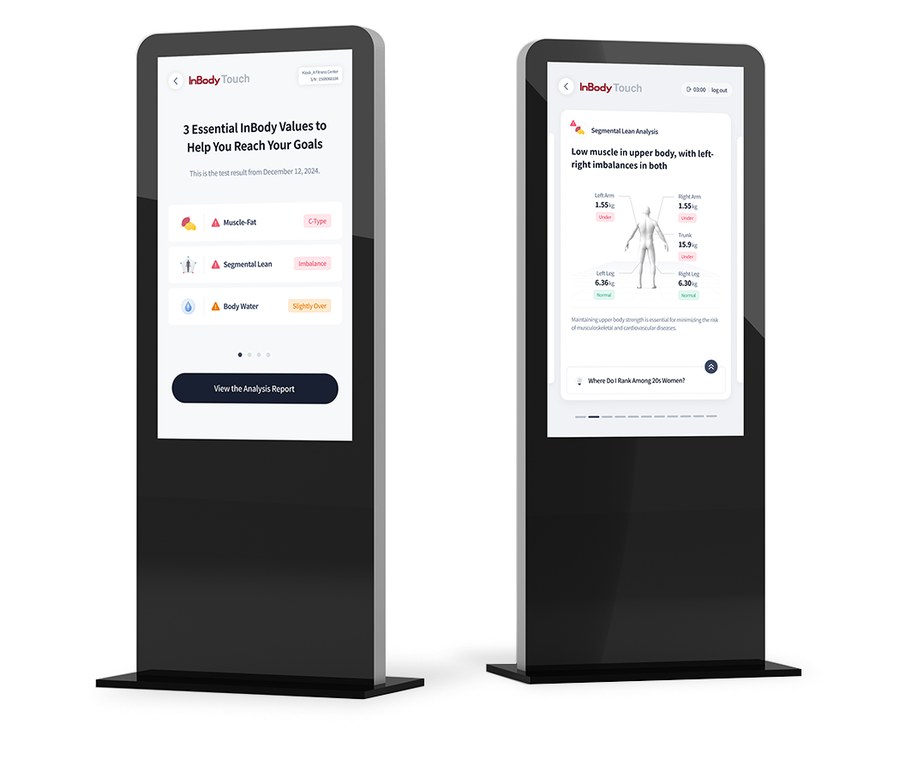
Before the Test: The Conditions That Matter
In the 24 hours before
- Avoid alcohol. It affects fluid distribution meaningfully.
- Avoid unusually intense or unfamiliar exercise. A heavy session causes fluid shifts and, if it produced muscle soreness, inflammation that alters readings.
- Keep fluid intake normal. Neither deliberately loading up nor restricting.
In the 2–3 hours before
- No heavy meal. Food in the digestive tract adds weight and shifts fluid. A light meal two to three hours before is fine; a thali thirty minutes before is not.
- No large volume of water. Normal sips are fine. Drinking half a litre in the waiting room is not.
- No exercise. Test before training, not after.
- No sauna, steam or hot shower. All cause fluid loss through sweat.
- Use the toilet beforehand. A full bladder registers as weight.
Timing
Morning, after using the toilet and before a heavy breakfast, is the most reproducible window. But the specific time matters less than picking one and keeping it. If your only realistic slot is 6 pm after work, use 6 pm every time. Consistency beats theoretical ideal conditions.
What to wear
Light clothing. You will remove socks and shoes and stand barefoot on the electrode plates. Heavy items — jacket, belt, phone, keys, thick jeans — should come off, since the device weighs you as part of the measurement. Remove watches and, where practical, metal jewellery.
Who Should Mention Something Beforehand
Tell the centre in advance if any of these apply:
- You have an implanted electronic medical device such as a pacemaker or implantable defibrillator. As with any device passing a current through the body, manufacturer guidance applies and the centre should advise.
- You are pregnant. Standard body composition reference ranges are not designed for pregnancy and results should be interpreted accordingly, if testing is done at all.
- You have significant oedema or fluid retention, or are undergoing dialysis. Readings remain useful but must be interpreted in that context — in dialysis specifically, timing relative to a session changes results substantially.
- You have metal implants or prostheses. Mention them so the operator can note it against your result.
None of these necessarily prevent testing. They change how the result should be read.
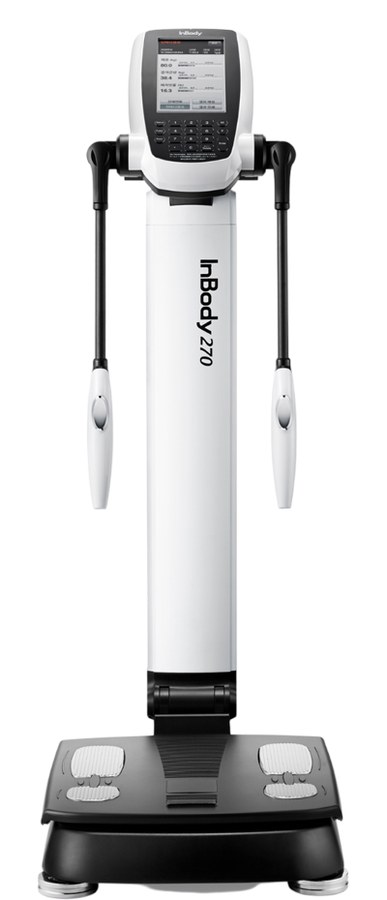
What Happens During the Test
- Registration. Height, age and sex are entered. Height should be measured rather than guessed — an error here shifts several derived values.
- Cleaning contact points. Some centres wipe the palms and soles with an electrolyte tissue to improve contact. This is normal and takes seconds.
- Standing on the device. Barefoot, with the balls and heels of your feet on the marked electrodes.
- Holding the hand electrodes. Thumbs on the upper contacts, fingers wrapped around the lower ones. Arms held away from your sides, elbows straight, so the arms do not touch the torso.
- Standing still. Roughly 15 to 60 seconds depending on the model. Stay still and breathe normally. You will feel nothing — the current is far too small to sense.
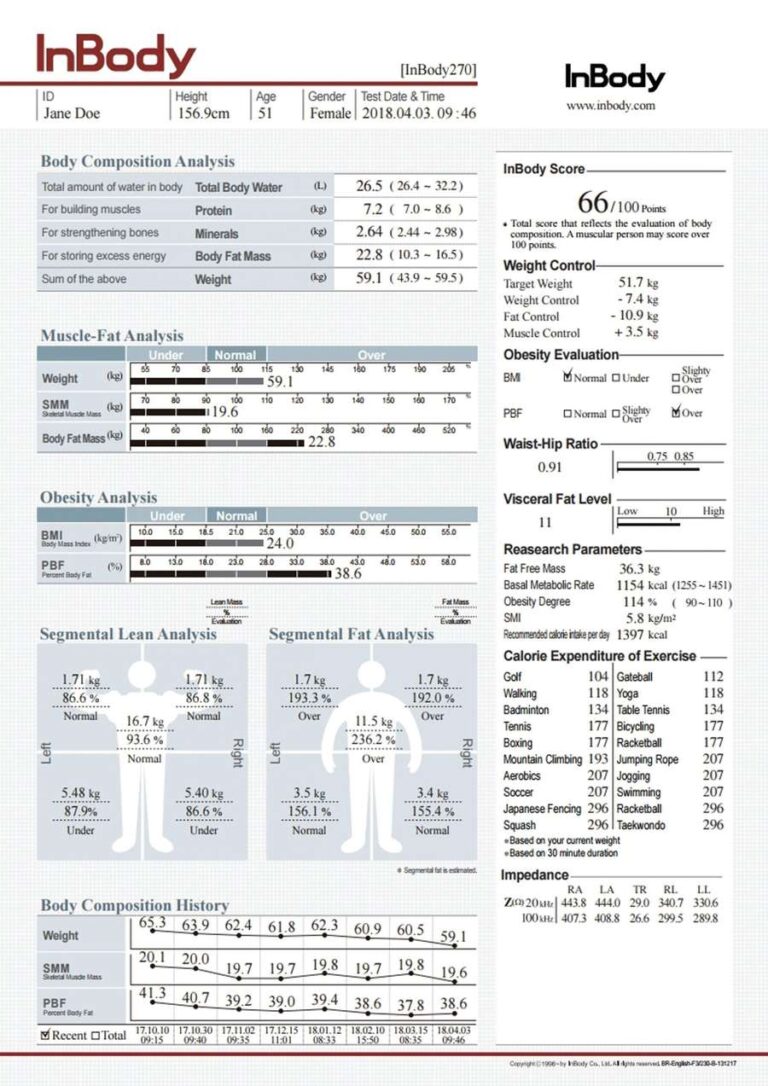
- The report prints. Usually immediately.
The most common cause of a poor reading is arm position. If your arms rest against your body, the current path shortens and the segmental values are wrong. A good operator will correct this.
Common Preparation Questions
| Question | Answer |
|---|---|
| Do I need to fast? | No. Avoid a heavy meal for 2–3 hours; a full fast is unnecessary. |
| Can I drink water? | Normally, yes. Avoid a large volume immediately before. |
| Can I test during my period? | Yes, though fluid retention may shift results. Comparing the same cycle phase across months is more informative. |
| Does it hurt? | No. You will not feel the current. |
| Is there radiation? | None. That is DEXA, a different technology. |
| How long does the appointment take? | Usually under 10 minutes including registration and report walkthrough. |
| Can I test after coffee? | Yes, though caffeine is a mild diuretic — keep it consistent across tests. |
After the Test: Making It Count
Three things turn a printout into something useful.
Get it explained. Ask the centre to walk you through skeletal muscle mass, body fat mass, visceral fat and segmental balance. If interpretation is not offered, our guide to reading a BCA report covers the essentials.
Keep the report and note the conditions. Write down the time of day and whether you had eaten or trained. In eight weeks this is what lets you judge whether a change was real.
Book the re-test before you leave. Six to eight weeks out, same time of day, same device where possible. A single body composition test is a snapshot; the value is almost entirely in the comparison.
Why Consistency Matters More Than Perfection
People sometimes read a preparation list like this and conclude the measurement is fragile. It is not. It is a physical measurement responding to a real variable — body water — and body water genuinely changes through the day.
The practical consequence is simple. A test taken under slightly imperfect but identical conditions every eight weeks will show you your trend accurately. A test taken under perfect conditions once, then compared against one taken after lunch and a gym session, will not. Standardise whatever you can and keep it the same.
Book It, and Book the Second One Too
Preparation takes almost no effort and roughly doubles what you get out of the measurement. The other half is simply testing again.
Book an InBody body composition test at inbody.in/inbody-test.php, or find a centre near you at inbody.in/locations. Related reading: how to read a BCA report, how to choose a testing centre, and is a body composition test worth it.

Most trending articles
वज़न बढ़ाने के लिए क्या खाएं? सही डाइट प्लान (सिर्फ ज़्यादा खाना नहीं)
सिर्फ ज़्यादा खाने से मांसपेशी नहीं बनती, चर्बी बढ़ सकती है। सही कैलोरी सरप्लस, प्रोटीन और डाइट प्लान जो वज़न को सही तरीके से बढ़ाए — पूरी जानकारी हिंदी में।
भारत में प्रोटीन कितना ज़रूरी है? असली आंकड़े और सही फॉर्मूला
IMRB के एक सर्वे में लगभग 73% भारतीय आहार प्रोटीन-कम पाए गए। सही प्रोटीन टारगेट कैसे निकालें और किन फूड्स से पूरा करें — पूरी जानकारी हिंदी में।
Metabolic Age क्या होती है? आपकी उम्र से ज़्यादा है या कम?
आपकी असली उम्र 34 है पर शरीर 50 साल जैसा व्यवहार कर सकता है। Metabolic age क्या है, मांसपेशी घटने के जोखिम क्या हैं और इसे कैसे घटाएं — पूरी जानकारी।