
Body Composition 8 min read
ECW Ratio on Your InBody Report: What’s Normal, What’s Not
Normal ECW ratio on an InBody report is 0.360-0.390. What a higher reading can mean, what it can't, and why one scan isn't a diagnosis.
Reading about body composition? Find an InBody test centre near you →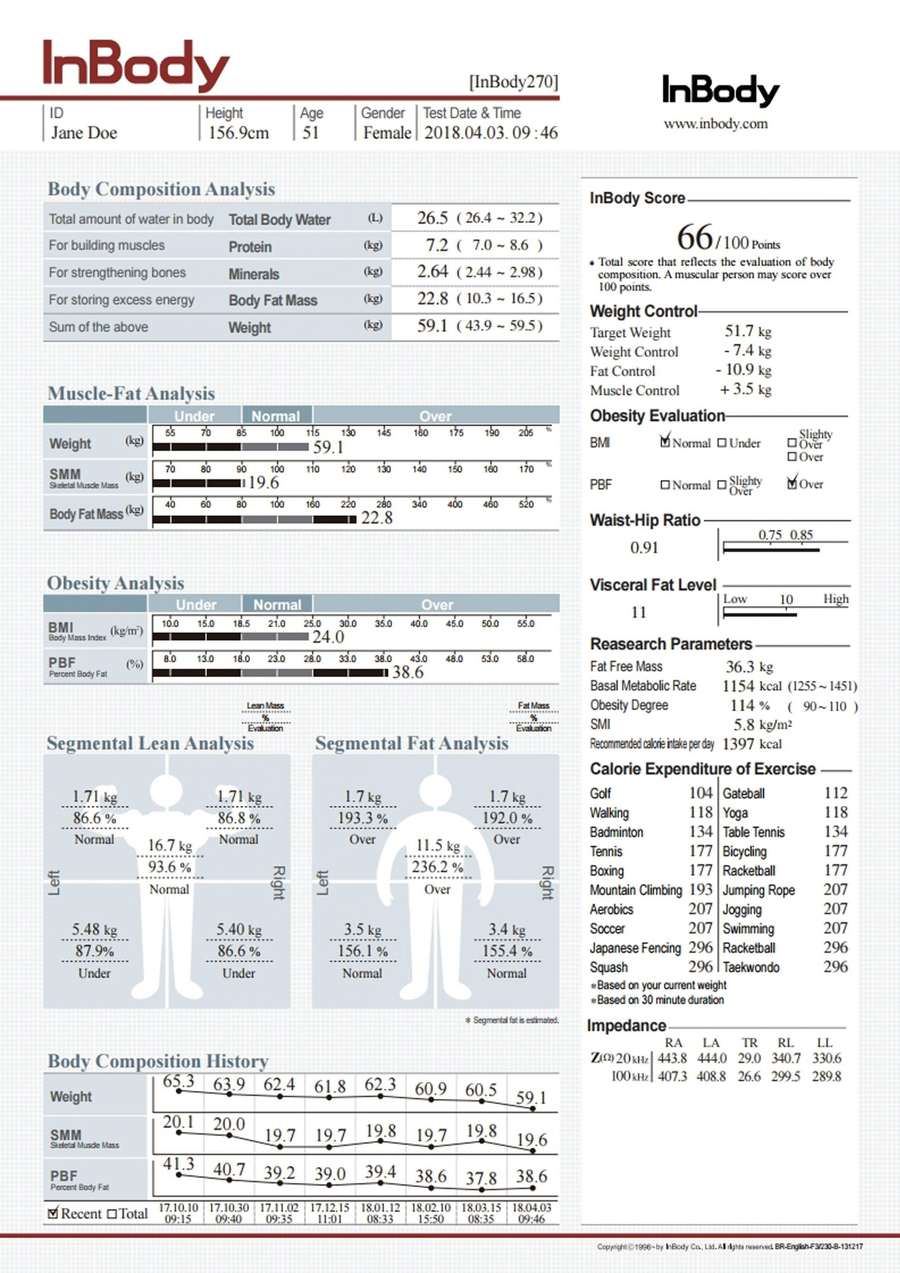
ECW Ratio on Your InBody Report: What’s Normal, What’s Not
You get your InBody printout, find the line labelled ECW ratio, and it says 0.402 instead of the 0.38 you were half-expecting. Nobody at the centre explained it. A quick search gives you either a one-line definition or a frightening paragraph about heart and kidney disease. Neither helps.
Here is the plain version. The ECW ratio (extracellular water divided by total body water, also written ECW/TBW) tells you how your body’s water is split between the fluid outside your cells and the fluid inside them. InBody prints a normal range of 0.360 to 0.390. A reading above that is a flag worth understanding, not a diagnosis. This guide covers what the number measures, what can push it up, what it does not mean, and how to get a reading you can trust.
What the ECW Ratio Actually Measures
About 60% of an adult’s body weight is water, and it sits in two places. Around 62% of that water is intracellular water (ICW), inside your cells, where it is mostly tied to muscle and organ tissue. The rest is extracellular water (ECW): blood plasma and the fluid that bathes your cells.
In a healthy adult, around 38% of total body water is extracellular. That is where the “0.38” comes from. Divide ECW by TBW, and a typical healthy person lands close to 0.380. Small day-to-day wobble is normal.
The ratio matters because the two compartments behave differently. Intracellular water follows your lean tissue. Extracellular water follows fluid balance: salt, circulation, inflammation, swelling. When ECW creeps up relative to the total, the ratio rises, even if your total water has barely changed.
The Ranges InBody Prints (and Why They Differ Slightly)
InBody’s own materials agree on the core band: 0.360 to 0.390 is normal. Where they differ is in how they describe the numbers above it.
| ECW ratio | How InBody materials describe it |
|---|---|
| 0.360 – 0.390 | Normal range on result sheets and training manuals |
| 0.390 – 0.400 | Called “slightly over” on InBody’s body-water analyser sheet; “mild imbalance, worth monitoring” in InBody India’s result-sheet guide |
| 0.400 and above | Called “over” on the body-water analyser sheet; several sheets say to consult a physician at 0.400 or above |
So the honest reading is this: 0.390 is where InBody starts flagging, and 0.400 is where several of its sheets say to speak to a doctor. The exact wording varies by device. One more caveat: these tiers are set by the manufacturer. They are practical flags, not cut-offs derived from outcome studies on healthy Indians.
What Can Push the ECW Ratio Up
The important word is can. A high ratio tells you that more of your water is outside your cells than usual. It does not tell you why. InBody’s own guidance and the clinical literature point to several possibilities:
- Localised swelling or injury. A sprained ankle or a recently operated limb holds extra extracellular fluid. This is the most common benign reason for one segment reading high.
- Inflammation. Fluid shifts outward when tissue is inflamed, including after illness.
- Excess body fat. InBody lists obesity among the reasons ratios drift upward across the whole body.
- Medical conditions. Heart, kidney and liver conditions can all cause fluid retention. This is why InBody advises a doctor’s opinion for persistently high readings.
- Recent surgery. Fluid balance takes time to settle.
- Salt and fluid intake, and test conditions. A very salty meal the night before, dehydration, or a scan taken straight after hard exercise can nudge the number.
- Ageing and low muscle. As muscle mass falls, intracellular water falls with it, so the ratio can rise in older or very lean people without any visible swelling. Researchers have noted this when reading the ratio in elderly patients.
If you have visible swelling, especially on one side, sudden swelling of the face or abdomen, or swelling with breathlessness or chest pain, do not wait for a repeat scan. The NHS guidance on oedema lists these as reasons to seek medical help promptly.
What a High ECW Ratio Does Not Mean
This is where many web pages overreach, so it is worth being direct.
- It is not a diagnosis. No InBody document claims the ratio diagnoses heart failure, kidney disease or any other condition.
- It is not a heart-risk score. We found no InBody-specific outcome study that validates 0.390 or 0.400 as risk bands for heart disease.
- It is not proof of “inflammation” or “toxins.” It is a fluid-distribution measurement.
- One slightly high reading is rarely meaningful by itself. Illness, a hard workout, a long flight, or a salty dinner can all produce one.
It is also not on every device. Professional models such as the 570, 770S and 970S report ECW/TBW. Do not assume the same output appears on a home scale; check the specific model’s output list.
Why It Matters for the Rest of Your Report
The ECW ratio is most useful as a quality flag for the numbers around it. Water inflates lean mass. If your ratio is high and your lean mass or skeletal muscle looks surprisingly good, some of that “muscle” may simply be extra water. InBody’s own guidance says as much: a high fat-free mass together with a high ECW ratio usually means excess water, not extra muscle.
So read it alongside your muscle numbers and your phase angle. If you are working through the whole sheet, our guide to reading the InBody results sheet walks through every section, and the segmental fat analysis explainer covers the arm, leg and trunk bars.
How Doctors Use the ECW Ratio in Research
Outside the fitness context, researchers have studied ECW/TBW in several clinical settings. Studies in patients on haemodialysis have linked a higher ratio to worse outcomes. Smaller studies have looked at it in intensive care, liver disease, cancer and sarcopenia in older adults.
Two things to keep in mind. First, the cut-offs differ from study to study and population to population: a dialysis study might use 0.385 for one group and 0.395 for another. Second, much of this work is observational. It shows an association, not a rule that you can apply to your own printout. That is why a doctor, not a web page, should interpret a persistently high number alongside your symptoms and tests.
How to Get a Clean Reading
Because the ratio responds to fluid shifts, test conditions matter more here than for almost any other number on the sheet. Our test preparation guide covers the full checklist. The short version:
- Test at the same time of day, ideally in the morning, for every scan you want to compare.
- Keep hydration and salt normal the day before. Do not load up on water or skip fluids to “improve” the number.
- Avoid hard exercise just before the scan, and follow your centre’s rule on how long to wait after eating.
- Use the same device each time. Different machines are not interchangeable for trend tracking.
- Repeat before you react. One high reading deserves a second scan under standard conditions, not a conclusion.
What to Do With a High Number
If your ratio is slightly above 0.390 and you feel well, repeat the scan in a few weeks under the same conditions and note what changed in between: illness, travel, a new training block, a salty week. If it stays elevated, or if you have swelling, breathlessness, or sudden weight gain you cannot explain, show the printout to your doctor and describe your symptoms. Do not try to “lower” it with diuretics, detox drinks or fluid restriction. That is a medical decision, not a self-treatment target.
Frequently Asked Questions
What is a normal ECW ratio on an InBody scan?
InBody’s normal range is 0.360 to 0.390, with most healthy adults close to 0.380. Readings above 0.390 are flagged, and several InBody sheets advise speaking to a doctor at 0.400 or above. The exact wording varies by device, and a single reading is best confirmed with a repeat scan.
Is an ECW ratio of 0.4 dangerous?
Not by itself. A reading around 0.400 is a flag that more of your body water sits outside your cells than usual. Causes range from a recent injury or a salty week to conditions that need medical attention. Repeat the scan under standard conditions, and see a doctor if it persists or comes with swelling or breathlessness.
Does a high ECW ratio mean heart disease?
No. Heart conditions can raise it, but so can kidney or liver problems, inflammation, recent surgery, ageing and test conditions. InBody does not present the ratio as a heart-risk score. It is a fluid-distribution marker that a doctor interprets alongside symptoms and other tests.
Why is my ECW ratio high when my muscle mass looks good?
Extra extracellular water inflates lean mass readings. A high ratio together with high fat-free mass often means some of the “muscle” is water. Repeat the scan under standard conditions and compare segmental readings before trusting the muscle number.
Can dehydration or overhydration change the ECW ratio?
Yes. Fluid intake, salt, exercise and the time since your last meal all shift body water between compartments. That is why InBody asks for consistent test conditions, and why a single scan taken after a long flight or a hard workout can read differently from your usual.
How do I lower my ECW ratio?
Do not self-treat. Work out the cause first, usually with a doctor if the reading stays high. Sodium or fluid advice should come from your doctor based on your health. For a borderline reading with no symptoms, re-testing under consistent conditions often shows it was temporary.
Read the Whole Sheet, Not Just One Line
The ECW ratio is one number among thirty. To see it in context with your muscle, fat and segmental readings, find an InBody test centre near you and ask for the printout from a model that reports ECW/TBW. You can also see what each section of the result sheet shows before you go.
This article is for general education and is not a substitute for medical advice. Talk to your doctor about any persistent swelling or abnormal reading.
Related reading: how to read your InBody report, how sodium controls water balance, and bioelectrical impedance analysis explained.

Most trending articles
Student Fitness Screening in India: A Guide for Schools
CBSE HPE, Fit India and Khelo India rely on BMI. How schools and colleges can add body composition screening safely, with child caveats and DPDP consent.
Creatine and Your Body Composition Scan: What Changes
Creatine raises body water and lean mass readings within a week on BIA and DXA. What the studies show and how to time your scans to read progress honestly.
Fitness Testing and Body Composition for Sports Academies
A practical fitness testing battery for Indian sports academies: body composition, grip, jumps, sprints, Yo-Yo, Khelo India context and youth maturation.