
Medical 8 min read
DSM-BIA vs Single-Frequency BIA: Why Accuracy Differs (Clinical Guide)
“BIA scale” can mean two completely different things. A ₹3,000 bathroom scale from an e-commerce site uses BIA. A ₹15 lakh hospital body composition analyser also uses BIA.…
Reading about body composition? Find an InBody test centre near you →
“BIA scale” can mean two completely different things. A ₹3,000 bathroom scale from an e-commerce site uses BIA. A ₹15 lakh hospital body composition analyser also uses BIA. Both claim to measure body composition. Both work on the same underlying principle, bioelectrical impedance, but the accuracy gap between them is wider than most consumers and even many clinicians appreciate.
The difference comes down to two engineering choices: how many electrodes, and how many frequencies. Together, these decisions determine whether a device can distinguish your left arm from your right, your intracellular water from your extracellular water, or your visceral fat from subcutaneous fat. Or whether it just gives you a single rough estimate based on an averaged formula.
This guide explains DSM-BIA Direct Segmental Multi-Frequency BIA, the technology used by InBody’s professional range, versus single-frequency BIA used by most consumer scales. By the end, you will know exactly why two devices measuring the “same thing” produce different answers, and which one your clinical use case actually requires.
The BIA principle in 30 seconds
Bioelectrical impedance analysis sends a tiny, safe electrical current through your body and measures the resistance the current encounters. Different tissues conduct electricity differently. Muscle is rich in water and electrolytes (low resistance, conducts well); fat is poor in water (high resistance, conducts poorly). The device then uses your resistance reading, combined with your height, age, and gender, to estimate body composition.
The principle is sound. The variation lies in how thoroughly the measurement is made. Full BIA technology explainer here.
Single-frequency BIA is what most consumer scales do
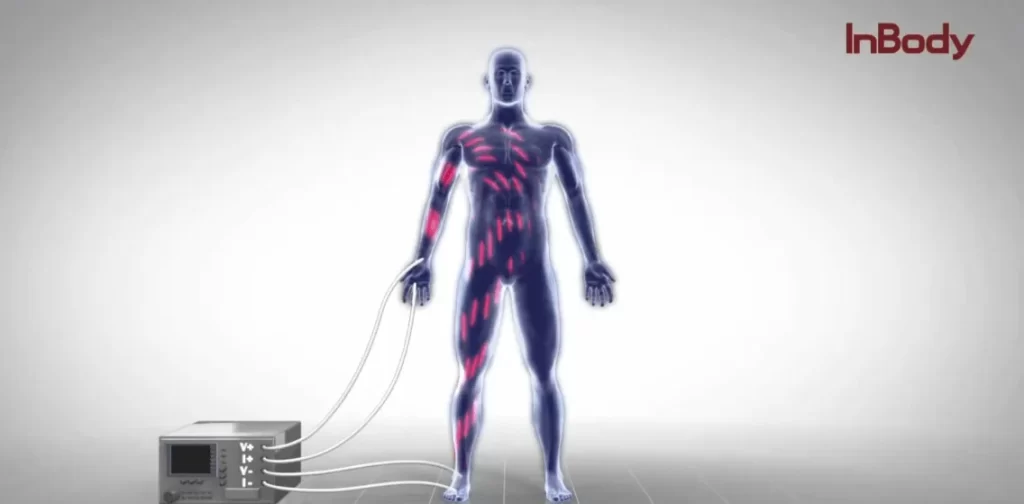
Single-frequency BIA sends a single frequency of electrical current, typically 50 kHz, through the body via 2 or 4 contact points (feet only or feet and hands).
- What it measures: Total body water, then derives lean mass, fat mass, and body fat percentage using standard formulas.
- What it cannot measure: Intracellular vs extracellular water (cell health vs inflammation), segmental balance (left arm vs right arm), visceral fat with precision, phase angle.
- Where the inaccuracy creeps in: The single 50 kHz frequency passes through extracellular water relatively easily but cannot fully penetrate cell membranes. So it estimates total water but cannot distinguish water inside cells (e.g., healthy, hydrated muscle) from water around cells (e.g., inflammation, lymphedema, kidney issues).
- Typical accuracy band: ±2–4% body fat in either direction for a single reading. Adequate for tracking your own trend over weeks. Inadequate for clinical decision-making or comparing across individuals.
Single-frequency BIA is the technology in most consumer bathroom scales, most fitness wristbands that claim body composition, and several entry-level gym scales. The home InBody Dial range (H40, H30, H20) also uses single-frequency BIA, designed deliberately for personal trend tracking, not clinical use.
DSM-BIA, what professional InBody machines do
DSM-BIA stands for Direct Segmental Measurement Multi-Frequency Bioelectrical Impedance Analysis. Two engineering changes make it dramatically more precise than single-frequency BIA:
1. Segmental measurement (8 electrodes, 5 segments)
Instead of treating the body as a single unit, DSM-BIA places 8 tactile electrodes 2 on each foot, 2 on each hand and measures 5 segments independently: left arm, right arm, trunk, left leg, right leg. Each segment gets its own impedance reading.
This matters because the human body is not symmetric. A right-handed person typically carries more muscle in the right arm. A patient with a previous stroke may have one-sided muscle atrophy. A diabetic with early sarcopenic obesity may have selectively lost leg muscle while abdominal fat increased. Whole-body BIA averages these patterns away. DSM-BIA reveals them.

2. Multi-frequency analysis (1, 5, 50, 250, 500, 1000 kHz)
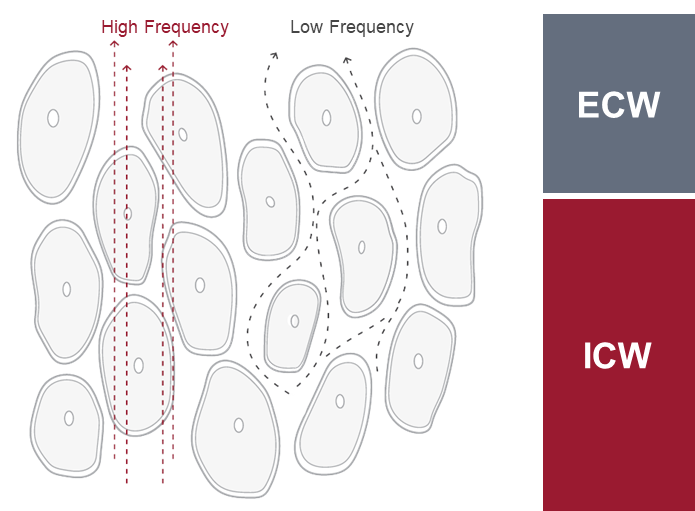
Different electrical frequencies behave differently in the body. Low frequencies (1–5 kHz) pass around cells but cannot penetrate cell membranes. High frequencies (250–1000 kHz) pass through both cell membranes and the surrounding fluid. By comparing the resistance at multiple frequencies, the analyser can mathematically separate:
- Intracellular water (inside cells reflects muscle quality and cellular health)
- Extracellular water (around cells reflects hydration, inflammation, lymphedema)
- Total body water (sum of both)
The ratio of these (ECW/TBW) is a clinical signal; values above 0.39 indicate fluid imbalance from inflammation, kidney issues, or chronic overtraining. Single-frequency BIA cannot calculate this ratio at all.
Multi-frequency also enables phase angle measurement, a derived metric increasingly used in oncology, sarcopenia screening, and clinical nutrition to assess cellular integrity.
The accuracy gap is quantified
| Measurement | Single-frequency BIA | DSM-BIA (InBody Professional) |
|---|---|---|
| Total body fat % | ±2–4% margin | ±1% margin; 98.4% DEXA correlation |
| Skeletal muscle mass | Estimated whole-body | Measured per segment (arms, legs, trunk) |
| Visceral fat | Rough estimate or absent | Direct estimation validated against MRI |
| Intracellular water | Not measured | Measured |
| Extracellular water | Not measured separately | Measured |
| ECW/TBW ratio | Cannot calculate | Calculated; clinical flag >0.39 |
| Phase angle | Not available | Available; used in clinical nutrition |
| Cross-individual comparability | Variable | High (used in clinical trials) |
| Use in clinical decisions | Not recommended | Standard in many hospitals |
Why the difference matters in practice
Three clinical scenarios where the single-frequency vs DSM-BIA distinction changes the medical decision:
Scenario 1: Pre-bariatric assessment
Illustrative example composite based on typical patient profiles. A 52-year-old patient is being evaluated for bariatric surgery. A single-frequency BIA reading shows body fat 41%, clearly above the intervention threshold. Surgery is approved. Post-surgery, the patient lost 22 kg of total weight. But a follow-up DSM-BIA scan reveals 11 kg of that loss was skeletal muscle sarcopenic obesity that has been created surgically. Had the pre-surgical workup used DSM-BIA, the patient’s segmental muscle mass deficit would have been visible upfront, triggering pre-surgical resistance training and protein optimisation. The outcome would have been the same fat loss, but with intact muscle.
Scenario 2: Dialysis dry weight calibration
Illustrative example. A nephrologist managing a chronic kidney disease patient needs to set the “dry weight” target, the patient’s weight after fluid removal during dialysis. Setting it too high leaves the patient fluid-overloaded; too low causes intra-dialytic blood pressure drops. Single-frequency BIA estimates total body water but cannot distinguish intracellular from extracellular. DSM-BIA separates the two and reveals an ECW/TBW ratio of 0.42, clearly elevated. The dry weight is recalibrated downward by 1.5 kg. The patient stops crashing mid-dialysis.
Scenario 3: Athlete monitoring
Illustrative example. A 24-year-old badminton player has a body fat 9%. Single-frequency reading suggests excellent body composition. Continue current training load. DSM-BIA reveals ECW/TBW at 0.395 borderline-elevated extracellular water, indicating systemic stress. Phase angle dropping over consecutive scans. The coach reduces training intensity for 10 days. Recovery markers normalise. The injury that would have followed is averted.
These are not hypothetical edge cases. They are routine reasons hospitals, dialysis centres, and elite sports academies specify DSM-BIA in their procurement criteria.
Which technology should you actually buy?
The decision rule is clean:
- You are an individual tracking yourself over time → single-frequency BIA is sufficient. Buy a home Dial. See the InBody Dial range.
- You make clinical decisions, business decisions, or comparisons across multiple people based on the readings → you need DSM-BIA. See the professional InBody range.
- You are running a gym, hospital, clinic, or corporate wellness programme → DSM-BIA. The accuracy difference shows up in patient outcomes and customer retention.
For India specifically, the DSM-BIA preference is sharper than in Western markets because the Indian thin-fat phenotype creates patterns that whole-body single-frequency BIA misses with alarming frequency.
Frequently asked questions
Q. What is the main difference between DSM-BIA and single-frequency BIA?
DSM-BIA uses 8 electrodes to measure 5 body segments independently and runs multiple frequencies of current. Single-frequency BIA typically uses 2 or 4 electrodes and one frequency. DSM-BIA can distinguish intracellular from extracellular water, measure segmental muscle balance, and produce clinical-grade visceral fat and phase angle readings. Single-frequency BIA cannot.
Q. Is DSM-BIA as accurate as DEXA?
For most clinical purposes, yes. InBody DSM-BIA correlates 98.4% with DEXA in peer-reviewed validation. DEXA remains the gold standard for one-off precision research applications. DSM-BIA is the practical standard for repeated tracking because it has zero radiation, takes 60 seconds, and costs a fraction per scan.
Q. Why do gym scales give different body fat percentages than my hospital InBody?
Almost always because the gym scale uses single-frequency BIA, and the hospital InBody uses DSM-BIA. The two technologies are measuring different things: single-frequency estimates whole-body composition with a wider error margin; DSM-BIA measures it directly per segment with multi-frequency confirmation. The DSM-BIA reading is the more reliable absolute number.
Q. Can a home BIA scale ever match a professional one?
Not for absolute single readings. The engineering and number of electrodes, number of frequencies, and fixed reference databases are genuinely different. However, a home single-frequency BIA scale can match a professional DSM-BIA scan for tracking your own trend over time, as long as you use the same device under the same conditions consistently.
Q. Why does multi-frequency matter clinically?
Because cell membranes are selectively permeable to electrical current at different frequencies. Low frequencies cannot cross cell membranes; high frequencies can. By measuring at multiple frequencies, the device mathematically separates water inside cells from water around cells. That ECW/TBW ratio is a real-time signal of cellular health, inflammation, kidney function, and lymphedema. Without multi-frequency, you cannot calculate it.
Q. Are there any clinical situations where DSM-BIA is NOT recommended?
Patients with implanted electronic medical devices (pacemakers, ICDs) should not undergo BIA of any type, as the safety current can interfere. Patients in active fluid imbalance (dialysis day-of, severe dehydration, recent surgery) will produce readings that need interpretation by a clinician. More on InBody accuracy and clinical contraindications.
Want to see the difference yourself? A 60-second professional InBody scan gives you segmental muscle balance, intracellular vs extracellular water, visceral fat, and phase angle, none of which appear on a single-frequency consumer scale. Find an InBody centre near you, or talk to our clinical team about DSM-BIA for your hospital or clinic.

Most trending articles

Sarcopenia in India: Why Indians Lose Muscle Faster After 35 (And How to Stop It)
Sarcopenia (age-related muscle loss) hits Indians harder than most populations. Understand the risks, warning signs, and the evidence-based protocol to prevent and reverse it.

Thin Fat Syndrome: Why Slim Indians Have Dangerous Body Composition
TOFI — Thin Outside, Fat Inside — is an epidemic in India. You can look slim, weigh 60kg, and still have 35% body fat and pre-diabetic visceral fat levels. Here's what to do.

7 Lifestyle Diseases Body Composition Testing Predicts Before Your Doctor Does
Diabetes, heart disease, and NAFLD are body composition problems before they become blood test problems. The visceral fat thresholds that predict disease risk for Indians.