98.4% correlation with DEXA. 100% reproducibility. Zero radiation. The science behind the world's most trusted body composition analyzer.
Every number below is backed by independent peer-reviewed research, not internal claims.
InBody's patented DSM-BIA technology eliminates the three main sources of error found in conventional BIA devices.
Standard BIA measures the whole body as a single path and estimates segmental composition. InBody measures each segment — right arm, left arm, right leg, left leg, trunk — directly and independently. This eliminates estimation error, especially critical for detecting muscle imbalances and regional fat distribution.
InBody uses multiple frequencies (1kHz to 3MHz depending on model) to separately measure intracellular and extracellular water. Low frequencies measure extracellular water only; high frequencies penetrate cells and measure total body water. Single-frequency BIA cannot perform this separation.
Most BIA devices apply population-based prediction equations derived from a reference group. InBody uses only raw impedance measurements from its 8-electrode 4-limb contact — no age, gender, or ethnicity corrections applied. This eliminates demographic bias and makes InBody accurate across diverse populations including South Asian subjects.
How does InBody compare to other body composition measurement methods on the metrics that matter?
| Method | Accuracy | Radiation | Scan Time | Visceral Fat | Cost |
|---|---|---|---|---|---|
| DEXA Scan | ⭐ Gold Standard | Yes | 20–40 min | Yes | High (hospital) |
| InBody (DSM-BIA) | 98.4% vs DEXA | None | 60 seconds | Yes | Low (per test) |
| Standard BIA (home scales) | 70–80% estimated | None | 30 sec | No | Very low |
| BMI | Not applicable | None | Instant | No | Free |
| Hydrostatic Weighing | ~95% | None | 30–60 min | No | High (specialist) |
From clinical research to commercial wellness — every InBody model delivers the same DSM-BIA accuracy.
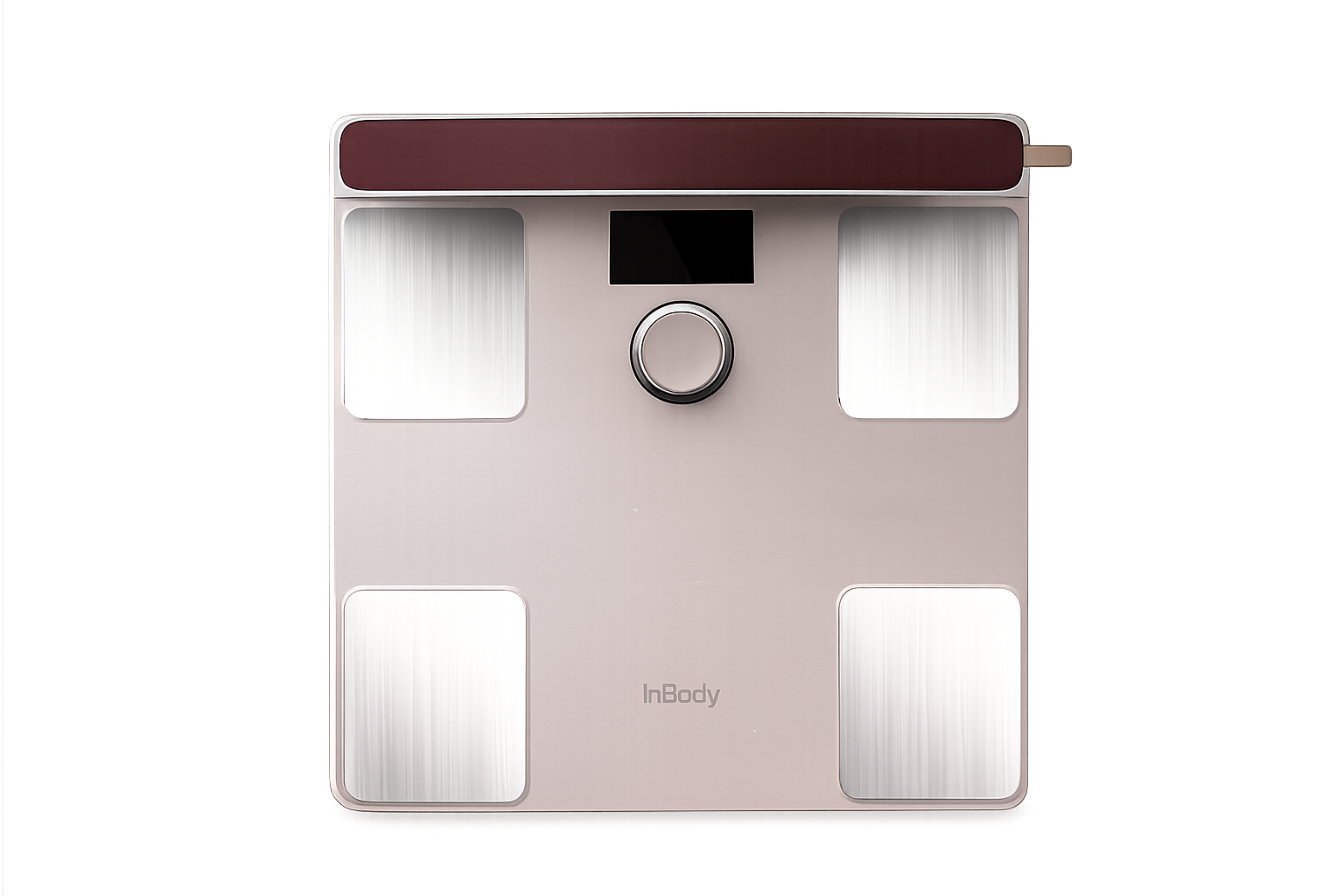


InBody accuracy has been independently validated across the full spectrum of clinical and research applications.
InBody achieves 98.4% correlation with DEXA scan — the gold standard. Unlike DEXA, InBody uses no radiation, takes 60 seconds, and costs a fraction of the price per test. It is the most accurate non-invasive, radiation-free alternative to DEXA available today.
Significantly more accurate. Home scales use single-frequency BIA with population-based estimation formulas — prone to large errors of ±5–10% body fat. InBody uses multi-frequency direct segmental measurement with no estimation equations. The validated accuracy difference is substantial, especially for tracking small changes over time.
100% reproducible under identical conditions. This is why InBody is used for longitudinal tracking — you can trust that changes in your result reflect actual body composition changes, not measurement noise. This is a critical clinical requirement.
Yes. InBody applies no demographic correction equations — results are based purely on impedance measurements. Studies with South Asian populations confirm InBody's accuracy. Its visceral fat measurement is especially relevant for Indian adults who tend to accumulate more visceral fat at lower BMI than Western populations.
Yes. InBody is used in clinical settings by hospitals, oncology centres, nephrology departments and bariatric surgery programmes across India and globally. 6,000+ peer-reviewed studies have used InBody as their measurement tool — including studies published in top-tier journals in oncology, cardiology, nephrology and sports medicine.
Our specialists offer free demonstrations at your facility across India. See the result sheet, compare with your existing method, and validate before you buy.