
Body Composition 4 min read
Energy Expenditure & Metabolism: How the InBody 770 Measures BMR
Evaluated in Clinical Research in India Most people think metabolism is just about how fast you burn calories.But your body’s energy expenditure is far more complex, and understanding…
Reading about body composition? Find an InBody test centre near you →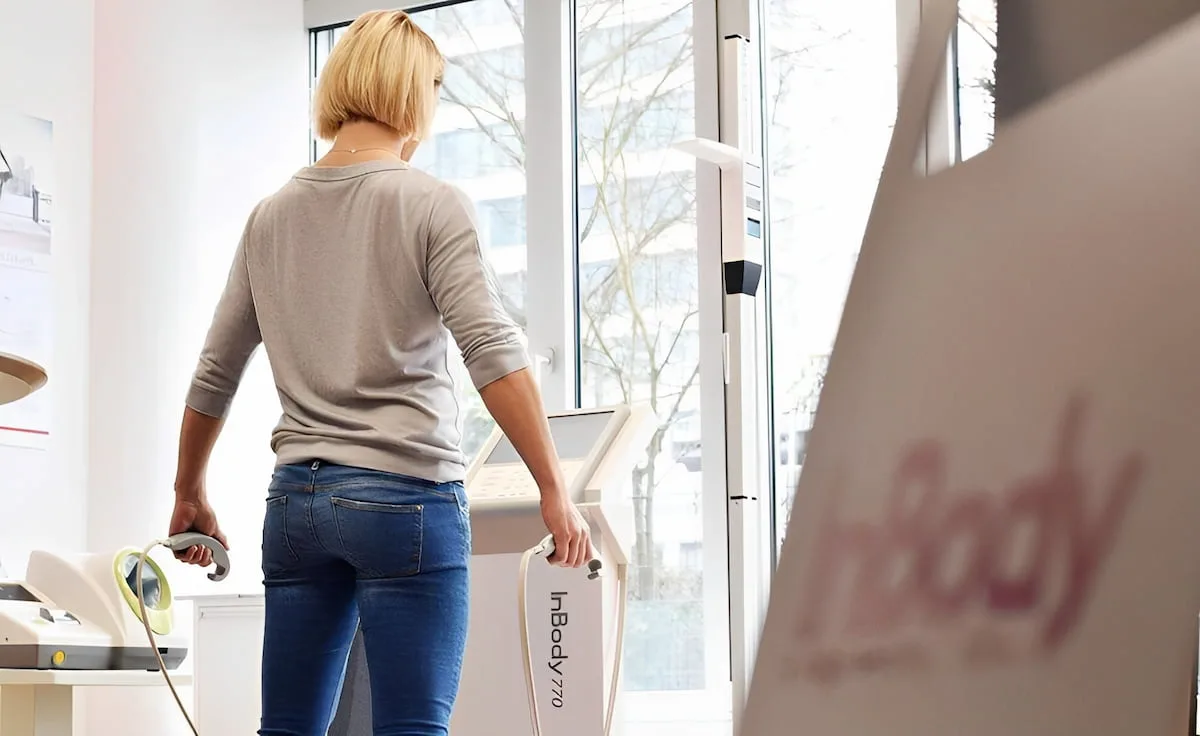
Evaluated in Clinical Research in India
Most people think metabolism is just about how fast you burn calories.
But your body’s energy expenditure is far more complex, and understanding it accurately can completely change the way you manage nutrition, performance, and recovery.
What Is Resting Energy Expenditure (REE)?
Your Resting Energy Expenditure (REE) represents the amount of energy your body needs to maintain basic functions like breathing, blood circulation, and cellular repair, even when you’re at rest. It’s the foundation of your metabolism and typically accounts for about 60–70% of total daily energy use.[1]
Accurate REE measurement can help health professionals plan personalised nutrition and weight management and guide recovery strategies in clinical settings.
How the InBody 770 Measures Metabolism
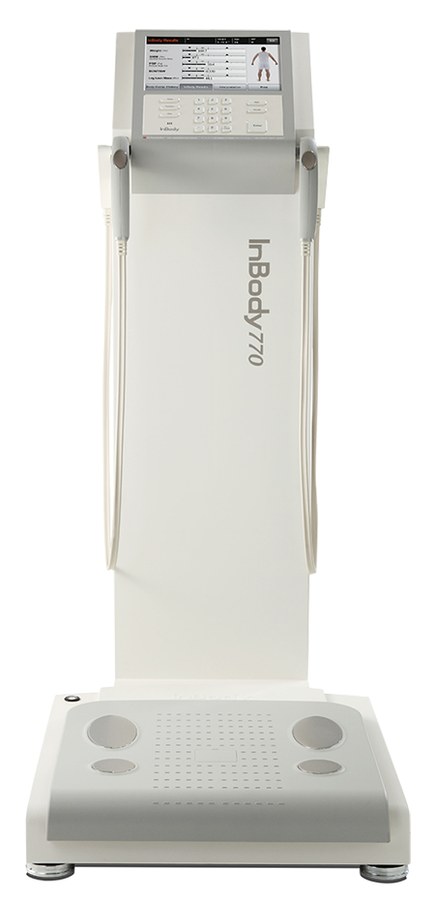
Indirect calorimetry (IC) is the clinical reference method for measuring REE, but access is often limited by equipment cost and the technical expertise it needs.[2] The InBody 770, however, offers a non-invasive, rapid alternative that uses advanced multi-frequency bioelectrical impedance analysis (BIA), and a published Indian study has compared it against IC (details below).
Key advantages:
- Estimates energy expenditure based on your unique body composition, not just weight or height.
- Offers real-time metabolic data within minutes.
- Can be applied across diverse groups, although population-specific validation is still needed.[2]
- Gave a clinically comparable REE estimate to calorimetry in obese Indian adults in the study below, and is more accessible than calorimetry.[2]
Backed by Clinical Evidence
A peer-reviewed study published in Cureus (October 2025) by Dr. Sanjith Saseedharan and Dr. Amit Bhalerao of S. L. Raheja Hospital, Mumbai, and Dr. Kalyani Badve of RKD Medical College, Bhopal, evaluated the accuracy of the InBody 770 against Indirect Calorimetry.[2]
Study Design
- Participants: 50 Indian adults aged 18–65 with a BMI ≥ 25 kg/m² (classed as obese in the Indian context), recruited at S. L. Raheja Hospital
- Protocol: Both tests were performed under standardized fasting and resting conditions.
- Goal: Compare REE values obtained from the InBody 770 and indirect calorimetry.
Results
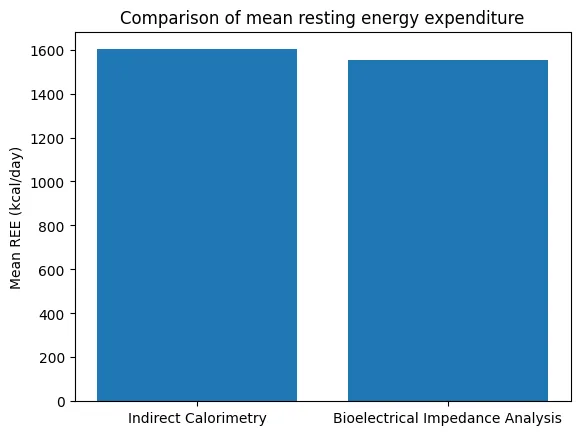
| Measurement Method | Mean REE (kcal/day)[2] | Standard Deviation |
| Indirect Calorimetry | 1601.56 | 376.72 |
| InBody 770 (BIA) | 1554.20 | 355.70 |
The analysis revealed a strong correlation (r = 0.918) and excellent concordance (CCC = 0.912) between the two methods. On average the InBody 770 read about 47 kcal/day lower than indirect calorimetry, a difference that was not statistically significant (p = 0.052), and the authors reported the two methods to be equivalent within a ±10% margin. Individual differences were wider, though: the 95% limits of agreement ran from −279 to +373 kcal/day.[2]
Visual Insights
Comparison of Average REE Values
In this study, average InBody 770 results were close to those from indirect calorimetry.
Correlation Between Both Methods
The scatter plot shows a clear positive correlation between the two methods; correlation alone does not show agreement, which is why the authors also tested concordance and bias.

Why It Matters
Accurately knowing your Resting Energy Expenditure is essential for:
- Building customized nutrition plans based on real metabolic data.
- Preventing underfeeding or overfeeding during weight loss or clinical care.
- Supporting recovery in patients and optimizing performance in athletes.
- Understanding metabolic health changes over time.
Even small inaccuracies in estimating REE can matter for nutrition planning.
In this study, the InBody 770 offered a practical balance between accessibility and precision, which may help clinicians and practitioners make informed, data-driven decisions.
Conclusion
This study suggests that InBody’s multi-frequency BIA technology can be a practical tool for metabolic assessment, especially where indirect calorimetry is not readily available. It was a single-centre study of 50 adults, and the authors call for validation in larger and more diverse populations.[2]
By combining body composition analysis, energy expenditure, and cellular health indicators (Phase Angle), the InBody 770 provides a comprehensive view of human metabolism, empowering better decisions for nutrition, rehabilitation, and clinical care.
Learn More
InBody continuously supports research and innovation in the field of body composition and metabolism.
If you’re interested in a research collaboration or would like to request a demo, feel free to contact us!

Find an InBody Scanner Near You
Related reading: Visceral fat: the hidden health risk and how to reduce it · Energy expenditure and metabolism: how the InBody 770 measures BMR
References
- National Academies of Sciences, Engineering, and Medicine. Dietary Reference Intakes for Energy. Chapter 4, Factors Affecting Energy Expenditure and Requirements. Washington, DC: The National Academies Press; 2023. National Academies Press · DOI
- Saseedharan S, Bhalerao A, Badve K. A prospective comparative study to assess the accuracy of energy expenditures calculated by bioimpedance analysis and indirect calorimetry. Cureus. 2025;17(10):e95586. PubMed · DOI

Most trending articles
Student Fitness Screening in India: A Guide for Schools
CBSE HPE, Fit India and Khelo India rely on BMI. How schools and colleges can add body composition screening safely, with child caveats and DPDP consent.
Creatine and Your Body Composition Scan: What Changes
Creatine raises body water and lean mass readings within a week on BIA and DXA. What the studies show and how to time your scans to read progress honestly.
Fitness Testing and Body Composition for Sports Academies
A practical fitness testing battery for Indian sports academies: body composition, grip, jumps, sprints, Yo-Yo, Khelo India context and youth maturation.