
Body Composition 6 min read
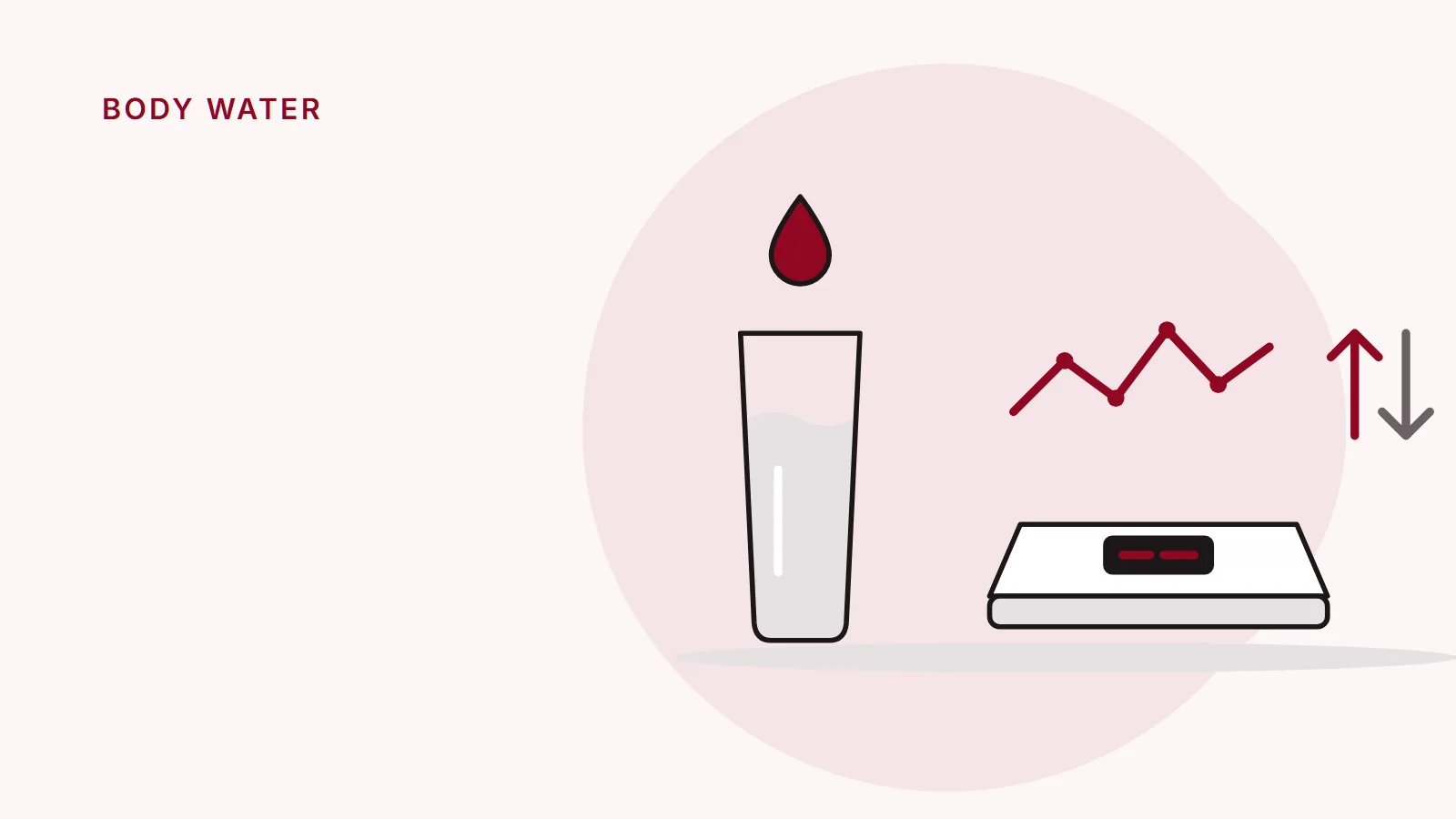
Water Weight: Why Your Weight Changes Every Day
Weigh yourself every morning for a week and you will rarely see the same number twice. Up half a kilo after a wedding dinner, down again two days…
In this article
- How much of you is water
- Seven things that move water weight
- The weekend effect
- How to weigh yourself so water does not fool you
- Drinking enough water helps, not hurts
- When it is more than water weight
- See water and fat separately
- Frequently Asked Questions
- Why does my weight go up overnight?
- How much can weight change in a day?
- How do I get rid of water weight?
- Does drinking more water cause water retention?
- Why do I weigh more before my period?
- Sources
Weigh yourself every morning for a week and you will rarely see the same number twice. Up half a kilo after a wedding dinner, down again two days later. That is not fat. Storing even half a kilo of fat takes thousands of extra calories over days, and you cannot lose it overnight either. Most day-to-day change is water, food and what is still in your gut.
How much of you is water
Water makes up roughly 50 to 60% of an adult’s body weight, usually more in men than in women. Muscle holds a lot of it and fat holds very little, so people with more muscle carry more water. About two-thirds of it sits inside your cells (intracellular water) and the rest outside them, in blood and the spaces between cells (extracellular water). Swelling (oedema) is extra water in that outside share.
Seven things that move water weight
- Salt. Sodium holds water. A salty restaurant meal, pickles, papad or namkeen often shows on the scale the next morning. WHO advises adults to keep salt under 5 g a day[1]. More in how sodium controls water balance.
- Carbohydrates. Your muscles and liver store carbohydrate as glycogen, and each gram is stored with roughly three grams of water[2]. That is one reason weight drops quickly in the first days of a low-carbohydrate diet and returns when carbohydrate intake goes back up.
- Food and gut contents. A large dinner, late meals or constipation can add weight that has nothing to do with fat.
- The menstrual cycle. Many women retain more fluid around the start of their period; in one year-long study, fluid retention was highest on the first day of flow[3].
- Heat, travel and long sitting. Long flights, train journeys and desk days let fluid pool in the legs and ankles.
- Hard or new exercise. Sore muscles hold extra water while they repair, and creatine pulls water into muscle; see what creatine does to your scan.
- Alcohol, late nights and medicines. Some medicines can cause fluid retention too; never stop a medicine without asking your doctor.
The weekend effect
In a study of people who weighed themselves daily, weight was highest on Sunday and Monday and fell during the week, with the lowest readings usually on Friday or Saturday[4]. The authors concluded that this weekly swing is normal, not a sign of weight gain. Compare averages, not single days.
In the example below, the lightest and heaviest mornings differ by 0.9 kg (70.3 kg on Friday, 71.2 kg on Sunday), yet nothing real changed. The number to compare with next week is the weekly average, 70.7 kg.
- Morning weight
- kg
How to weigh yourself so water does not fool you
- 1Same timeFirst thing in the morning
- 2Toilet firstAfter the toilet, before food or water
- 3Same scaleOn a hard floor, in similar clothes
- 4AverageUse the weekly average, not single days
- 5Compare monthlyJudge the trend over 2 to 4 weeks
If you are trying to lose fat, expect the scale to wobble and judge yourself on the trend over a month. Also see why the scale does not tell the whole story.
Drinking enough water helps, not hurts
Drinking more water does not make healthy people retain water; the kidneys pass out what you do not need. Our free water intake calculator works out a daily target, with extra for exercise and Indian heat.
When it is more than water weight
See a doctor promptly if your weight rises quickly together with swelling of the legs, ankles or face, breathlessness (especially lying flat), or passing much less urine than usual, and always if you have heart, kidney or liver disease. These can be signs of fluid build-up that needs treatment. Kidney problems in particular can be silent for years; read about slow-growing kidney disease.
See water and fat separately
A body composition test splits your weight into water, protein, minerals and fat, so you can see whether a change is fluid or fat. An InBody result sheet also reports the ECW ratio, extracellular water divided by total body water. InBody’s normal range is 0.360 to 0.390; readings above 0.390 are flagged, and several InBody sheets advise speaking to a doctor at 0.400 or above. Read more in ECW ratio on your InBody report or check a reading with the free ECW ratio checker.
- Normal 0.360–0.390
- Flagged 0.390–0.400
- Talk to a doctor 0.400–0.420
Want to know how much of your weight is water, muscle and fat? Find an InBody test centre near you. Prefer Hinglish? Read Pet ki charbi hai ya pani ki sujan.
Frequently Asked Questions
Why does my weight go up overnight?
Usually because of water and food, not fat: a salty or late dinner, more carbohydrate than usual, constipation, hard exercise or the menstrual cycle. Fat cannot be gained that fast.
How much can weight change in a day?
Day-to-day changes are mostly water and gut contents, not fat. Compare weekly averages instead of single days, and judge the trend over two to four weeks.
How do I get rid of water weight?
Cut back on very salty food, drink enough water, keep carbohydrate intake steady, move during long sitting or travel, and sleep well.
Does drinking more water cause water retention?
Not in healthy people. The kidneys pass out the water you do not need. Salt, by contrast, holds water in the body.
Why do I weigh more before my period?
Many women retain more fluid around the start of their period. In a year-long study, fluid retention was highest on the first day of flow. It usually settles within a few days.
This article is for general education and is not a substitute for medical advice. If you have a health condition, are pregnant or take regular medicines, talk to your doctor before changing your diet or training.
Sources
- World Health Organization. Guideline: sodium intake for adults and children. Geneva: WHO; 2012. WHO
- Fernández-Elías VE, Ortega JF, Nelson RK, Mora-Rodriguez R. Relationship between muscle water and glycogen recovery after prolonged exercise in the heat in humans. Eur J Appl Physiol. 2015;115(9):1919-1926. PubMed
- White CP, Hitchcock CL, Vigna YM, Prior JC. Fluid retention over the menstrual cycle: 1-year data from the prospective ovulation cohort. Obstet Gynecol Int. 2011;2011:138451. PubMed
- Orsama AL, Mattila E, Ermes M, et al. Weight rhythms: weight increases during weekends and decreases during weekdays. Obes Facts. 2014;7(1):36-47. PubMed
Related articles
What 15%, 20%, 25% and 30% Body Fat Looks Like (Indian Men and Women)
Search for “what 20% body fat looks like” and you get a grid of shirtless photos. They are a poor guide. Lighting, posture and…
Body Fat Percentage to See Abs: Men and Women (Honest Answer)
Short answer: abs usually start to show at about 10–14% body fat in men and about 16–20% in women, with a sharp six-pack lower…
चेस्ट फैट कैसे कम करें? पुरुषों के लिए क्या काम करता है और क्या नहीं
पुरुषों की छाती पर दिखने वाली चर्बी आमतौर पर दो में से एक चीज़ होती है। पहली, साधारण बॉडी फैट (जिसे स्यूडो-गाइनेकोमैस्टिया भी कहते…