
Body Composition 8 min read
Are Smart Body-Fat Scales Accurate? What Studies Show
Are smart body-fat scales accurate? What independent studies found on weight versus fat readings, and how to choose and use one in India.
Reading about body composition? Find an InBody test centre near you →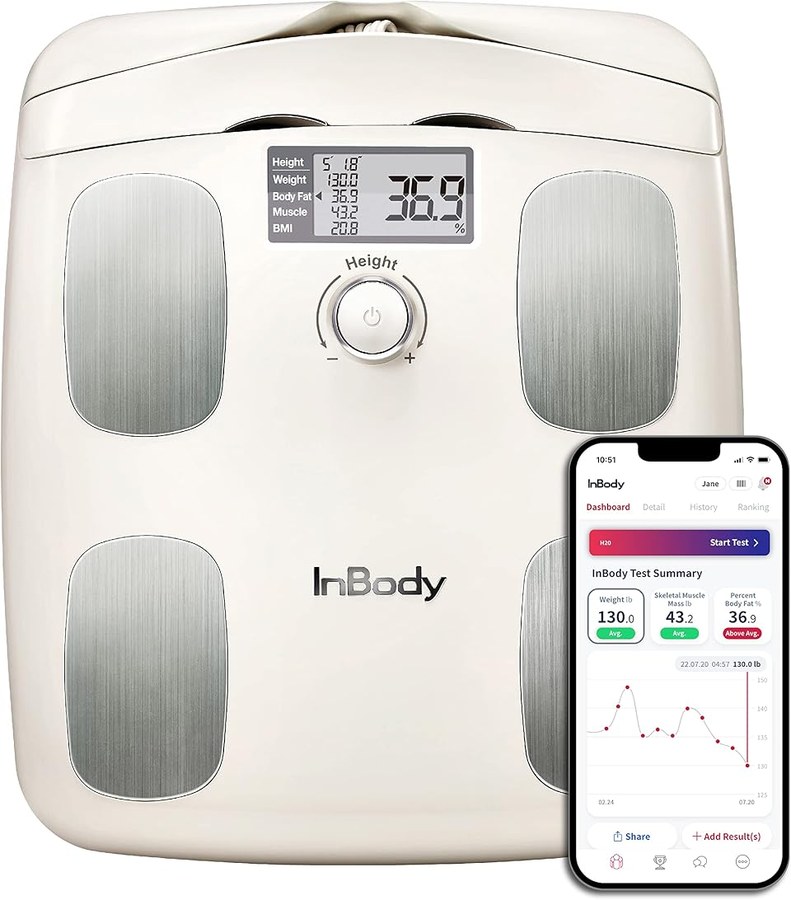
Are Smart Body-Fat Scales Accurate? What Studies Show
Search for a smart scale in India and you will find a wall of listings promising body fat, muscle mass, bone mass, visceral fat and “metabolic age” for the price of a dinner out. So the real question is a fair one: are smart body-fat scales accurate, or is the body fat number just decoration?
The short answer from independent studies: good for weight, rough for fat. Home scales tend to be reliable at what a scale was always meant to do and much less reliable at estimating body fat for any one person. That does not make them useless. It changes how you should use them. This guide goes through what researchers actually measured, why different scales disagree with each other, what we can and cannot say about the popular budget brands sold in India, and a short checklist for buying one.
Short Answer: Weight Is Fine, Fat Is Approximate
The clearest independent test of home smart scales comes from a French study published in JMIR mHealth and uHealth in 2021. Researchers compared three consumer smart scales against DEXA in hospital patients, roughly 50 people per scale. The results:
- Weight: median error of 0.3 kg or less. Scales are good at this.
- Fat mass: the scales under-read by a median of about 2 to 4.4 kg compared with DEXA, with wide spread between individuals.
- Authors’ conclusion: the scales were not accurate for body composition and should not replace DEXA in patient care.
Two cautions. These were patients attending a hospital for DEXA, not a typical Indian household. And the study tested those three scales, not the models sold here. But the pattern, accurate weight with an unreliable fat estimate, is the one worth remembering.
How a Bathroom Scale Estimates Body Fat
A smart scale sends a very small electrical current through your body and measures how much resistance it meets. This is bioelectrical impedance analysis. Fat resists current; water-rich lean tissue conducts it. The scale then uses an equation, built from reference populations, to turn that resistance into a body fat percentage.
Where scales differ is in the design:
- Foot-to-foot scales send current through the legs and lower trunk only, then estimate the rest.
- Hand-to-foot designs use handles or extra contacts so the current travels through the arms, trunk and legs.
- Frequency. Single-frequency scales mostly see total water. Multi-frequency designs can separate fluid inside and outside cells better.
- The equation behind it. This is proprietary, and it is where most of the guesswork lives.
What Independent Studies Have Actually Measured
| Study | What was compared | What it found |
|---|---|---|
| JMIR mHealth 2021 (France) | Three consumer smart scales vs DEXA, hospital patients | Weight accurate; fat mass under-read by about 2 to 4.4 kg (median) |
| Czartoryski et al., J Exerc Nutr 2020 | InBody 270 and a handheld consumer device vs DXA, 47 trained adults | InBody 270 not significantly different from DXA; the handheld device under-predicted body fat |
| Garcia et al., J Exerc Nutr 2020 | InBody 270 vs DXA, 88 adults | Significantly under-predicted body fat percentage and fat mass; over-predicted fat-free mass |
| Biophysica 2026 | An Omron monitor and a Tanita scale against an InBody 770 reference, 115 people | The Omron read higher and the Tanita read lower than the reference, by roughly 2 to 4 body-fat points; the authors advised against using devices interchangeably |
Read that table the way a sceptic would. The two studies of the same InBody model disagree with each other, which is exactly what you would expect from real-world data: results depend on who was tested, how, and what the reference was. The 2026 study used another bioimpedance device, not DEXA, as its reference, so it shows that scales disagree with each other. It does not show which one is right.
Group Average vs Your Own Number
Studies often report that a device “agrees well” on average. Averages hide the individual. If a scale reads 3 points too high for one person and 3 points too low for another, the group mean looks perfect while both individuals are wrong.
That is why researchers report limits of agreement, the range within which most individual errors fall. A preliminary independent test of the InBody Dial H30 shows what that looks like. In a conference poster from the University of South Carolina Upstate (2026, 55 young adults, three-compartment reference model), the Dial H30 read on average 1.9 body-fat points higher than the reference, with individual differences ranging from about 4 points too low to nearly 8 points too high. The authors concluded that it was usable for group-level or longitudinal tracking but not interchangeable with multi-compartment methods for individuals. It is a poster, not a peer-reviewed paper, and the sample was young and lean, so treat it as an early signal rather than a verdict.
Why Scales Disagree With Each Other
Stand on two different scales on the same morning and you can get body fat readings several points apart. That is not a malfunction. It is design and equations. In the 2026 comparison above, one device read higher than the reference and another lower, and the authors’ advice was not to swap devices when tracking change. The practical rule: pick one scale and stay with it.
Your own body adds noise too. Hydration, a recent meal, hard exercise, a hot shower, and even the time of day all shift the reading. A fat percentage that jumps from 24% to 27% overnight is far more likely to be water than fat.
What We Can and Cannot Say About Budget Scales
Many Indian buyers are choosing between popular budget brands such as Xiaomi, Realme or Fitelo. We searched for independent, peer-reviewed accuracy testing of those specific models against DEXA and did not find any. That means two things:
- Any claim that they are “accurate” rests on the manufacturer’s own statements.
- Any claim that they are “inaccurate” is equally unsupported. The honest line is that no independent study we could find has tested them, and the evidence on similar-design scales suggests treating the fat percentage as approximate.
A Five-Question Buying Checklist for India
- How many electrodes, and where? Feet-only contacts estimate the upper body. Designs that include the hands see more of the body.
- Can you see trends? A good app stores every reading, shows weekly averages and lets you export data.
- Does it support several users? Useful in a family, as long as each person is profiled correctly.
- Who supports it in India? Look for an Indian warranty, servicing and a working app.
- What does the maker actually claim? Be wary of “clinical grade” or “medical accuracy” without a named study you can look up.
When a Home Scale Is Enough, and When It Is Not
A home scale is a reasonable tool if your goal is to watch direction: is muscle holding steady while the weight comes down, is body fat trending the right way over weeks? Weigh at the same time of day, under the same conditions, and look at four-week averages, not daily readings.
A home scale is not the right tool if you need a baseline for a medical decision, you are on a weight-loss medicine, you are managing a condition like diabetes, or you want segmental data for each arm and leg. In those cases a scan at a clinic or centre gives you a more detailed reading to start from. InBody’s home range, the InBody Dial, is designed for the first use case. For a professional baseline, find an InBody test centre near you, then track the trend at home. Our comparison of professional versus home analysers and the Dial H20 versus H30 guide go deeper.
How to Use Any Smart Scale Properly
- Same time, same conditions. First thing in the morning, after the toilet, before food and drink.
- Bare, dry feet on clean contacts.
- Do not read a single day. Use a rolling four-week view.
- Do not change scales mid-journey. A new device resets your baseline.
- Cross-check once. A single professional scan can tell you whether your home scale reads high or low for you.
Frequently Asked Questions
Are body fat scales accurate?
They are accurate for weight and approximate for body fat. An independent French study found three consumer smart scales read weight within about 0.3 kg but under-read fat mass by roughly 2 to 4 kg compared with DEXA. Use them for trends, not for a single absolute number.
Are Xiaomi or Mi body composition scales accurate?
We found no independent peer-reviewed study testing those models against DEXA, so accuracy claims come from the manufacturer. Evidence on similar-design scales suggests the body fat percentage is approximate. Use it to watch your trend over weeks and keep using the same scale.
Which is right, Omron or Tanita?
Neither is a reference standard. A 2026 comparison against an InBody 770 found one read higher and the other lower by roughly 2 to 4 body-fat points. The takeaway is that devices disagree, so choose one and avoid switching during a tracking period.
Can a home scale replace a DEXA scan?
No. The JMIR study authors concluded that smart scales should not replace DEXA in patient care. A home scale suits long-term tracking. If you need a clinical baseline, use a professional body composition scan or DEXA.
Is the InBody Dial H30 accurate?
The only independent data we found is a preliminary 2026 conference poster in 55 young adults. It showed a small average bias of about 1.9 body-fat points, with wide individual differences, and suggested it suits tracking over time. Larger, peer-reviewed studies in Indian adults are still needed.
How much can body fat readings change from day to day?
They vary with hydration, meals, exercise and time of day, sometimes by several points. We do not have a single reliable figure for everyone, which is why a four-week average is more meaningful than any one morning’s reading.
What is a good body fat percentage for Indians?
It depends on age and sex, and healthy ranges are higher for women than men. See our body fat percentage chart for India for ranges by age.
Start With One Reliable Baseline
If you are buying a scale to track real change, begin with a measured starting point. Find an InBody test centre near you for a professional baseline, or see the InBody Dial range for tracking at home.
Related reading: body composition methods compared and how to choose a body composition test centre.

Most trending articles
Student Fitness Screening in India: A Guide for Schools
CBSE HPE, Fit India and Khelo India rely on BMI. How schools and colleges can add body composition screening safely, with child caveats and DPDP consent.
Creatine and Your Body Composition Scan: What Changes
Creatine raises body water and lean mass readings within a week on BIA and DXA. What the studies show and how to time your scans to read progress honestly.
Fitness Testing and Body Composition for Sports Academies
A practical fitness testing battery for Indian sports academies: body composition, grip, jumps, sprints, Yo-Yo, Khelo India context and youth maturation.