
Body Composition 6 min read
How to Choose a Body Composition Analyzer in India (2026)
Four specifications separate a device that measures your body from one that guesses it from population averages. Plus 8 questions to put to any supplier.
Reading about body composition? Find an InBody test centre near you →
Choosing a Body Composition Analyzer Without Getting Sold the Wrong One
Search for a body composition analyzer in India and you will find devices separated by an enormous range in price, all claiming similar things: body fat percentage, muscle mass, water balance, DEXA-level accuracy. The specification sheets look broadly alike. They are not alike.
The difference between a device that measures your body and a device that estimates it from population averages is not visible in the marketing. It is visible in four specifications, and once you know which four, the market sorts itself out quickly.
This guide is for anyone buying for a gym, clinic, hospital, corporate wellness programme or sports facility — and for anyone who simply wants to understand what the machine they stood on was actually doing.
The Four Specifications That Decide Everything
1. Does it use empirical estimation?
This is the single most important question, and most buyers never ask it.
Some BIA devices measure a limited set of values, then apply statistical corrections based on your age, sex or ethnicity to fill in the rest. The output looks like a measurement. Part of it is a prediction drawn from population data.
The practical consequence: two people of the same age, sex, height and weight receive near-identical reports even when one is a trained athlete and the other is sedentary. The device is partly describing a demographic, not the person standing on it.
InBody devices calculate results directly from measured impedance in each segment, with no age, sex or ethnicity corrections applied. Ask any supplier this question directly and insist on a specific answer.
2. Direct segmental measurement, or whole-body?
An arm and a trunk are electrically very different. A device treating the body as one uniform cylinder cannot tell you where your muscle is.
Direct Segmental Multi-frequency BIA (DSM-BIA) measures five segments independently: right arm, left arm, trunk, right leg, left leg. This is what surfaces a weaker left leg after an injury, a muscle deficit in the trunk, or asymmetry that a whole-body number averages into invisibility. For clinical and training use, segmental data is where most of the actionable insight lives.
3. How many frequencies?
Low-frequency current travels mostly around cells, through extracellular water. Higher-frequency current crosses cell membranes into intracellular water. A device using a single frequency cannot separate those compartments, so it cannot properly assess fluid balance.
- Single frequency — adequate for a rough fat estimate, not for clinical use.
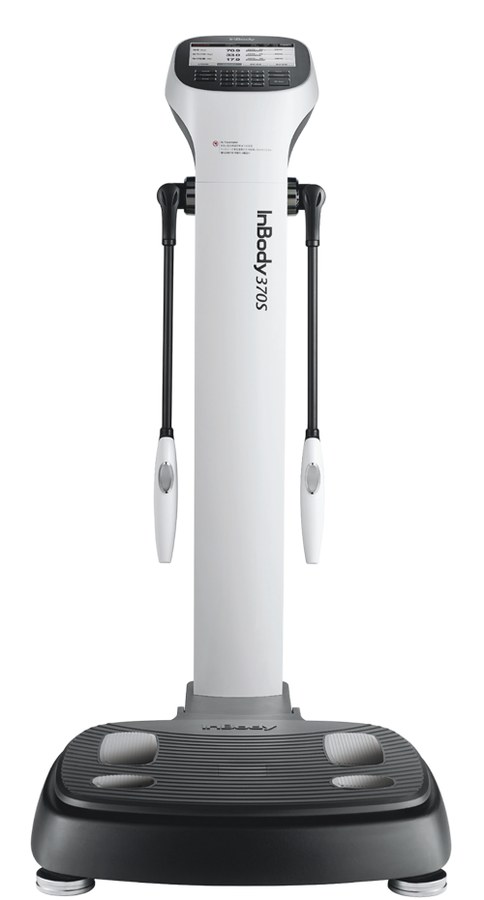
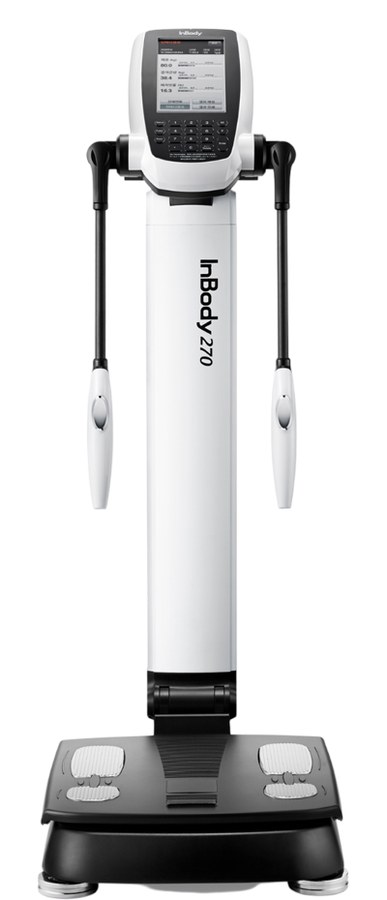
- Three frequencies (for example 20, 50 and 100 kHz on the InBody 270S) — the practical standard for gyms, wellness and general clinical work.
- Six frequencies (1 kHz to 1,000 kHz on the InBody 770S) — needed for Phase Angle, segmental water analysis and extracellular-to-total body water ratios used in nephrology, oncology and critical care.
4. What electrode system does it use?
Look for tetrapolar 8-point tactile electrodes. Tetrapolar means the electrodes injecting current are separate from those sensing voltage, which removes skin-contact resistance from the result. Eight-point tactile means the measurement starts at a fixed anatomical point — the wrist and the ankle — every single time.
That fixed start point is what makes a re-test eight weeks later genuinely comparable to the baseline. Devices measuring foot-to-foot only, as most consumer scales do, cannot assess the upper body at all.
Comparing the Options Honestly
| Device type | Typical use | What it does well | Where it falls short |
|---|---|---|---|
| Consumer foot-to-foot scale | Home | Cheap, convenient, fine for tracking a rough trend | Cannot measure upper body; heavy reliance on estimation |
| Single-frequency handheld | Basic screening | Portable, low cost | No segmental data, no fluid compartment separation |
| 3-frequency DSM-BIA | Gyms, clinics, wellness | Segmental muscle and fat, visceral fat, ~60-second test, 98% DEXA correlation | No Phase Angle; limited research-grade water analysis |
| 6-frequency DSM-BIA | Hospitals, research, sports science | Phase Angle, segmental ECW/TBW, visceral fat area in cm², 99% DEXA correlation | Higher cost than a gym setting needs |
| DEXA | Bone density, research | Reference standard for fat and lean mass; measures bone mineral density | Radiation exposure, fixed installation, slower, no water or Phase Angle data |
DEXA deserves a specific note, because it is often positioned as strictly superior. It is the reference standard for body fat and lean mass, and it is the only option if you need bone mineral density — BIA devices do not measure bone density at all. But DEXA involves radiation exposure, needs a fixed installation, takes longer, and does not report body water compartments or Phase Angle. The comparison is covered fully in InBody vs DEXA vs calipers.
Match the Device to the Setting
Buying above your requirement wastes budget. Buying below it produces data nobody trusts.
- Gym or fitness studio — three-frequency professional device, fast test, member-readable sheet. Detail in our gym buyer’s guide.
- Clinic or OPD — three-frequency minimum, with segmental lean analysis and visceral fat, and a printout that files cleanly into patient records.
- Hospital department, nephrology, oncology, critical care — six frequencies, Phase Angle, segmental water balance. See the hospital and clinical guide.
- Corporate wellness screening — throughput and reporting matter most; covered in corporate wellness screening.
- Home — a professional analyser is not the right purchase. See professional vs home analysers.
Questions to Put to Any Supplier Before You Sign
- Does the device apply empirical estimation based on age, sex or ethnicity? Ask for a direct yes or no.
- Does it measure all five body segments independently?
- How many measurement frequencies, and what are they?
- What is the published validation against DEXA, and in which study?
- What does the service and calibration plan cover, and for how long?
- Is the device supplied with authorised warranty support in India?
- How many measurements does it store, and can results be exported per patient or member ID?
- What consumables are required, and what do they cost annually?
A supplier who answers all eight clearly is selling a device worth considering. One who deflects on question one is telling you something important.
A Note on Accuracy Claims
Almost every analyser on the market claims high accuracy. The claim is only meaningful with a reference and a study behind it. InBody professional devices report 98% correlation with DEXA in published validation work, and the six-frequency 770S reports 99%.
Equally important, and less discussed: consistency matters more than absolute accuracy for most real uses. If you are tracking whether a member gained muscle over eight weeks, what you need is a device that produces the same reading under the same conditions every time. A device that is consistently off by a small margin is still useful for trend tracking. A device that varies unpredictably between tests is not useful for anything.
This is why fixed-point tactile electrodes and standardised test conditions matter as much as the headline correlation figure.
Start With Your Own Baseline
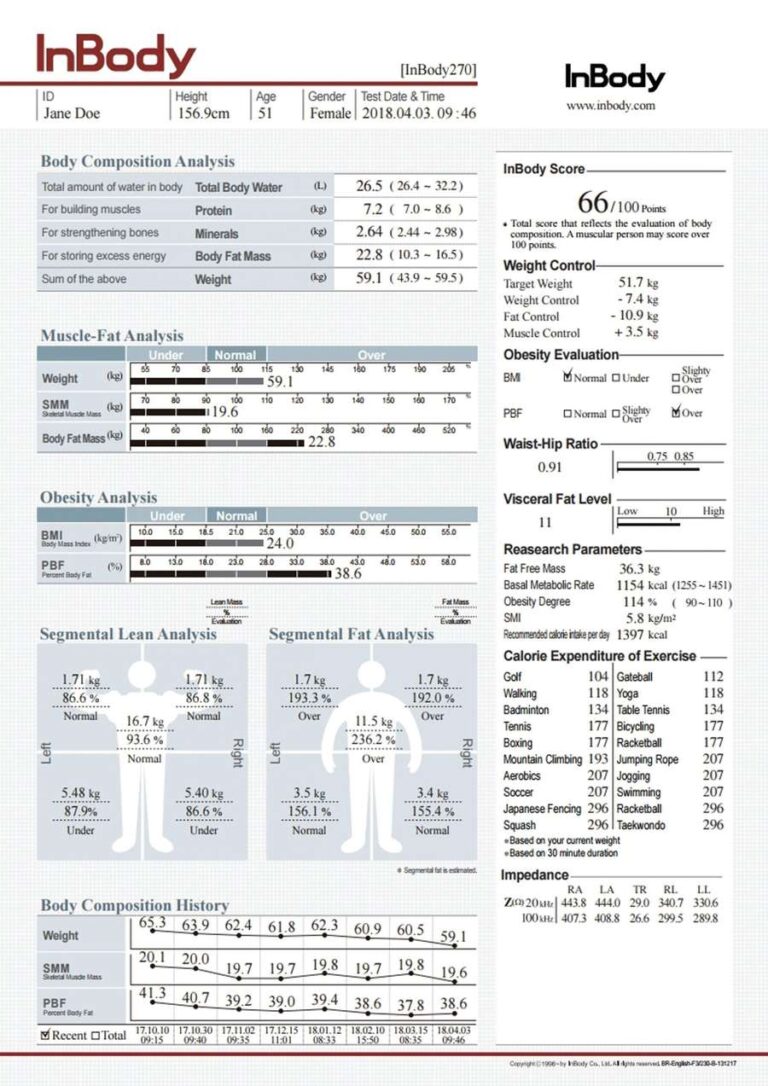
Specifications make more sense once you have seen a real result sheet and understood what each output is telling you.
Book an InBody test at inbody.in/inbody-test.php or find a centre near you at inbody.in/locations. Evaluating devices for a facility? Request a specification-matched quote at inbody.in/inbody-price.php. Related reading: the complete BCA machine guide, DSM-BIA vs single-frequency BIA, and how to read an InBody results sheet.

Most trending articles
वज़न बढ़ाने के लिए क्या खाएं? सही डाइट प्लान (सिर्फ ज़्यादा खाना नहीं)
सिर्फ ज़्यादा खाने से मांसपेशी नहीं बनती, चर्बी बढ़ सकती है। सही कैलोरी सरप्लस, प्रोटीन और डाइट प्लान जो वज़न को सही तरीके से बढ़ाए — पूरी जानकारी हिंदी में।
भारत में प्रोटीन कितना ज़रूरी है? असली आंकड़े और सही फॉर्मूला
IMRB के एक सर्वे में लगभग 73% भारतीय आहार प्रोटीन-कम पाए गए। सही प्रोटीन टारगेट कैसे निकालें और किन फूड्स से पूरा करें — पूरी जानकारी हिंदी में।
Metabolic Age क्या होती है? आपकी उम्र से ज़्यादा है या कम?
आपकी असली उम्र 34 है पर शरीर 50 साल जैसा व्यवहार कर सकता है। Metabolic age क्या है, मांसपेशी घटने के जोखिम क्या हैं और इसे कैसे घटाएं — पूरी जानकारी।