
Body Composition 8 min read
Skeletal Muscle Mass (SMM): Normal Range on InBody
What SMM means on your InBody report, how the 90-110% normal bar works, why SMM is not SMI, and the AWGS cut-offs used to screen for low muscle.
Reading about body composition? Find an InBody test centre near you →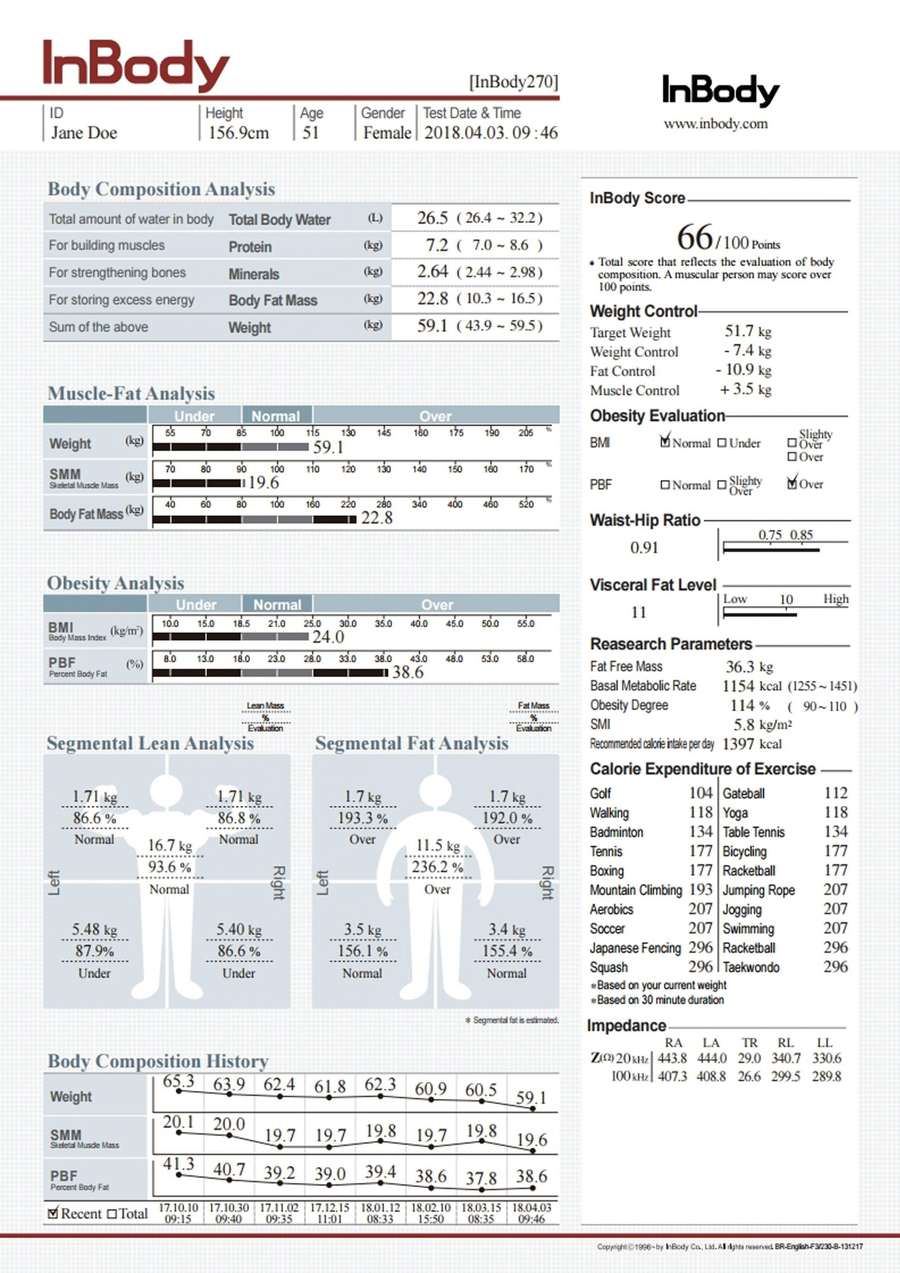
Skeletal Muscle Mass (SMM): Normal Range on InBody
SMM on an InBody report stands for skeletal muscle mass: the weight, in kilograms, of the muscle attached to your bones, the kind you use to walk, lift and climb stairs. The skeletal muscle mass normal range on an InBody sheet is not one fixed number. It is a bar, and InBody’s training manual defines normal as 90% to 110% of the standard muscle for your height. If your bar stops short of 90, the sheet marks you as “Under”.
This guide explains how that bar works, why a fixed “normal SMM in kg” chart can mislead, how SMM differs from the skeletal muscle index used to screen for sarcopenia, and what to do with your number.
What SMM Measures (and What It Does Not)
Your body has three kinds of muscle: skeletal muscle, heart muscle and the smooth muscle in organs such as the gut. Only skeletal muscle responds to training, and only skeletal muscle is counted in SMM.
SMM is also not the same as lean body mass. Lean body mass, which current InBody sheets call Fat Free Mass, includes all your body water, organs, skin and bone. SMM is one part of it, so it is always the smaller number. If you are comparing the two, our post on lean body mass vs muscle covers the difference.
One more caveat. A bioimpedance analyser such as InBody does not see muscle directly. As the European sarcopenia consensus (EWGSOP2) explains, BIA estimates muscle from how the body conducts a small current, using equations calibrated against reference scans. It is a good estimate, and it is best used for trends on the same device.
How InBody Shows the SMM Normal Range
Look at the Muscle-Fat Analysis section, three horizontal bars under the main table: Weight, SMM and Body Fat Mass. Each bar has a percentage scale along the top.
The InBody 770 training manual explains the scale. A bar reaching 100% means you have the average skeletal muscle for a person of your height at a standard weight. The normal range of SMM is 90% to 110% of that standard. The InBody 270 and 370S result sheets used across India print the same 90–110% normal band. The number printed at the end of the bar is your actual SMM in kilograms.
| Where your SMM bar ends | What it means on the sheet | Read it with |
|---|---|---|
| Below 90% | “Under”: less muscle than standard for your height | Strength and function; your doctor if you are older or losing weight |
| 90% to 110% | Normal for your height | Your trend over time |
| Above 110% | More muscle than standard, common in people who train | The ECW ratio, to rule out swelling inflating the reading |
This is why a single chart of “normal SMM for men is X kg” is less useful than your own bar. Two healthy women of 150 cm and 175 cm should not have the same muscle in kilograms. The bar adjusts for that.
Reading the Three Bars Together
The SMM bar means most when you read it against the other two. InBody’s manual teaches this with letter shapes, drawn by joining the ends of the Weight, SMM and Body Fat Mass bars.
- C shape: weight and fat bars long, SMM bar short. The manual notes the person may be within the normal weight range and still not have an ideal composition. Its advice is to aim for losing fat while gaining muscle, which may not require losing any weight at all.
- D shape: SMM bar longer than the weight and fat bars. The manual calls this the ideal body composition, and still advises keeping an eye on abdominal fat with age.
Plenty of results sit between these two. The shape is a quick visual, not a verdict.
The sample sheet in the image is a clear C. A 51-year-old woman, 156.9 cm, 59.1 kg. Her BMI of 24.0 prints as “Normal” on that sheet, but her SMM bar (19.6 kg) stops before 90% while her body fat bar runs past 200%. Weight alone would never have flagged it.
SMM vs SMI: The Number Used for Sarcopenia
Here is a point most pages miss. Sarcopenia guidelines do not use whole-body SMM. They use appendicular muscle, the muscle in your arms and legs, divided by height squared. This is often called the skeletal muscle index, or SMI, in kg/m².
The Asian Working Group for Sarcopenia 2019 consensus sets these cut-offs for low muscle mass:
| Measure | Men | Women |
|---|---|---|
| Height-adjusted muscle mass by bioimpedance | Below 7.0 kg/m² | Below 5.7 kg/m² |
| Height-adjusted muscle mass by DXA | Below 7.0 kg/m² | Below 5.4 kg/m² |
| Handgrip strength (low strength) | Below 28 kg | Below 18 kg |
Three things to keep straight:
- Do not compare your SMM in kilograms to these numbers. They apply to SMI, a different calculation. On models that report it, SMI appears under research parameters; the sample 270 sheet above lists SMI 5.8 kg/m².
- Use the cut-off that matches the method. The women’s cut-off differs between bioimpedance and DXA.
- Low muscle alone is not sarcopenia. AWGS requires low muscle mass together with low strength or performance. The 2025 AWGS update, published in Nature Aging, extended diagnosis to adults aged 50 to 64 and made low muscle mass plus low strength the core requirement. Our AWGS 2025 explainer covers the changes for clinicians.
Strength is the half most people never test. Our post on hand grip strength normal values explains how a grip test fits in.
Why Your SMM Matters
Skeletal muscle is the body’s largest site of glucose disposal after meals, it carries you through daily movement, and it is the reserve you draw on during illness. Low muscle for your size is one reason a normal-weight person can still have poor metabolic health.
Muscle also tends to fall with age unless you work to keep it. Our post on sarcopenia in India covers why that matters and what slows it. If one limb is lower than the others, the Segmental Lean Analysis section of the same sheet shows it; for the fat bars beside it, see our segmental fat analysis post.
What Changes Your SMM Reading
Real muscle changes slowly. Readings can move faster for other reasons:
- Hydration. Muscle holds a lot of water, and BIA estimates muscle partly from water. Dehydration can make muscle read low.
- Swelling or injury. Extra fluid in a limb can inflate its lean reading. Check the ECW ratio on models that report it.
- A hard workout or a big meal just before the test. Both shift fluid and weight.
- Switching devices. Different analysers use different equations. Compare like with like.
A reasonable rule: do not react to one scan. Look at the direction across three or more tests taken under the same conditions.
How to Move a Low SMM Bar
The levers are well known, even if they take patience:
- Resistance training two or more days a week, covering the legs, which hold a large share of your muscle.
- Enough protein and total food. Muscle is hard to build in a steep calorie deficit. Your dietitian or doctor can set targets that fit your kidneys and health.
- Sleep and consistency over months, not weeks.
- Re-test every few weeks to a few months on the same device, so you can see whether the bar is moving.
If you are older, unwell, losing weight without trying, or on weight-loss medication, talk to your doctor before changing diet or training. A falling SMM in those situations deserves a clinical look, not just a gym plan.
Frequently Asked Questions
What is SMM in body composition?
SMM stands for skeletal muscle mass, the weight of the muscle attached to your bones. It excludes heart and organ muscle, body fat, bone and most body water. On InBody sheets it appears as the middle bar in the Muscle-Fat Analysis section, with your value in kilograms.
What is the normal range of SMM on InBody?
InBody defines normal as 90% to 110% of the standard skeletal muscle for your height, shown by where your SMM bar ends. Because it depends on height, there is no single normal SMM in kilograms that applies to everyone.
How much SMM is good?
Within or above the normal band for your height is a good place to be, and a steady or rising trend matters more than any single reading. If you are above 110%, check that swelling or water is not inflating the number.
Is SMM the same as muscle mass on other scales?
Not always. Some devices report a broader “muscle mass” figure that is defined differently, so the number is not directly comparable. Compare SMM only with SMM from the same device.
Can I use my SMM to check for sarcopenia?
Not directly. Sarcopenia cut-offs use appendicular muscle divided by height squared, not whole-body SMM, and they also require low strength. A doctor makes the diagnosis using muscle mass, a grip test and clinical judgement.
Skeletal muscle kitna hona chahiye?
Koi ek fixed number sabke liye sahi nahi hai, kyunki muscle height ke hisaab se badalta hai. InBody report par SMM bar 90% se 110% ke beech ho to normal maana jaata hai. Bar 90% se kam ho to “Under” dikhta hai.
Find Out Where Your SMM Bar Ends
A tape or a weighing scale cannot show your skeletal muscle. Find an InBody test centre near you and ask for the full printout, then use our result sheet guide to read the bars.
This article is for general education and is not a substitute for medical advice. A body composition reading alone does not diagnose sarcopenia or any other condition.
Related reading: how to read your InBody report and muscle mass tests in India.

Most trending articles
Student Fitness Screening in India: A Guide for Schools
CBSE HPE, Fit India and Khelo India rely on BMI. How schools and colleges can add body composition screening safely, with child caveats and DPDP consent.
Creatine and Your Body Composition Scan: What Changes
Creatine raises body water and lean mass readings within a week on BIA and DXA. What the studies show and how to time your scans to read progress honestly.
Fitness Testing and Body Composition for Sports Academies
A practical fitness testing battery for Indian sports academies: body composition, grip, jumps, sprints, Yo-Yo, Khelo India context and youth maturation.