
Body Composition 7 min read
DEXA Scan in India: Cost, Availability and When You Need One
For bone density, DEXA is the only option. For tracking muscle and fat it is often the wrong tool. Honest comparison vs BIA, plus India availability.
In this article
- DEXA Scans in India: Availability, Cost Factors, and When You Actually Need One
- What DEXA Actually Does
- Where to Get a DEXA Scan in India and What to Ask
- What to ask before you book
- InBody as a radiation-free alternative for tracking
- What Determines DEXA Scan Cost
- DEXA vs BIA for Body Composition: An Honest Comparison
- Which Should You Book?
- A Note on “Gold Standard”
- Pick the Instrument That Answers Your Question
- Sources
DEXA Scans in India: Availability, Cost Factors, and When You Actually Need One
Searching for a DEXA scan near me usually means one of two very different things. Either your doctor has asked for a bone mineral density assessment, or you have read that DEXA is the gold standard for body fat measurement and want the most accurate number available.
Those two goals lead to different answers. For bone density, DEXA is not merely the best option — it is effectively the only one. For routine body composition tracking, it is frequently the wrong tool, and this guide explains why.
What DEXA Actually Does
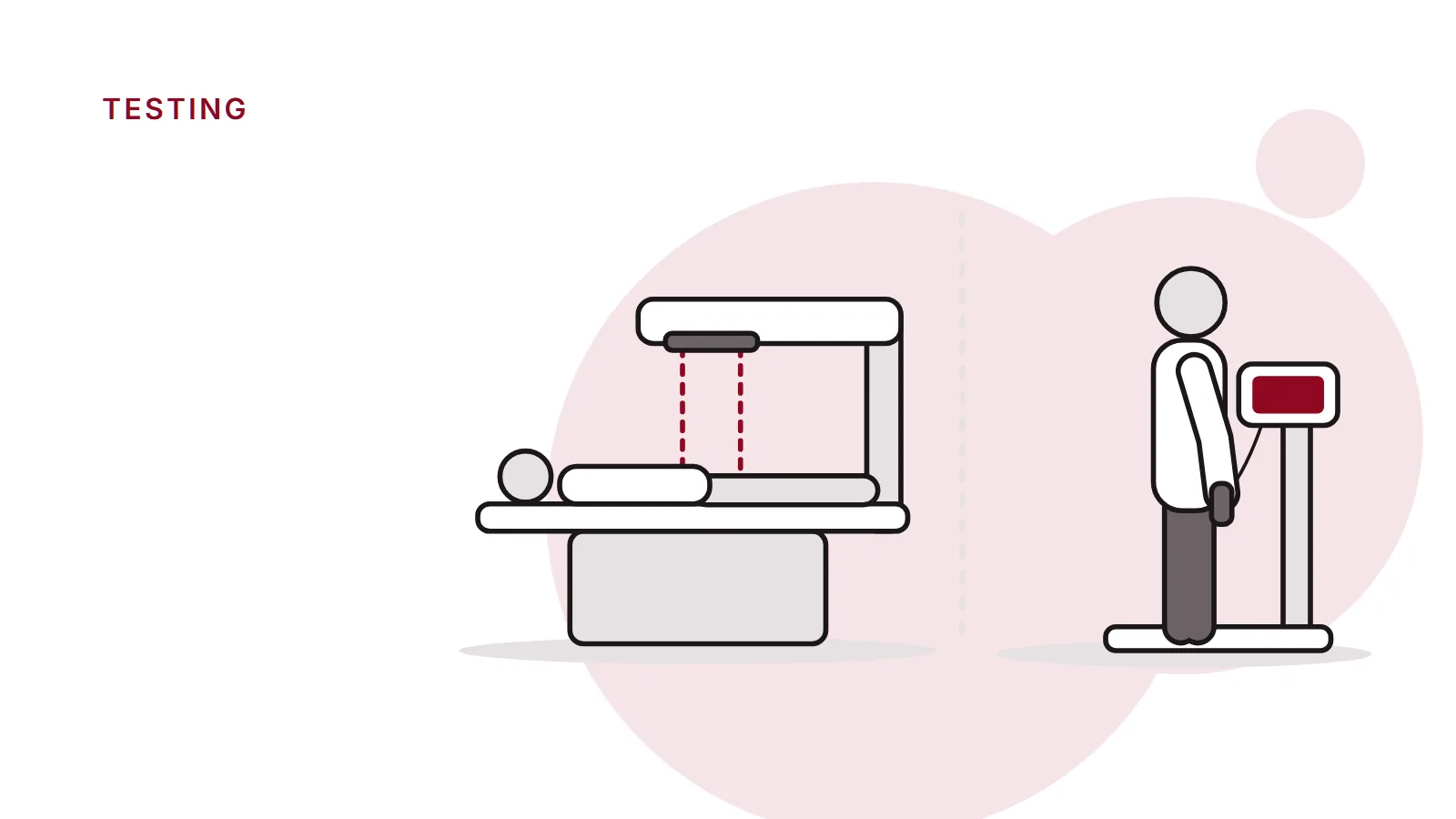
DEXA stands for Dual-Energy X-ray Absorptiometry. It passes two X-ray beams of different energy levels through the body. Because bone, lean tissue and fat absorb those energies differently, the scanner can separate the three.
It reports:
- Bone mineral density — the primary clinical purpose, used to diagnose osteopenia and osteoporosis.
- Fat mass and lean mass, including regional distribution.
- Android and gynoid fat distribution, giving an indication of abdominal fat.
It is the reference standard against which other body composition methods are validated, and that reputation is deserved for what it measures.
Where to Get a DEXA Scan in India and What to Ask
DEXA requires a fixed installation, a shielded room and a licensed radiology setup. That limits where it exists:
- Larger hospitals with radiology departments, in most metros and tier-1 cities.
- Established diagnostic chains, though not at every branch — usually only larger centres.
- Some specialist orthopaedic, endocrinology and sports medicine facilities.
Availability thins considerably outside major cities. If you are in a tier-2 or tier-3 city, expect to travel to the nearest large hospital or diagnostic centre. Scans generally require an appointment, and bone density scans often require a doctor’s referral depending on the facility.
What to ask before you book
- Which scan is it? A bone density scan of the hip and spine and a whole-body composition scan are different services. Make sure you are booked for the one you need.
- How should I prepare? Ask whether to stop calcium supplements beforehand, wear clothes without metal, and tell the centre if you could be pregnant or have recently had a barium or contrast test.
- What is the radiation dose? DEXA uses a low dose of X-rays, but it is still radiation, so ask about it if you are pregnant or planning repeat scans.
- What will the report include? Ask whether a radiologist’s report is included, which values you will get (T-score and Z-score for bone density; fat, lean and regional values for body composition), and whether follow-up scans can be done on the same machine, since results compare best on the same scanner.
InBody as a radiation-free alternative for tracking
If your goal is to track muscle and fat rather than bone density, a body composition analysis such as an InBody test uses no X-rays and can be repeated as often as you need, so you can compare results every few weeks. It does not measure bone density, so it is not a substitute when your doctor has asked for a DEXA scan, and people with a pacemaker or other implanted electronic device should not use it. Find an InBody testing centre near you.
- 1Which scanBone density or whole-body composition
- 2PreparationCalcium supplements, metal, pregnancy, recent contrast tests
- 3Radiation doseAsk if pregnant or planning repeats
- 4ReportT-score and Z-score, or fat and lean values
- 5Same scannerFor follow-up comparisons
What Determines DEXA Scan Cost
There is no single national price. Cost varies with:
- Scan type. A targeted bone density scan of the hip and lumbar spine is a different service from a whole-body composition scan.
- City and facility tier. Metro hospital pricing differs from a diagnostic chain in a smaller city.
- Whether it is bundled. Bone density scans frequently sit inside osteoporosis screening or executive health packages.
- Whether radiologist reporting is included. Some quoted prices cover the scan only.
- Insurance coverage. When medically indicated and referred, bone density scanning may be covered; elective body composition scanning generally is not.
Call the specific centre and ask which scan type the quoted price covers, and whether a formal report is included. That single question resolves most of the confusion.
DEXA vs BIA for Body Composition: An Honest Comparison
If your purpose is bone density, stop reading — you need DEXA. If your purpose is tracking muscle and fat, the comparison is genuinely more balanced than the “gold standard” framing suggests.
| DEXA | Professional BIA (e.g. InBody) | |
|---|---|---|
| Bone mineral density | Yes — the only option | No |
| Fat and lean mass | Reference standard | Close agreement in peer-reviewed testing (McLester et al., 2020) |
| Radiation | Low-dose X-ray | None |
| Scan time | Typically 10–20 minutes | About 60 seconds |
| Body water compartments | No | Yes — intracellular and extracellular |
| Phase Angle | No | Yes, on clinical models |
| Visceral fat | Estimated from android region | Reported as level or area in cm² |
| Availability in India | Larger hospitals and diagnostic centres | Widely available — gyms, clinics, labs, hospitals |
| Appointment needed | Usually, often with referral | Frequently walk-in |
| Suitable for frequent repeat testing | Limited by radiation exposure | Yes |
Two points from that table deserve emphasis.
Radiation limits repeat testing. The dose in a DEXA scan is low, but it is not zero, which makes it unsuitable for the six-to-eight-week tracking cycle that makes body composition data genuinely useful. BIA can be repeated as often as needed. Our overview of body scanner machines and what each type measures puts DEXA alongside the other options.
DEXA does not report body water or Phase Angle. For clinical applications involving fluid status — dialysis, cardiac failure, post-surgical monitoring — or nutritional assessment via Phase Angle, DEXA simply does not produce the output. This is why hospitals often run both.
Our fuller three-way comparison is at InBody vs DEXA vs calipers.
Which Should You Book?
Book DEXA if:
- Your doctor has requested bone mineral density assessment.
- You are post-menopausal, over 65, or have osteoporosis risk factors such as long-term steroid use, prior fragility fracture or a strong family history.
- You need a one-off reference-standard body composition measurement for a specific clinical or research purpose.
Book a body composition analysis if:
- You want to track muscle and fat over time — the six-to-eight-week cycle where the value actually lives.
- You want visceral fat quantified for metabolic risk.
- You want segmental muscle data to guide training or rehabilitation.
- You want fluid balance or Phase Angle data.
- You would like the result today rather than after an appointment and a referral.
These are not competing purchases so much as different instruments. Many people who need a one-off DEXA for bone density also benefit from routine BIA tracking in between.
A Note on “Gold Standard”
DEXA earns the label for fat and lean mass measurement, and that is worth respecting. It is also worth keeping in proportion.
For the question most people are actually asking — am I gaining muscle or losing it, and is my visceral fat coming down — what matters is a device that produces consistent, comparable readings across repeat tests under standardised conditions. A method you can use every eight weeks beats a more precise method you will realistically use once. Precision that you cannot repeat does not show you a trend.
Pick the Instrument That Answers Your Question
Bone density needs DEXA. Muscle and fat tracked over time needs something you can repeat without an appointment or a radiation dose.
Find a body composition testing centre near you at inbody.in/locations, or book a test at inbody.in/inbody-test.php. Related reading: InBody vs DEXA vs calipers, how BIA works, and how to choose a testing centre.
Sources
- Nicholson WK, Silverstein M, Wong JB, et al. Screening for Osteoporosis to Prevent Fractures: US Preventive Services Task Force Recommendation Statement. JAMA. 2025;333(6):498-508.
- Messina C, Albano D, Gitto S, et al. Body composition with dual energy X-ray absorptiometry: from basics to new tools. Quant Imaging Med Surg. 2020;10(8):1687-1698.
- Ling CH, de Craen AJ, Slagboom PE, et al. Accuracy of direct segmental multi-frequency bioimpedance analysis in the assessment of total body and segmental body composition in middle-aged adult population. Clin Nutr. 2011;30(5):610-5.
Related articles
How to Prepare for a Body Composition Test: Full Checklist
Hydration moves your result. What to do in the 24 hours and 3 hours before, what happens during the scan, and the arm-position mistake…
Body Scanner Machine: The 4 Types and What Each Measures
Body scanner can mean four very different machines. Which one measures muscle and fat, which only maps your outline, and which involves radiation.
Student Fitness Screening in India: A Guide for Schools
CBSE HPE, Fit India and Khelo India rely on BMI. How schools and colleges can add body composition screening safely, with child caveats and…