
Fitness 11 min read
Night Shift Body Composition: How Circadian Disruption Doubles Metabolic Risk for India’s IT/BPO Workforce
Shift work more than doubles metabolic syndrome risk (pooled OR 2.17). Why India's IT/BPO night-shift workforce gains visceral fat despite eating clean.
Reading about body composition? Find an InBody test centre near you →
The 11 PM Log-In That’s Quietly Wrecking Your Body Composition
You eat clean. You hit the gym four days a week. Your diet tracker says you’re in a deficit. Yet your night shift body composition keeps moving the wrong direction — visceral fat creeping up, muscle looking softer, energy gone by month three. If you work a US-hours BPO, KPO, or IT shift, this isn’t a discipline problem. It’s a clock problem.
India’s night runs on this workforce. NASSCOM’s Strategic Review 2026 puts direct tech-sector employment at nearly 5.95 million people, a large share of it working hours built around someone else’s daylight: US East Coast, US West Coast, UK, or Australia. Add India’s Global Capability Centres — 1,760+ GCCs employing roughly 1.9 million professionals as of 2025, per Zinnov’s research — plus voice BPO, healthcare, and manufacturing shift staff, and you have a genuinely enormous population whose biological night and working day are permanently at odds.
The uncomfortable finding from the research: circadian misalignment changes body composition through a completely different mechanism than a bad diet or a missed workout. You can do everything “right” by daytime-worker standards and still lose the fight, because the shift itself — not the food on your plate — is working against you.
The Mechanism: How Circadian Disruption Rewires Your Metabolism
Your body runs on more than one clock. The master clock sits in the suprachiasmatic nucleus of your brain and is set almost entirely by light. Smaller “peripheral clocks” in your liver, pancreas, muscle, and fat tissue take their cues from meal timing and activity. When you work through the night and sleep through the day, these clocks stop agreeing — a state called circadian misalignment, the central mechanism connecting shift work to weight and metabolic disease, independent of total sleep hours.
Cortisol Stops Resetting
Normally, cortisol peaks shortly after waking and tapers through the day, hitting its lowest point around midnight. Research on irregular-shift populations has found this reset doesn’t happen properly — cortisol stays measurably elevated even on days off, a prolonged stress response day-shift workers don’t show. Cortisol favours fat storage specifically in the visceral depot — the fat wrapped around your liver, pancreas, and intestines — exactly the fat an InBody scan flags as Visceral Fat Area (VFA), and exactly the fat a bathroom scale cannot see.
Melatonin Loss Drives Insulin Resistance Directly
Melatonin isn’t just a sleep signal. It regulates GLUT4, the transporter your muscle cells use to pull glucose from the bloodstream, and supports normal insulin receptor function. Night-shift sleep — shorter, lighter, interrupted by daylight and household noise — suppresses melatonin output. Research on shift populations has linked this suppression to a nearly threefold increase in markers of elevated beta-cell activity, an early signature of insulin resistance, before fasting glucose looks abnormal on a routine blood test. Continuous shift work has separately been associated with roughly double the risk of developing type 2 diabetes versus fixed day work.
Leptin and Ghrelin Flip Against You
Leptin tells your brain you’re full. Ghrelin tells it you’re hungry. Circadian disruption and the fragmented sleep that comes with it suppress leptin and raise ghrelin — a shift linked to an extra 350–500 calories of intake per day, concentrated in snack foods rather than meals. This is why “eating clean” during the day often fails to prevent weight gain for shift workers: the biology driving 3 AM cravings for something fried and salty is not a willpower failure. It’s leptin and ghrelin working exactly as circadian disruption has reprogrammed them.
What This Looks Like in Actual Body Composition Data
A 2025 case-control study in the British Journal of Nutrition compared 52 male shift workers against 52 matched non-shift workers and found body fat percentage averaging 31.7% in shift workers versus 22.7% in non-shift workers — alongside higher triglycerides, LDL cholesterol, blood pressure, and visceral fat. Within the shift-working group, “evening chronotype” workers fared even worse than morning-oriented colleagues on the same rotation. A 2022 meta-analysis in Obesity Reviews, pooling 12 studies on healthcare shift workers, found the odds of metabolic syndrome were more than double (pooled OR 2.17) versus day workers — rising to an adjusted OR of 2.74. A larger 2021 dose-response meta-analysis spanning 36 studies and 274,263 participants confirmed the pattern at scale, with a pooled OR of 1.35, climbing the longer someone stayed on rotating shifts.
| Marker | Shift / Night Workers | Day Workers |
|---|---|---|
| Body fat percentage (case-control study, 2025) | 31.7% | 22.7% |
| Metabolic syndrome risk (healthcare shift workers, meta-analysis) | OR 2.17–2.74 | baseline |
| Metabolic syndrome risk (36-study dose-response meta-analysis) | OR 1.35 | baseline |
| Type 2 diabetes risk (continuous shift work) | ~2x | baseline |
India’s Night-Shift Workforce Is Enormous — And Uniquely Exposed
Every one of the mechanisms above lands on a specific, identifiable Indian lifestyle pattern.
Scale. Between the tech sector’s near-6-million headcount, India’s 1,760+ GCCs, voice BPO operations serving the US and UK, and rotational shifts in hospitals, pharma manufacturing, and logistics, the number of Indians whose working hours are structurally opposed to daylight runs into the millions — and is growing as more GCCs open to cover US and European hours.
Daytime sleep is lower-quality sleep by default. A study of 163 IT professionals working night shifts in Puducherry found that 100% of participants scored above the threshold for poor sleep quality on the Pittsburgh Sleep Quality Index — not “most,” every single one. Daytime sleep in an Indian household competes with heat, traffic noise, deliveries, and family members who are awake and active. The study also found dietary pattern was significantly correlated with sleep quality: bad sleep worsens eating, and worse eating worsens sleep.
Family and social time compress the sleep window further. A night-shift worker sleeping 8 AM to 4 PM technically gets eight hours — but weddings, school events, and ordinary family life pull at that window from both sides. The realistic pattern for many isn’t eight consistent hours; it’s six, interrupted, on a schedule that shifts every time there’s a family obligation.
Late-night eating is built into the job. The 2 AM–4 AM “shift meal” on most Indian BPO and IT campuses is canteen food — fried, carbohydrate-heavy, and eaten precisely when insulin sensitivity is at its lowest. A study of night-shift women in Chennai’s BPO sector documented this cluster directly: disrupted eating patterns alongside musculoskeletal complaints, weight gain, and disrupted family life as the most commonly reported problems.
Why the Scale and the Mirror Lie to Shift Workers
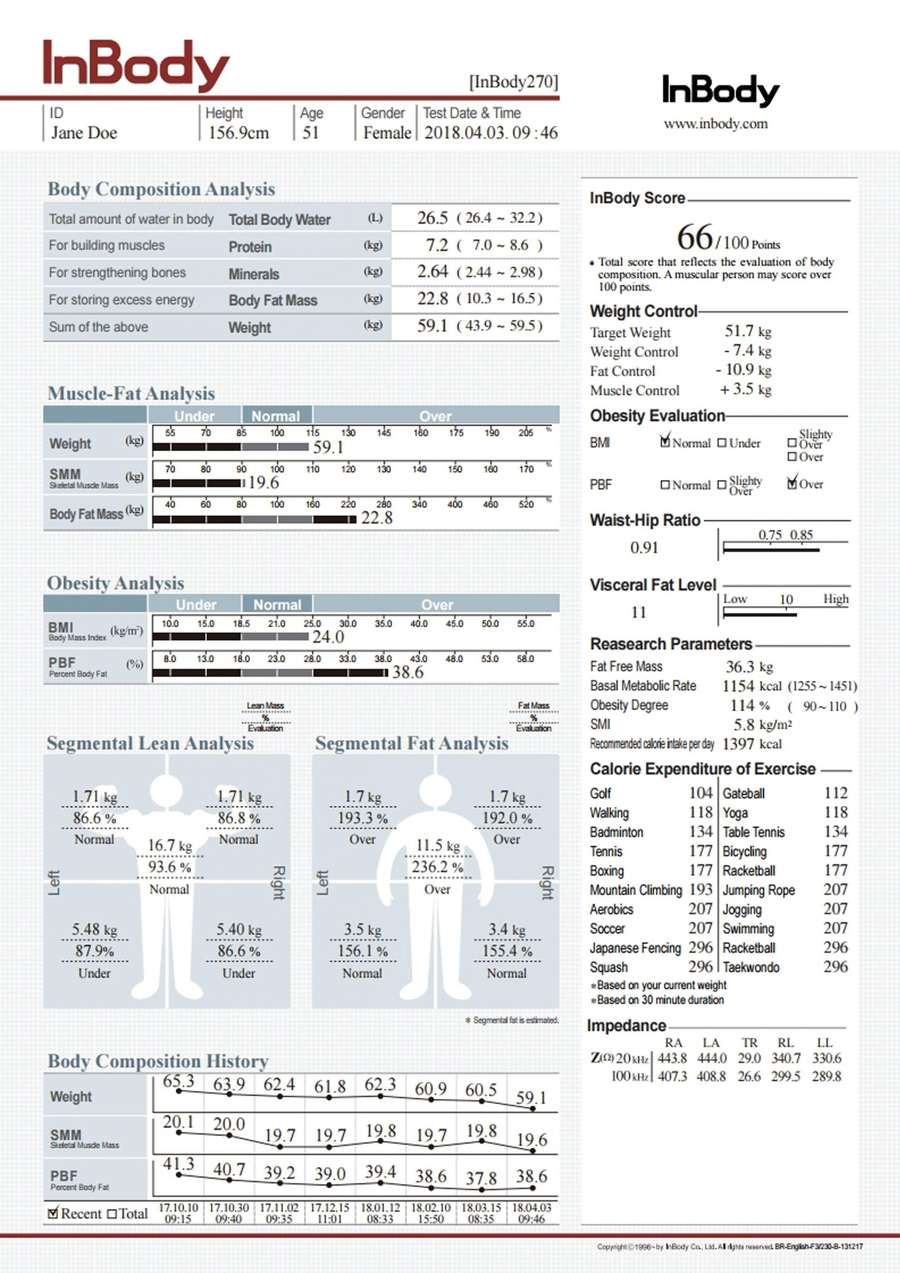
This is the part that confuses people most: a night-shift employee can hold a stable body weight for years while their internal composition quietly deteriorates. Visceral fat rises. Skeletal muscle mass drifts down, even in people who train regularly, because elevated cortisol works against the muscle-building signal from exercise. Water distribution shifts too — chronic circadian stress is a low-grade inflammatory state, and inflammation pushes water out of cells into extracellular space, a pattern that shows up as an elevated ECW/TBW ratio on a scan long before it shows up anywhere else.
None of this is visible on a scale, because fat gain and muscle loss can roughly cancel out in kilograms while making the person measurably less healthy — exactly the kind of change a BMI or weight check misses entirely. A body composition scan separates the two: it tells a shift worker whether the number on the scale is stable because nothing is happening, or stable because fat is quietly replacing muscle underneath it.
The Shift-Work Body Composition Protocol
Generic advice — “sleep more, eat clean” — doesn’t survive contact with a rotating roster. Here’s what actually works with the shift, not against it.
- Manage light like a variable you control, not weather. Get bright light during the first half of your shift to stay alert and suppress melatonin release at the wrong time. On the commute home after sunrise, wear sunglasses — bright morning light tells your brain it’s time to be awake, the opposite of what you need before sleeping. Blackout curtains and an eye mask for daytime sleep aren’t optional extras; they’re the single highest-leverage fix available.
- Time meals around the shift, not the clock on the wall. Treat the meal before you leave for your shift as your largest meal — biologically, this is your “lunch,” even at 6 PM. Make the 2–3 AM shift meal your smallest and lightest: protein and fibre, not fried canteen food, because insulin sensitivity is at its lowest in this window.
- Cut caffeine on a fixed clock, not a fixed cup count. Stop caffeine 6–8 hours before your planned sleep time, whatever hour that is. Aiming to sleep at 9 AM means your last coffee needs to land by 1–2 AM — not “after my shift ends.”
- Protect one consistent sleep window all week, including off days. The instinct to “sleep normal hours” on weekends to see family is exactly what keeps the circadian system permanently unsettled. Where possible, keep the same sleep-wake window seven days a week, structuring family time around a fixed afternoon block instead.
- Anchor strength training to waking up, not to “whenever there’s energy.” Training in the first couple of hours after you wake — before the shift, while cortisol from waking still favours you — is easier to sustain across a rotating roster. Avoid vigorous training in the few hours before your intended sleep window; it delays sleep onset when you can least afford it.
- Track body composition, not body weight. Visceral fat and muscle loss can move in opposite directions while the scale stays flat, so a scan every 8–12 weeks is the only reliable way to know if the changes above are working. Watch three numbers: Visceral Fat Area, Skeletal Muscle Mass, and ECW/TBW ratio.
Frequently Asked Questions
Does night shift work really cause weight gain even if I eat healthy and exercise?
Yes — the effect is largely independent of diet quality and activity level. Circadian misalignment elevates cortisol, suppresses melatonin’s role in insulin sensitivity, and disrupts leptin and ghrelin, promoting visceral fat storage and muscle loss through hormonal pathways a clean diet alone cannot fully counteract. A 2022 meta-analysis found shift workers had more than double the odds of metabolic syndrome versus day workers.
Why do I have visceral fat even though I’m not overweight and I work out regularly?
Body weight and visceral fat can move independently. Elevated cortisol from unresolved circadian disruption directs fat storage to the visceral depot around your organs while working against the muscle-building effect of training. A 2025 case-control study found shift workers averaged nearly 9 percentage points higher body fat than matched non-shift workers despite similar activity levels — invisible on a scale but visible on a body composition scan.
How can I sleep well during the day after a night shift in an Indian household?
Blackout curtains, an eye mask, earplugs or white noise, and a cool room are the highest-impact tools, since daytime household noise, heat, and light are the biggest disruptors. Keep the same sleep window daily, including off days, rather than reverting to nighttime sleep on weekends — repeatedly shifting the schedule prevents your circadian system from stabilising.
What should I eat during a night shift to avoid weight gain?
Make your pre-shift meal (even at 6–7 PM) your largest and most protein-forward, since this functions as your biological “lunch.” Keep the 2–3 AM shift meal light — protein and fibre rather than fried canteen food — because insulin sensitivity is lowest during the biological night.
Does rotating shift work affect the body more than a fixed night shift?
Both disrupt circadian rhythm, but rotating shifts prevent the body from ever fully adapting to one schedule, since the internal clock is repeatedly reset. Research also shows people with a naturally “evening” chronotype tolerate night work with fewer metabolic consequences than “morning” chronotype people forced onto a night schedule — chronotype mismatch independently worsens outcomes.
Can body composition testing show damage that a regular health checkup misses?
Yes. Standard checkups report weight, BMI, and basic blood work, none of which separate fat mass from muscle mass or flag rising visceral fat. A body composition scan tracks Visceral Fat Area, Skeletal Muscle Mass, and the ECW/TBW ratio — an inflammation marker — showing circadian-driven changes months or years before they appear as an abnormal blood test.
How long does it take to reverse circadian-related body composition changes?
There’s no single verified timeline specific to shift workers, but related research on sleep-extension and cortisol-reduction interventions shows measurable improvement in inflammation markers within 6–8 weeks and visible visceral fat reduction within 3 months of consistent change. Re-scanning every 8–12 weeks is the most reliable way to confirm progress on your own numbers.
Get the Data Your Shift Roster Is Hiding From You
If you manage a team of night-shift or rotational employees — a BPO floor, a GCC delivery unit, a hospital’s night nursing staff — this research isn’t just an individual health story, it’s a workforce risk your annual checkup isn’t catching. InBody’s corporate wellness programmes bring body composition testing on-site, giving HR and occupational health teams the same VFA, muscle mass, and ECW/TBW data clinicians use — at scale, tracked over time.
If you’re a shift worker reading this for yourself: get scanned, get your numbers, and re-scan every 8–12 weeks as you make changes. Find an InBody testing centre near you.
For the mechanisms that compound with circadian disruption, see how chronic cortisol independently drives visceral fat, why general sleep deprivation wrecks body composition even outside shift work, and how prolonged sitting compounds the damage for shift workers who are also desk-bound for 9 hours a night.

Most trending articles
वज़न बढ़ाने के लिए क्या खाएं? सही डाइट प्लान (सिर्फ ज़्यादा खाना नहीं)
सिर्फ ज़्यादा खाने से मांसपेशी नहीं बनती, चर्बी बढ़ सकती है। सही कैलोरी सरप्लस, प्रोटीन और डाइट प्लान जो वज़न को सही तरीके से बढ़ाए — पूरी जानकारी हिंदी में।
भारत में प्रोटीन कितना ज़रूरी है? असली आंकड़े और सही फॉर्मूला
IMRB के एक सर्वे में लगभग 73% भारतीय आहार प्रोटीन-कम पाए गए। सही प्रोटीन टारगेट कैसे निकालें और किन फूड्स से पूरा करें — पूरी जानकारी हिंदी में।
Weight Loss या Fat Loss: असली फर्क क्या है?
वज़न घटना और चर्बी घटना एक चीज़ नहीं है। तेज़ी से वज़न घटाने पर मांसपेशी क्यों चली जाती है, और असली फर्क कैसे पता करें — हिंदी में पूरी जानकारी।